Category Archives: News

York Workshop on Inequality

Yesterday I attended an event titled Have We Become Acclimatised to Greater Inequality?, an all-day workshop at the National Science Learning Centre at the University of York (programme).  The previous event in this same series focused primarily on health inequality — this event extended the scope of the discussion to take a look at inequality more generally, including economic and social inequality.

Policy Ignorance and the Low-Pay, No-Pay Cycle

The first session in the morning was split into two workshops — I attended the workshop run by Robert MacDonald, a fellow Teesside University academic.  Robert’s work focuses on youth unemployment and social exclusion in the Tees Valley area of the UK, an area frequently ranked amongst the most deprived in Britain.  As Robert pointed out, however, as recently as the 1970s the Tees Valley was one of the most economically vibrant parts of the country.  So what happened to cause this drastic decline in the area’s fortunes?

The government would have you believe that the deprivation and unemployment in the region is a consequence of a ‘culture of worklessness’ — a pathological lack of ambition, a disdain for hard work derived from families that supposedly lead a life of leisure, sitting around the house while claiming government benefits and refusing to work on gaining new skills to increase their employability.  Iain Duncan Smith, David Cameron, and others have made this argument, setting up an alleged conflict between ‘shirkers’ and ‘strivers’ — those who want ‘to get on’, versus those who prefer a life on benefits.

This is the government orthodoxy regarding unemployment, and has led to a policy programme which focuses on ‘up-skilling’ the workforce, increasing benefit conditionality (making it harder to claim benefits), and increasing the number of highly-skilled jobs while reducing the lower-skilled, lower-paid jobs.  Robert confidently called this ‘Voodoo Sociology’, and set out to explain why such a programme ignores the real reasons behind the deprivation and unemployment evident in areas like the Tees Valley.

Youth in the Tees Valley — Underambitious or Underemployed?

Robert and his colleagues have followed youth in the Tees Valley in a series of studies since 1998, called the Teesside Studies of Youth Transitions and Social Exclusion.  These studies found that, in contrast to the rhetoric of central government, the youth in the area have a constant engagement with the labour market — there is no such thing as a ‘culture of worklessness’.  Long-term, post-school transitions for Tees Valley youth are characterised by short-term, insecure jobs that are non-progressive — they don’t lead to further opportunities, promotion, etc.

So we do not see the kind of idle underclass proposed by the government, but instead a constant ‘churning’ of young people through the lowest end of the labour market.  Young people are continuously attempting to enter the labour market, only to be dumped after a few weeks or months and forced to claim Job-Seeker’s Allowance once again.  The DWP’s own studies confirm that of the 340,000 young people aged 22-24 who claimed JSA in 2010-11, 73% had claimed JSA at least once before.  Robert referred to this precarious labour market position as economic marginality — young people in the Tees Valley are perpetually stuck on the fringes of the labour market, with no clear path to regular employment or job security.

The Perils of Voodoo Sociology

Having set out these points, Robert returned to the government’s ‘Voodoo Sociology’.  The government policy goals around vastly increasing the supply of skilled workers, fuelled by a significant expansion of the higher education sector, has been done largely in isolation: there has been no corresponding increase in demand from employers for highly-skilled workers.  The trend we see of late is an increase in ‘lousy jobs’ — low-paid, low- or no-skilled, and insecure — and ‘lovely jobs’ — very highly-paid, highly skilled, and secure.  The middle ground has been ‘hollowed out’, leaving a significant percentage of university graduates with nowhere to go.  In areas like the Tees Valley this endemic underemployment is a serious issue, leaving some 34% of graduates in non-graduate-level jobs, even 5+ years after graduation.  Plus, thanks to recent government policy, these same graduates will soon be saddled with enormous educational debt as well.

Robert also spoke briefly about Prof Ken Roberts — a well-known academic in this area and author of several books on the topic, such as Youth in Transition: Eastern Europe and the West.  His work has confirmed across 25 countries that youth suffer no shortage of ambition, even in the most deprived areas.  In fact, youth repeatedly and doggedly attempt to engage in productive work, but the severe shortage of secure, progressive jobs for young people makes this a struggle.  Youth are seeking out the opportunities that are available to them — but the structure of these opportunities themselves are not conducive to getting young people out of poverty.

The Government’s Approach

Given all of this hard data, what response have we seen from the government?  Well, aside from a partial U-turn on tax credit cuts, an anaemic Living Wage policy, and some lip-service given to ‘making work pay’, not an awful lot.  We don’t see any concerted effort toward reducing the number of bad jobs out there, or restructuring the poor opportunities available to younger people.  Nor have we seen any support forthcoming for short-term underemployed people, or recurrently underemployed/unemployed youth.

Instead we have institutions like the Work Programme from the DWP, which with a success rate of 8% is actually worse than doing nothing at all (more than 8% of people find jobs by themselves, without taking assistance from the Work Programme).  Apprenticeship schemes only accept one of every 28 applicants, making them a very unlikely means of finding a new trade. Here in the Tees Valley, a new project costing £30 million (funded by the EU, as are many things around here — take note, UKIP) is aiming to address ‘social exclusion’ by making young people ‘more work ready’ and ‘raising their aspirations’.   So we see the exact same rhetoric — young people are to blame, their aspirations are too low, too many of them are long-term ‘NEET’ (not in employment, education or training).  When we look at the figures, less than 50 people in the entire region could be classed as actually long-term NEET — the overwhelming majority are constantly attempting to engage with a labour market that seemingly wants nothing to do with them.

So, having established that government policy on this issue is getting things disastrously wrong, and that young people are not in fact to blame for their own misfortune, why does the government persist in this approach?  Robert suggests that this ideology of the ‘undeserving unemployed’ provides an easy platform for the government to justify cuts to the welfare budget and sweeping austerity programmes.  Rolling out welfare-to-work programmes like the Work Programme is much easier than actually restructuring the labour market to create proper opportunities for youth — and large companies love these programmes, as they often end up getting free short-term labour out of it with no particular commitment to taking anyone on.  With that in mind Robert left us with a question at the end of his slides: as a society we speak often about young people’s aspirations and their supposed lack of same, but what about our aspirations?  Do we aspire to create a society in which our youth can find productive, secure employment, and if so, why aren’t we properly doing anything about it?

Summing Up

I very much enjoyed Robert’s presentation.  I found it revealing and very important — I just wish central government would give this kind of work the attention and respect it deserves.  I hope that I might be able to contribute to this kind of work sometime in the future, perhaps by developing simulations as testing grounds for testing the effects of relevant labour market reforms.

I was hoping to summarise the whole day in this post, but this has gone on long enough already — I’ll save the rest for another post.  I’ll spoil it for you now though and say I did enjoy the rest of the day as well.

Although, if I may offer some feedback for the organisers: as someone with a physical health problem which prohibits me from standing for long periods without extreme discomfort, please don’t hold lunch/networking sessions without any seating.  While everyone else was networking and chatting amiably, I ended up sitting in another room by myself, and that wasn’t overly pleasant.

Tagged , , ,

More Science about Science

After a good few hours working on the simulation yesterday — and by ‘a few’ I mean ’15 hours’ — I have things working in a more stable configuration now.  The original simulation I’m working from was structured around a stable population, but in this simulation I’m using a dynamic population — a very dynamic one, in fact, as postdocs shuffle in and out constantly.

This has meant that I’ve been working a lot on re-writing some of the code to facilitate the addition of postdocs to the virtual research community.  Yesterday I ended up learning some new skills when I found that I needed lists of agents that retained the order of the elements within, so that was an interesting opportunity to learn more about ordered dictionaries in Python.  Presumably I might be able to make use of those in future models too, so that’s very helpful.

So, at the moment we have a nicely dynamic population of simulated academic agents in which postdocs enter the population every semester as grants are disbursed to tenured academics.  Tenured academics spend their time doing research and applying for research grants; they learn from experience and change their time allocation strategies regularly to try to maximise their success in these arenas.  The simulation starts with 100 tenured academics, and after 50 years in a typical run we end up with about ~1200 academics in total, with about a third to a half of those being postdocs, depending on the parameter settings.

These results are based on a generous virtual society though, at least compared to reality: 25% of postdocs get promoted to tenured posts at the end of their contracts; research funding is available to about 30% of academics even as the population grows massively over the years; and tenured academics holding grants get a 50% boost to their research output.  Initially I had included a ‘management penalty’ to research quality for grant-holders, to account for the time spent line-managing postdocs and administering projects rather than actually doing research, but in this generous situation I left that penalty out completely.

So, in this relatively happy situation compared to the real world, do we see any productivity gain from the mass introduction of non-tenured, research-only staff?

Well… no, not quite:

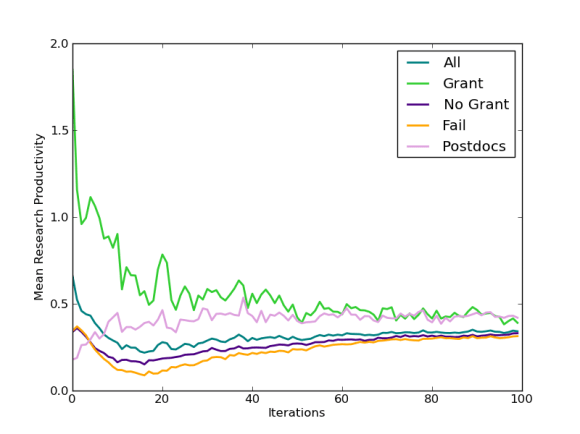
r_mean_pdr

As you can see above, once postdocs are introduced we see a relatively precipitous drop in research productivity.  Grant-holders in particular suffer a great deal on this front, despite having that 50% research output bonus.  Tenured academics not holding grants (in purple) and failed grant applicants (yellow) also dip significantly, but then rebound slightly as they adjust their time allocation strategies between grant-writing and pure research.  Postdocs enter at a lower point and then settle at a middling level of productivity, necessitated by the lowered research productivity they experience at the beginning/end of their contracts.  Their output tends to be more ‘spikey’ in general, as they shuffle in and out of the population very frequently.  Toward the end of the simulation everyone begins to converge between the 0.3 – 0.5 range or so — and in this run we can see the postdocs just overtaking the grant-holders in productivity.

Another interesting aspect here is that in a no-postdoc situation there’s a reasonable positive correlation between research quality and grant disbursement — better researchers tend to get the money, in other words.  When postdocs are introduced that breaks down completely, and there’s little to no correlation between the two; in fact on more than a few runs I’ve seen slight *negative* correlations, this in spite of the fact that in the simulation research quality is used in the ranking of applications.

So — at this stage it seems like introducing a highly volatile, insecure population of researchers into the mix creates a large amount of uncertainty, reduces overall research output, and in general disrupts things significantly.  Even in a ‘generous’ research environment we see these problems clearly.

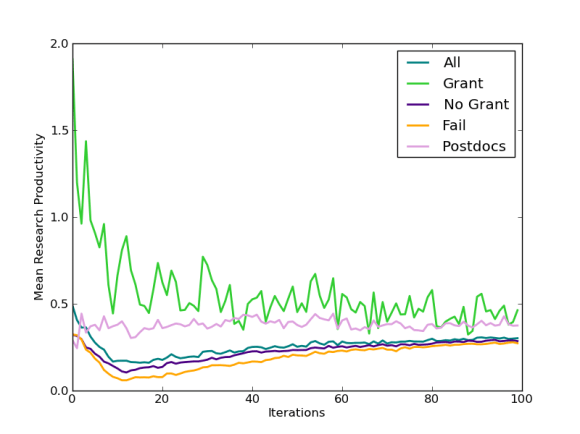
What about in a more challenging funding environment?  Let’s imagine we’re working in biology or something, one of those fields were grant applications only succeed 10-15% of the time, and money is scarce so permanent positions are even more difficult for postdocs to achieve:

r_mean_pdr

The population is much smaller, sustaining 605 academics in this particular run and just 96 postdocs — but the research output stats look extremely similar.  Grant-holders suffer a huge drop in overall productivity, punctuated by periods of high output when they’re holding that grant, and dipping again when they dump research time into grant-writing to try to get the next one.  Failed applicants and non-grant-holders still hover around the bottom edges, de-emphasizing research as they’re trying desperately to get research money through writing bids.  Postdocs, meanwhile, wobble around the 0.4 mark most of the time, never quite in post long enough to settle in  — and given that they’re not able to apply for grants, they never can benefit from that 50% bonus to output like the senior academics can.

Again these are early results and a very cursory analysis, but it seems like what’s happening here is pretty stable even with fairly significant changes to parameter settings (I’ve done many more runs on my own to check this).  This suggests that in order to escape these problems, future versions of the simulation will need to look at more drastic changes to the research career/funding structures in order to try to address these problems.

Next time, I’ll be adding some more analytical tools to the simulation, and developing some experiments to test alternative funding disbursement methods and career structures.  As ever please do get in touch with me if you have ideas or suggestions — I’m very keen to have more people to speak to about this kind of work!


Tagged , , , , ,

Modelling Research Careers: Very Early Results

I’ve managed to get that research careers simulation up and running today — a very early version, mind you.
Each time grants are disbursed to our simulated academics, the top 10 applicants receive a postdoc.  Postdocs work full-time on research and do not apply for grants.  At the beginning and end of their contracts (which range from 2-5 years long) their output is reduced significantly to account for stress caused by entering a new job or searching desperately for a new one, respectively.  Postdocs have a 10% chance of being made permanent at the end of their contracts; if they’re unlucky then they simply drop out of the system altogether (I haven’t implemented multiple contracts yet).
So what we have is a very volatile situation right from the beginning — we’ve got lots of people on short contracts, most of whom are under significant stress for part, or even all, of said contracts.  Postdocs are constantly being shuffled out of the system and replaced with new postdocs, so the research environment is being filled up with stressed-out people with highly variable levels of research talent — and talented ones are just as likely as crappy ones to be booted out the door at the end of their contracts.  Permanent academic jobs are in short supply, so most postdocs never get a chance to contribute to grant applications.
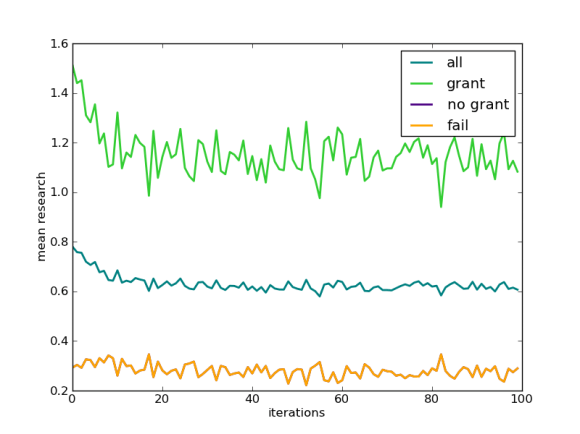
The results are rather more drastic than I anticipated.  Here are the results for mean research output from a quick run of the simulation including postdocs:r_mean
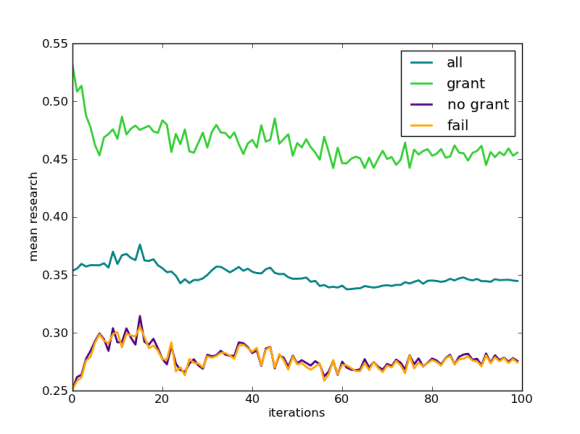
Contrast that with the below, which shows the mean research output from a run with the same initial conditions but without postdocs in the simulation:
r_mean
 
Mean research output across all categories, no postdocs: ~0.61
Mean research output across all categories, postdocs added: ~0.34
 
Given I wrote all this code in a day, these results are highly speculative at best — but I’m hoping that the final version will give us a decent representation of the impact of competitive funding systems and job instability on academic research quality.   At this point I’m just pleased to see it up and running!
There’s still a ton of work to do: double-checking everything, adding in detailed stats collection on the postdocs, then revamping the funding disbursement functions to tie grants and postdocs together explicitly so I can measure output by project/PI.  There’s a few other bits I really want to do, like implementing multiple contracts, etc.
I’ll keep posting progress reports as I go… please wish me luck!
Tagged , , , ,

NHS may charge migrants for GP services

There’s been coverage on the BBC today about a proposal to begin charging non-EU migrants for various NHS procedures.

Some of you who know me personally may remember when I ranted about the government’s decision to introduce charges for the NHS for migrants, and that this would be how the government introduces charges for NHS services across the board. That it would start with NHS fees with visa applications, then extend to GP and hospital charges for migrants, and then to the general citizenry. That the Tories couldn’t resist the opportunities presented by an NHS that suddenly and oh-so-conveniently has an infrastructure for charging for services.

Well, step 2 of that plan is already in evidence. If you didn’t believe me before, perhaps you should believe me now.

Oh, and Jeremy Hunt: I’ve been here for ten years, I’m not a ‘visitor’. I paid my own way as a PhD student and spent the years after that as a tax-payer, paying taxes for services I can’t even legally use as a migrant. I’ve even been doing research about health and social care provision in the UK.  So don’t you dare tell me I don’t ‘make a fair contribution to services’.

Do yourself a favour, people, and respond to the government consultation on Monday. Even if you don’t give a damn about people like me, us so-called non-EU ‘visitors’, and how this change would make my life in the UK unlivable and unaffordable, then at least look out for yourself by stopping this nonsense before the Tories extend it to everyone.

It’s time now to make a decision: is the NHS free at the point of delivery, or is it not?  If we want it to remain a free service, then we must stop this creeping commercialisation before there’s no turning back.

Let’s not forget too that the recent changes in April 2015 also included charges for 150% of the cost for non-emergency procedures for non-EEA visitors.  Perhaps a test run for introducing a profit motive within the NHS?

Tagged , , ,

Validation Workshop in Sheffield

I’m a bit late on posting about this since the workshop happened on Monday, but better late than never.  On Monday I was fortunate to be put on the programme at the last minute for a very interesting seminar at the University of Sheffield:

Validation and Models in Computational Biomedical Science: Philosophy, Engineering and Science

November 30 @ 9:00 am5:00 pm

Event Navigation

A Wellcome Trust funded workshop.

Computational modelling and simulation in all areas of biological and biomedical research have developed to a point where there is a highly sophisticated array of tools and techniques. Data intensive methods, network and multiscale models have the potential to provide new insights into biological mechanisms, that will ultimately be used for drug discovery, drug and medical device safety testing, diagnosis and treatment régimes.

The aim of modelling and simulation is to arrive at data and computational models that are ‘validated’; yet how to achieve validation is not always clear. While methodologies to tackle validation are often discussed, the deeper conceptual frameworks in which methodologies are embedded get less attention. As issues such as the pervasive variability of biological systems and model uncertainty increasingly come to the fore; and as the drive to find medical applications for computational modelling and simulation gains momentum, there is a need for creative reconceptions of the whole modelling process. This encompasses not only the scientific and engineering approaches, but also, crucially, the disciplinary, social and institutional dynamics associated with translation. There is however relatively little dialogue across the social science, philosophy, science, engineering and technology development communities. There are missed opportunities for learning and broaching the issues that challenge the implementation of computational modelling in biomedical contexts.

The ‘Validation and Models in Computational Biomedical Science’ workshop and special issue will provide one such opportunity. Our aim is to provide a platform for discussion and practice across scientific, engineering, clinical, philosophical and social perspectives on the central question of model validation that transcends any single discipline or sector, but which will potentially make a difference to practice.

I spoke at the very end of the morning session, presenting some ideas about how to validate computational models in the social sciences.  I proposed that validation takes a somewhat different form when using agent-based models, given that the complexities and non-linearities involved make it difficult to tie the results directly to the target system.  When I have some more time I’ll post the abstract and slides.


Given the title of the workshop and my complete lack of biomedical background I was slightly worried that my talk might be a bit of an oddball sideshow to the overall message of the workshop.  But in the end I was very pleased by the reception — a number of attendees came to speak to me about the talk later in the day, and I was relieved to hear that other agent-based modellers in the crowd are grappling with similar issues.


As I type this I’m waiting for another workshop to start (the Durham workshop on equality mentioned in my last post).  It’s a full week of activity here but so far it’s been quite productive!

Tagged , , ,

Evidence, Policy and Regulation: The Importance of Context

I’ve just confirmed my attendance next week at an interesting seminar at Durham University:

The Importance of Context: evidence, values and assumptions in public health policy seminar:  In Stockton-on-Tees, the difference in male life expectancy at birth between the most and least deprived areas is 17 years – the highest in England.  This reflects a larger pattern in which health inequalities are increasing in parallel with the rise of economic inequality, and despite stated policy commitments to reducing them.  Review of current policies suggests that the application and interpretation of research evidence in public health policy relies on questionable assumptions about a high degree of choice and control over lifestyle, income, and quotidian living/working environment.  Rich and poor live in different ‘epidemiological worlds’, and some have far more control over those worlds than others.  Against this background, what forms of evidence, disciplinary perspectives and research methodologies are most relevant for the design of policies to reduce health inequalities?

I am writing on behalf of Linda McKie (Professor and Head of School, School of Applied Social Science, Durham University), Nancy Cartwright (Professor of Philosophy, Durham University) and myself  to invite you to an interactive workshop on 2 December, 2015 on Evidence, Values and Assumptions in Public Health Policy.  The seminar is part of the 2015-16 activity theme (‘Evidence’) of Durham’s Institute of Advance Study, and of the activities of an ESRC-supported seminar series on Revitalising the Health Equity Agenda.  Key contributors:

  • Dr. Katherine Smith (Reader, Global Public Health Unit, University of Edinburgh; author, Beyond Evidence Based Policy in Public Health: The Interplay of Ideas; winner of a 2014 Philip Leverhulme Prize for outstanding early career achievements in social policy), on the diverse journeys that characterise the movement of evidence and ideas about health inequalities into public health policy;
  • Prof. Ted Schrecker (Professor of Global Health Policy, Durham University; co-author, How Politics Makes Us Sick: Neoliberal Epidemics) on how the treatment of evidence, values and assumptions in environmental health policy sheds light on the question of how much evidence is enough to act on socioeconomic inequalities that drive health inequalities (the standard of proof question).

The seminar will be held at the Institute of Advanced Study seminar room, Palace Green, Durham on Wednesday, 2 December with coffee at 14:00; the seminar will run from 14:30 to 17:00. In order to maximise opportunities for interaction and developing an agenda for future activities, we will be distributing background materials and a discussion guide in advance of the seminar.

I’m hoping to do some work on how health inequalities emerge (using simulation, of course) so I’m excited for this seminar.  I want to make the case for simulation methodologies as a particularly useful approach for examining policies — given that they can provide insight into the individual-level impact of high-level policy decisions, and allow policy-makers to play around with possible changes in silico before actually inflicting them on the populace.


As usual I’ll report back with my impressions….

Tagged , , ,

Rethinking UK Research Funding: Presentation Slides

A bit more content on Wednesday’s Rethinking UK Research Funding meeting.  The organisers have just posted the speakers’ slides, so do check them out if you have a moment and are interested in the topic.

For my part I’ve started working on the framework for a simulation model of the impact of short-term contracts and researcher stress on productivity.  In the first instance we’ll be constructing a very simple model just so we have a system to play around with — later on we will gather data from surveys of real-world post-docs to give our simulated researchers more realistic strategies.  Then we’ll see how our agents go about coping with the stresses of trying to bid for funding while also trying to get themselves a job and some semblance of security.

Watch this space 🙂

Tagged , , ,

Rethinking UK Research Funding, Part II: The Vengeance

Time for another long blog post summarising yesterday’s Rethinking UK Research Funding conference.  After the first session we had another set of speakers covering a range of topics, including a representative from UCU and our perennial nemesis, UCEA (Universities and Colleges Employers Association).  As you might expect there were some interesting divergent viewpoints.

Dr Ruth Gilligan — Athena SWAN Manager, Equality Challenge Unit

Ruth began her talk by talking us through the basics of the Athena SWAN charter, which is about creating a commitment to gender equality across higher education institutions.  She laid out some core principles for institutions to follow:

  • Recognise the talents of all
  • Advance gender equality
  • Recognise disciplinary differences
  • Tackle the gender pay gap
  • Remove obstacles to sustainable careers
  • Address short-term contract issues
  • Tackle discrimination against trans-gender people
  • Demonstrate commitment at senior levels in the institution
  • Make necessary structural and cultural changes
  • Consider intersectionality

Institutions are expected to collect data on all these elements and critically analyse the results.  They should work to identify reasons why certain groups may be excluded or underrepresented in the institution, develop action plans to address these reasons, and show progress over time.

Of particular interest here is the requirement to address short-term contracts.  I have seen evidence in the past that short-term contracts affect female academics more severely than males, and so when addressing gender equality concerns short-term contracts become a crucial ingredient.  Funding organisations have a crucial role to play here — the focus on predominantly short-term funding initiatives pushes the number of short-term contract staff higher and higher, so moving away from this short-termism at the funding council level could have a strong impact.

Ruth also showed some current figures, which showed the number of institutions and departments which have been awarded Athena SWAN Bronze, Silver, or Gold awards.  Quite a few institutions and departments have Bronze awards, far fewer have Silver, and only seven departments in the whole of the UK have reached Gold level — and no institutions at all.  So there’s still quite a lot of work to be done here.

I couldn’t help but think during this talk that later in the session we would have a representative from UCEA.  This is an organisation that has decided to try to force academics to accept a 1% pay rise yet again, on the back of a threat to refuse to work with us on addressing the significant gender pay gap in the sector unless we accept the offer without protest.

Given that UCEA represents all the employers, then if they refuse to work with us on the pay gap, the employers would all be dismissing a core principle of the charter as Ruth had outlined.  So surely, if that were to happen, the awards granted across the sector to date should be removed, and any funding linked to those awards rescinded?

Iain Cameron — Head of Research Careers and Diversity, Research Councils UK

Iain started off with a chart listing ‘pros and cons’ for short-term funding programmes.  I could summarise by saying the ‘pros’ column consisted of points that benefit employers and the research councils — ‘agility’ in the sense of being able to respond to research demands, flexibility for the employers, etc.  The ‘cons’ raised points that we’re all quite familiar with by now — career uncertainty, lack of career development and training time, research time lost to job searches for short-term researchers, and the general unreliability of redeployment arrangements in universities.

Iain acknowledged that the sector is packed to the gills with short-term workers with uncertain futures (21,000 PhDs granted each year, 45,000 post-docs around at any given time).  He laid out the RCUK vision for post-docs which he feels would improve their lot:

  • An overarching aim to support excellent researchers
  • Career support from beginning to end of a contract
  • Mentoring from senior colleagues
  • Networks to enable sharing of experiences
  • Broadening the definition of ECRs to ensure this assistance is widely available
  • Encouraging development of independence in research
  • Pushing institutions to treat post-docs as ‘proper employees’

Note that none of these points really involves RCUK changing anything about their funding structures or tying their funding to progress on short-term contracts from institutions or similar.  In my view these actions are far from sufficient and do not demonstrate a real commitment to addressing the problem.

He moved on then to a discussion of the post-doc academic fellowships available at some universities, in this case Leeds and Birmingham.  These fellowships are generally for five years and include substantial mentoring and career support as well as protected research time.  He called them ‘tenure-track equivalent’, which is of course not true, as tenure is a real thing with a legal framework behind it which does not exist in the UK at all (thanks, Thatcher).  Personally I’d be more excited about these fellowships if they were commonplace, rather than being offered at only two of the many dozens of HE institutions in the country.

After this Iain discussed the PhD situation for a little while, noting that PhDs are being granted to many more people now than even a few years ago, and that there is concern about where these people can make use of these skills when academic jobs are so incredibly scarce and competitive.  He pointed out some figures from businesses, who seem moderately enthused about hiring PhD grads, who they say provide innovative perspectives and valuable skills.  I don’t doubt that this is true, but unfortunately the great majority of PhD students take on the challenge because they want an academic job, not so they can become a juicier prospect in the business world.

In general my personal reaction — as you’ve probably gathered — is that this presentation seemed to acknowledge the problems presented by short-term funding regimes and their effect on the research career structure, but offered very little in the way of solutions on the RCUK side of things.

Michael MacNeil, National Head of Bargaining and Negotiations, University and College Union

Next up is Michael MacNeil, long-time high-level UCU official and a nice chap who I’ve spoken to a number of times about fixed-term contracts in UK academia, so I was pleased to see him focusing on that topic during this talk.  He set out to discuss the HE sector record in supporting sustainable research careers (spoiler alert: it’s not good), and to lay out the case for moving away from fixed-term contracts in universities and for institutions to take responsibility for their researchers.

He noted that higher education is the third worst sector in the UK for insecure employment, coming in just below the hospitality industry and retail.  Two-thirds of the sector’s entire research base is employed on fixed-term contracts, and out of those 57% are for two years or less, and 29% are for one year or less.  While the Fixed-Term Contract Regulations 2002 do provide some protection for fixed-term workers, in practice they’ve made very little difference, as it remains straightforward for employers to deny permanency to fixed-term employees (I can vouch for this fact personally).

Michael then outlined why this issue matters, and why it creates enormous waste and inefficiency in the sector:

  • The human cost in stress and ill health, which also affects productivity
  • Unfairness, particularly towards women and minorities who are disproportionately affected by these trends
  • Great deal of time wasted as fixed-term researchers need to spend time searching for jobs or begging for a contract extension
  • Time and funds wasted on providing training for a constant influx of new researchers rather than retaining talented people within the institution

He also described a few possible actions that could be taken by funding councils and employers to reduce the wastage here:

  • RCUK could fund longer grants to reduce short-termist thinking
  • Tie the disbursement of funds to institutions providing ‘bridging funds’ to carry researchers between projects
  • Institutions themselves can move to open-ended contracts
  • Redeployment procedures exist at many institutions but are notoriously ineffective — fix them!

He noted as well, as Elizabeth Bohm said in the previous session, that the sector as a whole needs to stop pointing fingers and work together in concert to address the impact of short-termism on research and researchers.  He asked for employers to:

  • Work with UCU to push for stable funding and thus stable employment
  • Abandon their efforts to undermine the employment rights of fixed-term researchers
  • Negotiate policies that mitigate insecurity and promote continuity of employment
  • Stop passing the buck — all parts of the sector need to take responsibility

The second point above relates to when UCU discovered that UCEA reached out to government in secret to push for the removal of bargaining rights for workers reaching the end of a fixed-term contract, effectively making it far easier to make fixed-term researchers redundant.  They did this without discussing the issue with UCU, and at the same time as they were receiving Freedom of Information requests from UCU asking for details on their fixed-term workforce.

Personally speaking, the ‘stop passing the buck’ comment applies to our own community as much as it does to RCUK or UCEA.  While I was heavily involved in my union branch, I saw time and time again how academics in positions of power felt perfectly capable of denying help to young researchers on fixed-term contracts who were doing good work and were asking for some security.  That indicates to me that we are also quite happy to pass the buck.  That needs to stop if we are to have our sector regain its health.

Michael alluded to this at the end of his talk, when he discussed the gap in opinion and action between senior, established academics and younger academics seeking to build a career.  Established academics often don’t really see the fixed-term contract issue as relevant to themselves, even despite the obvious impact of lost research time and productivity due to this nonsensical structure.  As Michael said we need to band together as a community and understand that this issue affects the health of our entire sector and our research productivity, and that by addressing it we all benefit.

Laurence Hopkins — Head of Research, Universities and Colleges Employers Association

Laurence’s talk got off to an auspicious start when the chair of the session introduced him as a ‘colleague’, prompting laughter from the room.  “‘Colleague’ might be a bit of a stretch!’ remarked someone in front of me, causing more chuckles.  People simmered down after a moment, leaving Laurence to get started.  He opened by saying ‘I’m from UCEA… I’d explain more about what we do, but you might start booing me’.

Laurence started by discussing the massive increase in research-only staff compared to research/teaching staff (lecturers and above).  Since 2006 there has been a 14% increase in the number of research-only staff.  Out of these researchers some 19% take home a salary above £42k, compared to research/teaching staff where 80% take home more than £42k.

From here he started talking about the situation in some other countries.  UCEA apparently undertook some work with trade unions and employers associations in HE elsewhere to compare how badly researchers are faring worldwide.  As it happens the situation in Italy looked particularly bad — researchers average 6.2 fixed-term contracts before moving on or getting a permanent job, and 10% of researchers have between 13 and 30 contracts (!).  In a survey 63% of researchers in Italy said they ‘can’t imagine their professional future’.  Salaries are also significantly lower in Italy than in the UK, similar to other continental European nations.

While it was certainly striking to see those figures, I couldn’t help but think Laurence was doing his best to distract us from exactly how poor the UK figures are.  It may be true that other places have it even worse, but that doesn’t make what we’re doing excusable.  Similarly, he noted that Finland seemed to be the one place that has avoided an explosive growth in fixed-term researchers — they’ve kept a more balanced division in HE between researchers and permanent staff.  Of course he neglected to mention that Finland has worked to introduce tenure-track pathways which carry researchers smoothly into permanent posts, which is something UCEA could do, but clearly they have no interest in taking that step.

Now we diverged slightly into a discussion around the overproduction of PhD graduates, a topic which had popped up briefly in some earlier talks.  He noted that the current oversupply is not sustainable — we’ve had a 46% increase in doctoral grads since 2006, and the majority of these grads want an academic career.  Unfortunately, as we all know, academic careers are incredibly difficult to come by — the last figures I saw showed that only 12% of PhD grads get a post-doc, and out of those less than 10% are able to obtain a permanent academic job.  Meanwhile, despite Iain’s positive words about PhD graduates’ suitability for the business world, there are very few PhD-level researchers in business in the UK, and the numbers have actually dropped recently from 2.9% to 2.6% of PhD graduates.

As the talk meandered back toward researchers, Laurence shared the recommendations made by the UCEA report:

  • Review contractual arrangements for researchers
  • Manage researcher expectations
  • Ensure balance between research duties and teaching/admin duties
  • Improve status of research staff within institutions
  • Establish platforms for dialogue about research careers

Again these recommendations are profoundly disappointing.  None of these require any substantive action from UCEA itself — they’re just ‘reviewing’ or ‘improving’, no new solutions are being presented, no changes to the current arrangements are suggested.  I also suspect that ‘managing researcher expectations’ basically boils down to warning researchers ‘Hey, you know the conditions of your job will be terrible, right?  Better prepare yourself for that!’  Again one can’t look at these recommendations and believe that UCEA has any interest in actually addressing short-term contracts beyond a few token gestures.

Finally, Laurence finished up by asking whether our sector wants research-only careers that are distinct from academic careers.  Given that this would officially split fixed-term researchers into an exploited underclass with no hope of real advancement or prestige, I’d like to offer a resounding ‘NO’ in response to that question.

Panel Discussion

As the morning drew to a close our speakers gathered at the front again for questions.  One that caught my attention was a gentleman in front of me who asked Ruth what sort of ‘teeth’ are embedded in the Athena SWAN awards — in other words, what actually happens when an institution violates the principles they’re supposed to uphold?  Ruth said that so far no institutions or departments have had their awards rescinded, and that institutions are asked to send progress reports and analyses and demonstrate how they’re moving forward on gender equality and related issues.

Having seen what I’ve seen while working for the union, I suspect that said institutions and departments have got their spin doctors working overtime here.  I’ve seen more than my share of actions which should surely result in the loss of an Athena SWAN award, if departments truly are supposed to act on short-term contracts and so forth.  I wonder if there should be a campaign within the union to begin reporting these incidents directly to the Equality Challenge Unit?  Perhaps that would lead to a greater actual adherence to the principles laid out in the charter if there was an actual threat of awards being rescinded due to exploitative behaviour from departments and institutions.

There was also some discussion about why post-docs are not treated like academics when it comes to grant applications (a question posed by Dr Adam Glen again, who came wearing a home-made T-shirt saying ‘Why can’t a post-doc be a PI?’ on the front and ‘Post-docs are academics!’ on the back).  There was general agreement in the audience that there’s no reason why post-docs shouldn’t be allowed to submit grant applications.  Concerns were also raised that this strange restriction persists because the research councils are so dedicated to the idea of disbursing money almost exclusively to large, established groups who are seen as ‘safe bets’, and that keeping post-docs out of the running fits this agenda.  Adam suggested that small grants which have been cut in recent years should be re-established, as they allow post-docs to develop an independent research programme and become experienced academics.

Another member of the audience proposed that the Research Council could make progress on the fight against fixed-term research contracts by actually employing the researchers themselves on open-ended contracts as a sort of talent pool.  Projects that were funded would then be given researchers from the pool with the requisite domain knowledge, who would then return to the pool at the end of the project and await their next assignment.  This idea came up a few times during the day, and while it does have some attractive elements, I do wonder whether it just serve to divide permanent academics and post-docs even further.  I’d much rather see a system put in place which facilitates a transition from post-doc to established academic, and that allows researchers to remain as part of an institution independent of grant funding.  The system he was proposing would allow institutions to freely exploit researchers while taking no responsibility whatsoever, which is not a power I’d particularly like to give UCEA at this time.

Thoughts

In general the day provoked some vigorous discussion, and I enjoyed hearing what people had to say on these issues.  Most of all I was pleased to see how much people were engaging with the issues facing post-docs and fixed-term researchers in general, which is a topic I was focusing on in my previous work for the union.

However, the responses from some of the speakers were sadly rather predictable.  RCUK and UCEA both seemed to pay mere lip-service to the problems raised at the conference, offering nothing more than discussion forums and mentoring arrangements rather than actual significant, structural change.

I guess these talks reinforced the scale of these problems, and how they seem to be getting worse rather than better.  As several speakers said during the day, the research community as a whole needs to start taking responsibility if we are to make any progress, rather than passing the buck and pretending we’re all powerless to stop any of this.  Funding councils are in a position of great power, where they can demand change of institutions who seek to receive funding; UCEA could stop undermining researcher’s employment rights and engage with UCU in tackling short-term contracts and gender inequalities; and academics ourselves could stand up for each other and stop just putting our heads down and pretending the post-docs are doing just fine and they should really stop whining.

Put like this it all sounds pretty dire, but in fact I felt the day provides a bit of hope.  At least we had people representing all these parts of the research community in one room talking about these issues and challenging one another to develop new ideas.  That’s a start, and something worth building on.

Tagged , , ,

Rethinking UK Research Funding: Report, Part I

Yesterday I attend the Rethinking UK Research Funding conference at the University of Manchester.  We had quite a full day with plenty of interesting talks and discussion.  Since I’m starting some substantive work on this question now I kept some detailed notes during the course of the day, and I’m posting my thoughts here in case anyone finds it interesting.

I’m going to start by summarising the contents of the talks in the morning sessions.

Prof Adisa Adapagic, University of Manchester

Adisa opened the day with a look at how short-term funding affects research outcomes and integrity.  On a broader level, we know that the short-term nature of research finding has a number of effects on our research efforts:

  • Proposal preparation becomes a major time sink
  • Finding good researchers to join your projects can be difficult
  • The short timelines mean you may have a steep learning curve to climb in a short period
  • Publication pressure becomes even higher due to the time constraints
  • Reproducibility and reliability can suffer
  • Staff turnover increases
  • No continuity/job security for researchers

Reproducibility can suffer due to gaps in the data, or incomplete data, which can be difficult to deal with during a short project.  The quantity and reliability of your data may also be in question, but again that can be time-consuming to address.  These difficulties can then cause further problems during publication efforts, as the headlong rush to print can lead groups to take shortcuts.  Then we can end up with poorly-presented results based on incomplete data, and abstracts that oversell the paper’s contribution in order to make the project look good.

In order to improve these issues, Adisa proposed a few ideas:

  • Standardisation of data between disciplines
  • Use more open databases — stop clinging to your data!
  • Develop quality control methods

On the funding side, she argues that changes must be made to reduce these pressures that can lead to breaches of ethics.  Research funding is said to be ‘impact-driven’, but funding is short-term and impact is long-term (10+ years).  This leads to ethics pressures:

  • Chasing money means changing research direction — even into areas we don’t know that well
  • Publication pressures, particularly for young researchers
  • Publications suffer as we seek quantity over quality
  • Frequent self-plagiarism to produce papers faster
  • Reproducibility suffers due to poor quality/presentation of results

So what can we do to improve this situation?  Adisa offered a few suggestions on a general level:

  • Change from ‘short-termism’ to ‘long-termism’ — offer funding for longer-term projects
  • Change funding models completely to alleviate the pressure to get big grants all the time
  • Consider quality and integrity in assessing results
  • Develop ways to self-regulate our ethics
  • Push journals to get involved — their practices can exacerbate these problems

Peter Simpson — Director, N8 Research Partnership

Next up was Peter Simpson from the N8 Research Partnership, which focuses on fostering collaboration between academia and industry.  As a result his presentation focused more on funding considerations for interdisciplinary collaborations with businesses, which is not something I worry about too much but could certainly be relevant for other colleagues.

Peter summarised some of the challenges inherent to academia-industry collaboration:

  • Long-term partnerships are critical
  • First projects are often difficult, so long-term work allows better ideas to develop and flourish
  • Each side has different levels of urgency — businesses often seek quicker results
  • Openness and trust have to grow over time
  • Short-term funding can make these challenges more acute

The N8 Research Partnership itself seeks to promote research partnerships in the North of England.  The motivation here is to develop northern universities into ‘anchor institutions’ for regional economies.  In a post-industrial landscape where the former manufacturing powerhouses of the North are looking to rebuild their economies around research and innovation, the N8 sees itself as a key facilitator in building collaborations that can move this process forward.

In doing so, however, some challenges come to the foreground:

  • Culture clashes between academia and business
  • Unrealistic expectations from the business side
  • Frequent personnel changes and project closures can slow progress
  • Transparency can be an issue for the academics (we don’t like dealing with corporate secrecy!)
  • Business sometimes view academia as a cheap source of research (but less so nowadays)

In order to alleviate these issues, Peter suggested that academics should reinforce their innovative contributions by not just ‘doing what we’re told’ but suggesting and championing new ideas for these projects.  He proposed that ‘long-term thinking on short-term projects’ can remind businesses that academics are in a unique position to understand the research landscape and look further ahead to issues that will be important to businesses years down the line.

In terms of funding concerns, Peter suggested a few ways that funders could support this kind of work:

  • Undertake regular collaboration ‘health checks’
  • Ensure the continuity of lab-based scientists and project leads
  • Support the involvement of researchers with broader skill sets
  • Incorporate industrial collaboration in early-career researcher (ECR) training
  • Facilitate face-to-face meetings with higher-ups for junior research staff

Elizabeth Bohm — Senior Policy Advisor, The Royal Society

Elizabeth spoke to us about the culture of research in the UK, which was the subject of a major report from the Nuffield Council on Bioethics.  The aim of this project was to develop a constructive debate on the culture of research in the UK.  The final report was based on numerous discussion events and surveys performed in various areas of the UK research community.

When UK scientists were asked what words define good research, these were the top 5:

  1. Rigorous
  2. Accurate
  3. Original
  4. Honest
  5. Transparent

However the report also revealed a great deal of trepidation amongst the UK research community.  A few worries in particular topped the list:

  • Excessive competition
  • Funding issues
  • Research assessment methods
  • Research integrity
  • Career progression
  • Workload

In general we feel that science is extremely competitive, and that this brings out some of the best in us and also a great deal of the worst.  Funding in particular is an issue for UK academics:

  • Current trends lead to loss of creativity and innovation
  • Funding is too short-term
  • Funders are often risk-averse
  • Funds are disproportionately awarded to already-established scientists
  • Transparency issues — why are some projects not funded?

Research assessment is also a major concern, with some 58% of UK scientists stating that either they or their colleagues have been under pressure to compromise their research ethics in order to publish or receive research funds.  Young scientists under the age of 35 in particular report very high pressure in this area.  Elizabeth suggested that research institutions should provide training in good research practice from the very start of our academic careers, since it seems that the pressures of trying to establish oneself in science while under pressure to achieve quickly can lead to temptations to break ethics.

Career issues are another major area of concern:

  • Women in particular find it difficult to advance their careers
  • Culture of short-term results and productivity creates high pressure
  • Lack of time to think and start innovative projects
  • Very high stress levels in general
  • 54% of respondents think promotion systems have a negative impact on science in the UK

These results suggest that broader assessment criteria for promotion, mentoring practices within institutions, and developing good gender equality standards and guidance are critical to pushing back against these trends.

In general these core issues were reported by a very broad range of respondents, and there appears to be widespread agreement that these problems negatively impact UK science.  The report concludes that competition in science is a double-edged sword — it can push researchers to pursue loftier goals, but it also creates a great deal of stress, negative working environments, and a disproportionate focus on short-term results and quick publication.

Elizabeth points out that many of the stakeholders in UK research expressed a belief that these problems are out of their control — academics blame funders or managers, funders blame government, institutions blame academics, etc.  Thus in order to find a way forward, the entire community needs to engage in productive discussion about these problems and develop solutions that we can all get behind.

Andrew Miller — Former MP for Ellesmore Port and Chair of the House of Commons Science and Technology Select Committee

Andrew gave an interesting talk which was quite different in tone from the previous speakers.  As a former MP he spoke in the style of a politician — discussing some of the intricacies of government, relating stories and experiences while he was in government, and leaving aside the PowerPoint slides and bulleted lists.  As a consequence of this my notes here are rather less detailed, so I’ll just outline some generalities here.

Andrew seemed very aware about the issues posed by short-term funding pressures in science.  He argued that this focus on short-term results makes the research structure less robust overall — perhaps because this kind of funding environment leads to a focus on ‘safe’ research that relates to currently-fashionable problems, rather than leading the way on larger issues that await our society in the future.  He echoed previous speakers’ calls for reducing this time pressure, and expressed his belief that easing this pressure would make it easier for scientists to maintain their ethical frameworks rather than compromising themselves to obtain funding for their projects.

He spoke for some time as well about the need for researchers to engage more effectively with elected officials.  While the research councils are the people who actually disburse the funding, the structure of that system is imposed by central government — so when we have major concerns with how that structure operates, we need to lobby Parliament and government to raise our concerns.  In relation to this he discussed how the current government will be publishing a green paper soon on a proposed reorganisation of research funding in the UK.  Unfortunately this may mean some rather sweeping changes, including the consolidation of all the research councils into a single council, and of course the rumoured massive cuts in funding.  This would be a disaster, given that already the UK only spends 1.3% of its GDP on research — as compared to 7.8% in South Korea, 4.4% in Japan, etc.

I have to say I very much agree with Andrew’s statements on this front.  I’ve been very concerned that the only advocates we seem to have for universities and for research funding are our Vice-Chancellors and our research council leaders, neither of whom seem at all inclined to challenge the order of things in government.  Our union, UCU, works hard to lobby Parliament on these issues, but given the constant, sweeping, highly-damaging changes to UK higher education which the government imposes upon us all too frequently, it is difficult for the union to address research issues in sufficient depth.  With that in mind I feel we as academics need to organise some campaigns which express our discontent with the way things are going, and we must be prepared to stand up for ourselves if research funding is cut yet again.

Panel Discussion

At this point the speakers all gathered at the front of the room, where we had a brief panel discussion with questions from the audience.  Part of this was a discussion about publication norms, as a colleague in the audience (Dr Adam Glen, an outspoken advocate for post-docs) challenged Prof Adapagic on her status as an editor for two Elsevier journals — Elsevier being a highly-controversial academic publisher that charges exorbitant fees for journal subscriptions while posting absolutely enormous profit margins (by exploiting free academic labour that provides content and peer review).  She responded by expressing regret but saying that our research culture at the moment requires a certain amount of acceptance of these evil publishers so that we may advance our work.

I followed up by asking an admittedly aggressive question, pointing out that my two favourite journals at the moment (JASSS and Demographic Research) are both entirely open-access and charge no article publication fees.  I asked why we need for-profit publishers at all, when we live in the year 2015 in which server costs are minimal and basically anyone who wants to could start an open-access journal online and charge nothing for subscriptions or publication as long as they can stump up £10/month.  Prof Adapagic replied that she agreed with me entirely (!), but that she remained in a relationship with Elsevier despite being fully aware of how her work and expertise is being exploited because ‘we have to deal with this’ in our current research culture.  Elizabeth Bohm then jumped in to say that The Royal Society is hoping to improve things by experimenting with new modes of online publishing.  She said that for-profit publishers should remain in the sector because they have produced innovation in publication models in the past.

I strongly disagreed with this last point, because for-profit publishers have been completely behind the times in terms of open-access and Creative Commons publishing since their inception, and any ‘innovation’ they have produced was purely designed to allow them to continue to receive profits on the back of labour funded by the public purse while giving our community as few concessions as possible.  The chair of the session wanted to move on, however, so we left it there.

After this we had a tea break before the second session of talks, so I’m going to do the same now!  Tune in later for the second part of my excessively long summary of the conference.

Tagged , , , ,

One for my Japanese friends

Takako’s friend Michico Kamagata, a photographer, has an exhibition at Gallery Tosei going on right now.  I helped them to translate her statement on this exhibition from Japanese to English, so this marks my first-ever credit as a translator 🙂

白を掬う

When I am looking at scenery through a lens,
I sometimes become very conscious of the sound of my own breathing.
I hear it very loud, as if my ears were covered with my hands.
The scenery, so nearly tangible and yet so unreachable, flusters me.

As I tried to capture this unsettled feeling on photographic paper in the darkroom,
my photographs started losing black and gaining white.
I began to think that I might find out where my uneasy feeling was coming from
by collecting white and shedding light on the slightest indication of the other world
which exists right next to ours.

It has been many years since then.
I stopped caring about the source of this feeling anymore,
and started just appreciating the beauty and “quiet humidity”
which I sense from white.
Now I can even enjoy being provoked by this awkward feeling of strangeness.

(Translated by Eric Silverman & Takako Nose)

If you happen to be in Tokyo, please do stop by and check out this exhibition!  I think these photos have a very interesting, haunting quality, and I’m interested to hear how you feel about them.

Tagged , ,