Tag Archives: Tibetan Buddhism

Understanding Buddhism, Part II: Common Questions and Misconceptions

In the first article in this series, I laid out the basics of Buddhist thought and tried to illustrate the enormous diversity and complexity of Buddhist philosophy and practice.  I want to stress though that I only barely scratched the surface.  Even amongst those who have studied and practiced Buddhism for many years, there are innumerable concepts that remain elusive and difficult to understand.

However, there are some common misconceptions that can be addressed at least to some degree without delving too deeply into citing obscure passages buried deep in the various Buddhist scriptures and commentaries.  In this article I want to go over some common issues and misunderstandings that crop up pretty frequently in Western discourse on Buddhism, and hopefully provide some clarity and food for thought on these issues.

Again I want to stress that I’m no expert, just an everyday Buddhist with a strong interest in the material and years of reading under my belt, but I hope at least to provide some useful points for further exploration for anyone who might be reading these articles.  As with the first article, I will revisit this one from time to time and update and revise things as I learn more, or if I find better explanations for some of the concepts explored below.

For clarity, I should say that I’m a card-carrying Tibetan Buddhist; having said that, I also engage in Zen and Theravada practices, so I don’t consider myself a sectarian.  But given that I’m a human being with flaws and misconceptions of my own, I feel I should be clear that my own perspective comes primarily from Vajrayana with a mixture of other practices as well.

Life, Death and Rebirth
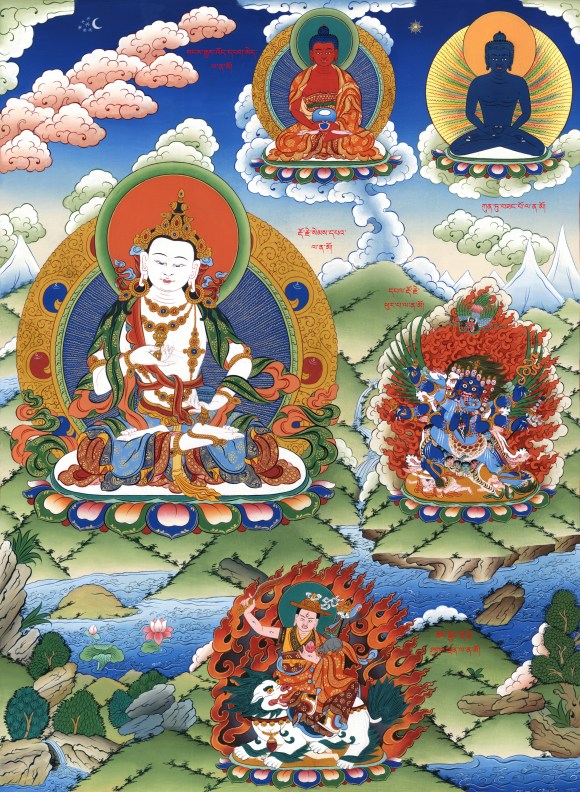
bhavacakra2
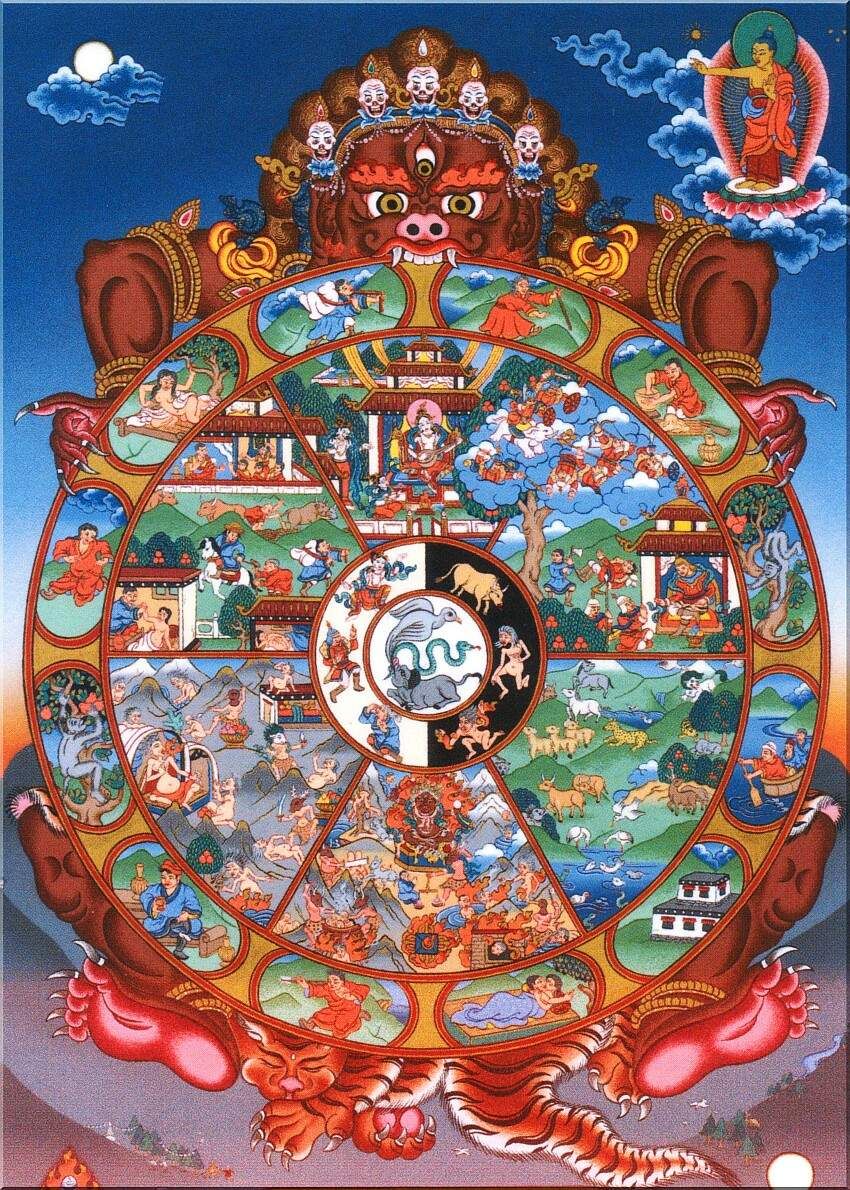
The Bhavacakra, or Wheel of Life, an image commonly found in Tibetan Buddhist temples. The innermost circle contains a bird, snake and pig, representing the Three Poisons of attachment, aversion and ignorance. The circle around that represents karma, then the circle outside of that represents the Six Realms in which one can be reborn, and outside of that are the Twelve Links of Dependent Origination. The deity Yama, associated with death, holds the Wheel and represents impermanence. The moon above represents liberation, and the Buddha in the upper-right points out the way toward liberation.

“Rebirth is not actually important in Buddhism, it was just included to appeal to ancient Indians who already believed in reincarnation.  Or, rebirth is just symbolic and not a ‘real’ thing, and can be safely ignored”.

Many people, including some Buddhists themselves, have trouble with the concept of rebirth.  As I described in the previous article, in Buddhism we are reborn not reincarnated, which means that while our karma continues from life to life, there is no self or eternal soul that survives between each existence, as there would be in reincarnation.  Even though the rebirth concept is in a sense a smaller conceptual leap than reincarnation, since a soul is not required and nothing of the self transmigrates, still it represents a major obstacle for many people who are otherwise intrigued by Buddhist beliefs.  In response, some Western scholars have proposed that actually rebirth was simply used by the Buddha as a metaphor, or as a means to convert ancient practitioners of the Vedic religions.  For some this is a very appealing interpretation, since without rebirth one can focus purely on the practical, immediate benefits of the Noble Eightfold Path and not be forced to accept any supernatural elements that are difficult to reconcile with our personal point of view.

In Buddhism there is no God ruling over creation, nor does Buddha hang about and judge any of us; we alone are responsible for our actions and our karma, and so how much of the Dharma we do or don’t believe is entirely our decision.  However, we should remember that while, technically, we can choose to take or leave rebirth as a concept, that doesn’t mean that the Buddhist conception of reality retains the same power if we excise rebirth entirely, or relegate it to a symbolic representation of moment-to-moment impermanence of consciousness.  Rebirth is stated very clearly by the Buddha to be critical to the path of liberation he outlines, and without it, some of the central moral and cosmological elements of the Buddhist path start to seem nonsensical.

I already mentioned this in the last article and others have explained it much better than I can, so I will be brief on this point, but we can be quite certain that the Buddha did not intend for rebirth to be taken as a metaphor for something else, nor did he use it as a cheeky tool to convert others to his way of thinking.  Throughout the suttas, the Buddha describes rebirth with very precise language, often using a phrase like ‘after death, and upon breakup of the body’ rather than simply saying ‘rebirth’.  This way of speaking clearly and directly about death and rebirth indicates that at the time of his teachings, this view of existence was controversial, and reincarnation was not as common a belief as we tend to think, so the Buddha needed to explain the details of his worldview unambiguously and convincingly.

He also speaks at length about the processes that lead to us taking rebirth, which we can see above in the bhavacakra painting; the Twelve Links of Dependent Origination describes precisely the chain of processes that lead from the root ignorance of the nature of existence to becoming, being born, ageing, and dying.  The first two Noble Truths relate directly to the existence of samsara, and the latter two to the means of freeing ourselves from this cyclic existence.  Rebirth is thus at the very core of the Buddha’s teachings; the ultimate outcome of following the path of liberation he outlines is to end dukkha, the suffering of samsara, the continuous cycle of life, death and rebirth.

The question still remains: what if I can’t accept rebirth as a concept, does that mean I can’t be a Buddhist?  If we ask Buddhist monks about this, generally they will answer that we should simply set it aside for now, and continue to practice.  Buddhism is fundamentally a philosophy that must be experienced, and not only studied, so contemplation, reflection and meditation are seen as ways to develop further insights about life, death and rebirth.  I have read accounts from a number of Buddhists reporting that they came to some sort of realisation after long periods of practice, and found that rebirth now made sense to them, or that they came to some personal synthesis of the concept that made them feel at peace with it.

The Buddha does talk about faith, but faith in the sense that we trust he is onto something, rather than unquestioning belief.  So, some Buddhists might take the view that, while rebirth is a lot to take in and doesn’t feel ‘right’ to them, they do believe the Buddha was right about a lot of things, so they’re willing to accept he may be right about this, too.  They can just be patient with themselves, and wait for things to become clearer with time.  

“If our consciousness doesn’t persist after death, and there is no soul that transfers over, then why should we bother to practice?  Isn’t death effectively a form of liberation, since whatever my suffering was in my life ends at the point of my death?”

This is a common question that arises when people start to ponder the reality of rebirth as depicted in the Buddhist framework.  We naturally associate existence with the existence of ourselves — if my future lives are not me but merely a karmic outgrowth of my actions, should I really care about them?  Once I die, doesn’t my suffering die with me, and some other poor chump has to live with the fruits of my karma?

Part of why this concept of rebirth is so challenging is that, like any of the core concepts of Buddhism, it derives its significance as part of that framework and must be considered in tandem with everything else.  So viewed in the broader context of Buddhist existence — anicca, anatta and dukkha — the question above quickly loses its rhetorical heft.

The question only really makes sense if we believe that the self exists as a definable essence, a thing that exists and then ceases to exist when the body dies.  Buddhism explicitly denies this, and contends that there is no self, no essence, and further, that none of us holds an inherent, independent existence.  All conditioned things exist in interdependence with one another, so in that context the ending of my suffering at death isn’t something I can suppose.  My suffering is deeply enmeshed with everyone’s suffering, and whether this life exists or not, that suffering will continue.

Similarly, consciousness not persisting into the next life does not remove the import of that life, because in Buddhism each life is an opportunity to practice the Buddha’s teachings, and therefore reduce and end suffering.  In fact Buddhists consider every human life particularly fortunate, because we are not gods who know no suffering and thus can’t improve ourselves, nor are we animals that cannot avoid ignorance of the nature of existence — we have the capacity to improve, to progress, and to end our suffering.  Conversely, death in samsara is not a liberation because it does not end anything — dukkha, suffering, still exists whether we die or not.  The only way to end suffering is to leave samsara through liberation.

The Buddha was explicit that his teachings constitute a Middle Way philosophy, a path between annihilationism, in which nothing exists after death, and eternalism, in which an eternal soul or essence persists.   What he calls annihilationist we might call materialist, but in any case, Buddhism posits that the end of the body is just the end of one cycle of our existence in samsara, and not an absolute end.  At the same time, Buddhism does not accept that a soul or eternal self exists and carries forward into future lives or into an afterlife in another plane of existence.  Buddhism instead says that each life is a new consciousness, a new being, yet that being is linked to many others through its karma.  Thus, we must use each life as best we can to progress toward liberation, because after this life we have to start all over again, and having good karma gives our next lives a bit of a boost.  So, each life matters in the grand scheme of things, unlike in the annihilationist view.  At the same time, we cannot sit quietly and simply wait for the afterlife, because there is no afterlife to go to and no eternal soul to travel there; if we decide not to act, we will continue to suffer indefinitely, in this reality.

To sum up, Buddhists must practice, because this life is a product of the karma that came before, and our next one is the product of the karma we produce now.  This life matters, because if we don’t use it, the chain of karma stretching through limitless time of which we are a part will continue to suffer, and that karma will recur over and over again bringing about more sentient beings, who will suffer in new ways.  The only way out from the Buddhist viewpoint is through liberation, and leaving samsara for good.

“The karma that we have now is determined by our previous lives, right?  So does that mean that if I am disabled, or otherwise disadvantaged, that Buddhists would say I deserve it?  Why should I have to suffer now for previous lives of which I have no knowledge?  None of this seems fair!”

Buddhists say all of life is suffering, because that is the nature of samsara.  Our ignorance of the nature of reality forces us to continue to exist time and time again, sometimes unknowingly poisoning our own future existences.  Samsara is terrible, and unfair, and that’s why the Buddha taught that we should strive to escape it.

Having said that, while karma does produce effects on future lives, Buddhists don’t consider this as any form of punishment.  Karma is simply a process of cause and effect — good actions produce good outcomes, bad actions produce bad outcomes.  One might imagine it as a sort of force of nature; gravity doesn’t punish us by making us fall to the ground, that’s simply what gravity does when we jump off a roof.  Likewise, karma doesn’t punish us by making our lives worse, that’s just what karma does when we do bad things.

One might still get a bit confused and try to impute some kind of karmic retribution on those in unfortunate circumstances — if they are suffering now, they must have been a terrible person in a previous life.  But this doesn’t fit with the Buddhist worldview either.  For example, when raising this question some years ago, a Tibetan Buddhist told me that we cannot assume that the problems we see for others are a consequence of evildoing — perhaps the person in question is a highly-realised Buddhist, and is living a life in a disadvantaged state to work off some last vestiges of previous karma.  Or perhaps what we perceive as a disadvantage is actually a boon, helping that person to focus on the Dharma and become a better person.  Karma is complicated, and only fully-enlightened beings know how it really works, so we can’t presume to ‘read’ a person’s karmic circumstances from our limited perspective.  Thinking more broadly, human rebirths of any kind are considered incredibly precious and special, even if that rebirth is in difficult circumstances.

So no, samsara isn’t fair.  But in Buddhism, everyone is worthy of loving-kindness, every human life is precious, and karma manifests in different ways for different people, which is beyond any of us to see perfectly clearly.  So, in the Buddhist framework, one should not assume that someone in tough circumstances is being punished, or that those circumstances reflect some deep unworthiness in their nature.
Buddhism: Religion or Philosophy?

“Buddhism is more of a philosophy than a religion.  There is no God, souls don’t exist, and the practices the Buddha describes are all really practical.  So I can call myself ‘Buddhist’ even if I don’t believe things like rebirth, or the Six Realms, etc.”

This is a tough one, and I’ll say right from the start that this is reflecting my view, but not the views of all Buddhists.

As I mentioned before, technically you can take or leave whatever parts of Buddhism you want — there is no Buddhist God to punish you, the Buddha is off doing his nirvana thing, and you can still have some good karma by being a good person and doing good things, even if you don’t practice the Dharma.  But I think people should be careful before calling themselves ‘Buddhist’ officially, if significant parts of the Buddhist worldview don’t appeal to them.

In the answers above I alluded several times to the generally intricate and interdependent nature of Buddhist thought.  This starts to become problematic if we consider Buddhism as a philosophy to be dissected into whatever random bits we find interesting, rather than as a coherent system of thought, each element resting on the others.  When we take some bits out, the other bits don’t work as well, and sometimes don’t work at all.  Yet this kind of approach is nonetheless fairly common, as we see in the Secular Buddhist community, but is perhaps most commonly seen in the widespread adoption of Mindfulness-Based Stress Reduction (MBSR — more on this below).

But, let’s flip this around and consider it from the point of view of a different religion.  If I were to call myself a Christian, but then say I don’t believe in God, or the afterlife, or that Jesus Christ died for our sins, is it really reasonable to call myself a Christian?  At that point I only like the trappings rather than the content.  In the same sense, if I call myself a Buddhist but don’t believe in karma, rebirth, Buddha-Nature, or whatever else, am I a Buddhist or just an interested observer?

This kind of issue becomes even more troublesome when we try to combine Buddhism with other religions.  For example, Buddhist cosmology and metaphysics is essentially diametrically opposed to the Judeo-Christian equivalents — Buddhism has no God, no souls, no eternal afterlife, and while gods of some kind exist in various sutras they’re just as beholden to impermanence as the rest of us.  In other words, if God existed in the Buddhist cosmos, he would also be in samsara and would eventually decay and die just like us humans, and he would have no ability to stop this as no being can interfere with the operation of karma.  So while it is certainly possible to be a Christian and engage in Buddhist practices, like meditation, I personally would object to a Christian saying they could also be Buddhist (or vice versa); in order to make these disparate ideas compatible that person would have to reject basically all the core concepts of Buddhism.

So, from my point of view, before calling ourselves official, capital-B Buddhists we should simply evaluate our standpoint based on common sense, and reflect on how our beliefs coincide with those of practicing Buddhists around the world.  If we feel the Four Noble Truths and the Noble Eightfold Path are how we wish to live our lives, and we try to practice Dharma in whatever way we can, then that sounds pretty Buddhist to me.  But calling oneself Buddhist while adopting very little of the Buddha’s teachings is more problematic, and in my view, is a bit disrespectful of the millions of Buddhists around the world who believe that the Buddha’s teachings are a complex and harmonious whole, and who orient their lives around these teachings.  Buddhism is certainly full of intriguing and penetrating philosophy, but it is not only that.

I’ll close with a quote from Donald Lopez, Professor of Buddhist and Tibetan Studies at the University of Michigan:

“Buddhism has always been a religion,” he says. “To see it as a way of life is a modern conceit that disparages the lives and religious practices of Buddhists over thousands of years.”


“Buddhism sounds cool, but everyone’s doing mindfulness now and that seems helpful enough, so shouldn’t we all just do that?  Why do all that other stuff?”

Again this is a tough one, so I will take this question on from my own point of view, but will back it up with some citations from some more respected Buddhist thinkers as well.

Mindfulness is everywhere today, usually in the form of Mindfulness-Based Stress Reduction courses, based on a curriculum developed by Jon Kabat-Zinn and now propagated around the world.  Businesses, schools, universities, and hospitals everywhere now offer mindfulness courses, and numerous studies have confirmed that it can enhance our wellbeing and provides numerous tangible health benefits.  Certainly practicing mindfulness has real-world impact, and has helped numerous people to cope with challenges in life.

But for Buddhists, this again is an instance of taking one small element of the Buddha’s teachings and removing it from all the surrounding context.  Mindfulness is just one element in the Noble Eightfold Path; in fact, only three of the eight elements are related to meditation (Right Effort, Right Mindfulness, Right Concentration), and the rest are much more general ethical and behavioural principles.  MBSR removes the ethical and metaphysical core of Buddhism, leaving behind only one isolated practice, and when that practice is one advocated by the Buddha for achieving insight into the nature of reality and transforming our understanding of our minds, not just a method for feeling calmer, then we should consider whether we are really getting the maximum benefit out of this practice.

Unfortunately, not only has the ethical centre of Buddhism been excised from MBSR, but that core has at times been replaced with an individualistic, goal-oriented framing that is a source of greater suffering, from a Buddhist point of view.  Mindfulness is presented as a way to conduct more successful business relationships, to reduce stress and misery, to enhance one’s mood or eradicate depression.  But this approach is quite at odds with the Buddhist perspective:

“Mindfulness in Buddhist tradition is to transform one’s sense of self; it’s not about attaining personal goals attached to personal desires; the goal is to liberate oneself from greed, ill will and delusion, not to achieve stress reduction.” [Ronald Purser, quoted here]

In addition, mindfulness has now been wholeheartedly adopted by corporate culture, and is offered as a way for employees to cope with the stress of the working environment.  Mindfulness is supposed to be about developing wisdom and insight, but instead it is being used as a way to pacify an increasingly underpaid, overworked and over-stressed workforce.  Mindfulness is even being used for war, with MBSR-based courses being utilised to enhance soldiers’ abilities to retain concentration in firefights.

This of course is in stark contrast to the motivations behind meditative practice in Buddhism, particularly in the Mahayana and Vajrayana traditions, where the primary motivation for all practice must be to work for the enlightenment of all sentient beings.  In Tibetan Buddhism, practices always include a dedication, wherein all the positive effects of the practice are dedicated to relieving the suffering of all beings.  Practitioners embark on mind-training exercises, designed to relieve them of pride, greed, and selfishness, so that all practices are performed with pure altruistic intention.  Tibetan Buddhism heavily emphasises the need to enter all meditation practices with pure motivation, and often the start of a practice includes chants and recitations on these themes.  For example, all practice texts provided by Thubten Chodron of Sravasti Abbey begin as follows:

I take refuge until I have awakened
In the Buddhas, the Dharma and the Sangha.
By the merit I create by engaging in generosity and the other far reaching practices
May I attain Buddhahood in order to benefit all sentient beings.

May all sentient beings have happiness and its causes.
May all sentient beings be free of suffering and its causes.
May all sentient beings not be separated from sorrowless bliss.
May all sentient beings abide in equanimity, free of bias, attachment and anger.

When we examine the types of practices associated with mindfulness in Buddhist traditions, we can see there’s a reason why mindfulness is only one small part of the Noble Eightfold Path.  As with everything else in Buddhism, mindfulness enhances and is enhanced by the other elements of the Path; being mindful helps one to take right action and engage in right speech, to develop loving-kindness for all sentient beings, and so on.  Mindfulness, in turn, is influenced and strengthened by developing skilful habits of mind and behaviour.   In Buddhist traditions, for mindfulness to be truly effective it must be part of a larger framework of mindful and compassionate behaviour, speech and action.  MBSR typically does not mention that as well as right mindfulness, there is wrong mindfulness — that is, mindful attention directed at negative behaviours and states of mind.  Right mindfulness is centred on ethical behaviour, altruistic intention and developing wholesome mental states.

In addition, because mindfulness involves turning inward and seeking insight, it may even be harmful for some people, depending on their state of mind.  Again I cannot speak for all Buddhists, but in the past Buddhists of Tibetan and Zen persuasions have both urged me to avoid insight meditation when suffering from poor mental health.  Meditating while suffering mental health issues can be a negative experience for some; even for people who are relatively centred and feeling well, states of deep meditative absorption can cause troubling emotions to arise, unearth painful and traumatic memories, or generate altered states of consciousness that can be confusing or even scary when we aren’t prepared for them.

Because of all this, I personally don’t consider MBSR-type mindfulness courses to be a particularly good idea, and don’t see them as having much to do with Buddhism aside from the link to one of the Noble Truths.  MBSR is too often used as a tool for pacification; a generalist treatment for patients who really would benefit far more from personalised mental and physical health care; and it may on occasion harm some people’s mental health, or turn others away from the broader set of Buddhist teachings that may actually be helpful for them.  Mindfulness is a powerful tool when paired with the ethical and moral centre of Buddhism, but on its own provides only fleeting benefits rather than lasting realisations.

For people interested in mindfulness, I’d instead recommend they visit a local Zen or Tibetan Buddhist centre, who will certainly welcome them to come and learn to meditate.  Or, if that sounds too scary, pick up any number of wonderful books by Thich Nhat Hanh or Bhante Gutaratana, and learn about mindfulness in its original context of the Buddhist belief system.  Even if they don’t find Buddhism itself that interesting, learning mindfulness as a means for cultivating compassion, non-attachment and liberation from suffering makes the practice of mindfulness meditation much more impactful.

“I feel strongly that Buddhism is for me, but I cannot meditate due to life circumstances, ill health, or other problems.  Because of this, I cannot be a Buddhist.”

If someone can’t practice meditation for one reason or another, that doesn’t mean they can’t be a Buddhist.  In Buddhist traditions being aware of the Buddha and his teachings at all is considered a wonderful thing, and even just reading the sutras is very meritorious.  If meditation is not feasible, other aspects of the Noble Eightfold Path are still available, since many of them are centred on behaviours we can engage in throughout our day, regardless of what we’re doing.  So if you can’t meditate, focus on conducting yourself in a positive, compassionate way, deal with colleagues and acquaintances skilfully and kindly, and refrain from lying or abusing others.  This too is Buddhist practice.

Also, not all meditation requires being seated in a quiet room for an hour, which is difficult to organise for many people.  One can also meditate while seated in an office chair, or while walking down the corridor.  Zen practitioners engage in a lot of walking meditation, so there are many good resources available on how to do it.  The formal Zen walking meditation practice may be difficult to do regularly, but the practice can be adapted for use while walking the dog, going to the shops, etc.

Even if none of that is possible, Buddhists take the long view on this kind of stuff.  We may not have the karma to be in a good position for meditative practice now, but there’s always the next life, or the one after that, or 100 lives from now.  Along the way, we do what we can do, and every effort we take, no matter how small, helps us inch along that path to liberation.  On the type of timescales Buddhists talk about (incalculable eons and such), a few slow lifetimes here or there really doesn’t make much difference.

In the Theravada traditions, many practitioners essentially leave the meditation to the monks, and instead practice the other elements of the Noble Eightfold Path and support the monks through donations.  The idea is that someday, if they continue to generate good karma, they will be reborn into a life where they themselves can become a monk, and at that point achieve liberation.

Tibetan Vajrayanists stand out here, of course, because in those traditions it’s completely possible to immerse oneself in tantric practice and level up to Bodhisattva in a single lifetime.  But again, most people don’t have the opportunity to do this, since pursuing that kind of path would involve a complete and total commitment, taking multiple-year-long retreats, and so on.  So many Tibetans deeply revere the Buddha’s teachings and practice some of the precepts, and will attend the temples for big holidays, but they save the crazy tantric stuff for another life where they have the time and accumulated karma to make that complete commitment.

In short, Buddhism is flexible on this, like it is on lots of things.  Buddhists believe that the Buddha taught the Dharma 84,000 different ways, so that every sentient being could understand it and practice it in a way that suits them.  That being the case, many Buddhists are pretty relaxed about how they expect others to practice.
The Buddhist World View

“This Buddhism stuff seems really depressing.  ‘All of life is suffering’?  That’s clearly not true, not all of life is painful, sometimes things are great!”

The First Noble Truth is often translated in this very stark way, as ‘All of life is suffering’ or something similar.  This can lead some to imagine a very dark world view in which every moment of life is filled with abject agony, but this isn’t what the Buddha presented in his teachings.

A more precise way to think of ‘suffering’ in a Buddhist context may be to think of it as ‘discontent’ or ‘unsatisfactoriness’.  The Buddha described three main varieties of suffering, or dukkha: the suffering of suffering, which is the pain of old age, sickness, and death; the suffering of change, which is the inevitable fading away of our achievements, wants and emotional states; and the suffering of existence, which refers to the general anxiety and stress borne of being in a fundamentally insecure position in the world.  These kinds of suffering are indeed everywhere — we often experience negative emotional or physical states, many of us feel a general sense of worry or that things ‘aren’t right’, and we know all too well that our happiness and joy tend to be short-lived.  

Note that none of these varieties of suffering preclude the possibility that we can be, and are, happy and joyful at times!  The suffering comes in when those great moments inevitably ends, and we are left unsatisfied; sometimes we feel suffering even during those great moments, as we know on some level that they will end.  In modern life we are constantly in search of contentment, often through the acquisition of possessions, or looking for a better job, or finding a new partner.  Yet, we know all too well that even if we achieve these things, we are left feeling much the same as before, and typically we end up continuing that fruitless search over and over again.

Here we see the Second Noble Truth — that suffering is borne of attachment and craving.  This is a critically important point, because in the Second Noble Truth we realise that the nature of reality itself is not suffering, but that suffering arises due to our actions in response to impermanence and change.  Throughout our lives, good and bad things will happen, this is just how life works; what generates dukkha is our desire to fix things in place, to cling to positive things that are inevitably fleeting, to seek out sense-pleasures while not addressing our underlying discontent.

This, in turn, leads us to the Third and Fourth Noble Truths — that suffering can be ended, and the way to end that suffering is the Noble Eightfold Path.  Seen in its totality, the Buddhist world view is actually fundamentally positive, because while accepting unflinchingly the reality that life is fundamentally unsatisfactory, Buddhist thought also declares that we can overcome these deep problems.  Not only is it possible to overcome them, but absolutely anyone can do this.  

So, while the Buddhist world view can certainly seem disquieting — after all, we must accept that life is pervaded with discontent, and that everything is impermanent and subject to constant change — but following through on these realisations we are given a fundamentally uplifting philosophy.  Buddhists believe that the suffering of life can be ended, that we can do it even by ourselves without begging forgiveness and mercy from a God or gods, and that when we do so we can experience blissful contentment, free from suffering.

If you worry that Buddhism is too dark, or that enlightenment might lead to a robotic detachment from the occasional joys of life, I urge you to spend some time watching interviews, seminars and talks from His Holiness the Dalai Lama.  The Dalai Lama is an enlightened being, and has spent his life deeply immersed in the most complex, esoteric aspects of centuries of Buddhist thought.  What you will see is not a dour, depressed, self-serious figure, but instead a charming, relatable man with a sparkling wit, a disarmingly silly sense of humour, and profound empathy and compassion.  The Dalai Lama is a living example of how Buddhism provides tools that enable us to cultivate joy, compassion and wisdom in every moment.  The idea of all-pervasive suffering may be scary at first, but applying that knowledge can actually make life much more joyful.

“Buddhists seem really cool and chill, and they don’t do grim stuff like Crusades and wars like the other religions!”

In my experience, most Buddhists typically are pretty chill, but as with any other system of thought there are plenty of Buddhists who behave very poorly indeed.  During World War II, Zen masters got involved in Imperial Japan’s war efforts; Buddhist monks have openly advocated for oppression of Rohingya peoples in Burma; and monks have advocated violence during the Sri Lankan civil war.  In these examples, we see that even devotion to the words of the Buddha doesn’t necessarily preclude one from developing profoundly harmful ideologies, or even directly supporting violent and murderous behaviour.  Generally speaking, such behaviour is perhaps less common in Buddhism than in other major religions, but we must remember that not everyone who is Buddhist will successfully live according to Buddhist principles, and some may even abuse those principles for their own selfish ends.

Here in the West, we are lucky to have easy access to a wide variety of highly-realised Buddhist masters of various traditions, who have reached out to us given our recent enthusiasm for Buddhist perspectives.  With relatively little effort, we can attend live/online teachings from enlightened beings like His Holiness the Dalai Lama, and often these teachings are completely free.  As traditions like Zen and Tibetan Buddhism have spread throughout the Western world, dedicated practitioners have built monasteries and communities of practice all over, to such an extent that nowadays most anyone in the Americas or Europe can find a Buddhist community within relatively close proximity.

However, we must keep in mind that Buddhists are not infallible, as noted above, and that there are unscrupulous types who do seek to exploit one’s enthusiasm for spiritual fulfilment.  When joining a Buddhist community or Dharma centre, I strongly recommend doing research online to find out more about that community before joining.  In particular, some communities branding themselves as Tibetan Buddhist have poor reputations, and may extort large amounts of money from their members while providing teaching of questionable quality.  There have even been some instances of psychological or sexual abuse.

Tibetan Buddhism can be particularly challenging in this regard, because sustained practice in these traditions requires a deep and personal relationship with a guru.  Therefore, finding a cultivating a positive, healthy relationship with that guru is of critical importance, and a bad guru relationship can be very disheartening or even damaging.  So, when joining a Tibetan Buddhist community, be sure to check which Tibetan tradition the community belongs to (Nyingma, Kagyu, Sakya, Gelug, Jonang, Bon).  Also be sure to research the teachers within that community, and look for teachers who can demonstrate that they have an unbroken lineage of transmission (meaning they have received training passed down from highly-realised masters in recognised Tibetan lineages).  Of course even these qualities may not guarantee a good experience, but you are much more likely to have a positive and transformative experience if you can rely on your community and its teachers as being part of a genuine tradition, and having lifetime(s) of experience teaching the Dharma.

If you are unable to find a reputable community near you, don’t despair!  In these modern times, Buddhism is more accessible than ever.  Even the deepest esoteric teachings of Tibetan Buddhism, which must be transmitted to you directly by a guru, are available online.  Some reputable Tibetan Buddhist online programmes include: Tara’s Triple Excellence; the Foundation for the Preservation of the Mahayana Tradition’s Basic Program;  and Mingyur Rinpoche’s Vajrayana Online.  Note that these are all very intensive and very long programmes that will carry you from novice all the way to esoteric tantric practice!  Less intensive forms of practice are even more accessible, and numerous short courses in foundational Buddhist principles and practices are available from many reputable sources.

“Buddhism has less of a focus on supernatural things, and much more focus on the internal world of our thoughts and perceptions, unlike other religions.”

Buddhists certainly do have a much more detailed and systematic approach to understanding mind and reality than most major religions.  They also do not believe in a creator God, or in an eternal soul, so in that respect they may appear less inclined toward the supernatural than, say, Judeo-Christian traditions.

However, spending any amount of time reading Buddhist scripture will reveal many supernatural elements.  Buddhist cosmology includes six separate realms of existence — the human realm, demi-god realm, god realm, animal realm, hungry ghost realm, hell realm — each of which is home to huge numbers of unusual beings.  Teachings from the Buddha himself describe the attainment of superhuman psychic powers as a result of Buddhist practice, such as being able to read minds or appear in two places at once (interestingly, these powers are widely considered to be very real and many highly-realised masters report experiencing them, but generally they rarely speak of them, do not consider them important, and actively discourage practitioners from seeking out these powers).  Buddhas and bodhisattvas are depicted both as actually-existent omniscient beings that try to help all sentient beings achieve enlightenment, and as conceptual entities reflecting only internal properties of our minds (this is a deep and fascinating topic all in itself).

In short, Buddhism includes plenty of elements that we would consider ‘supernatural’.  However, in the context of Buddhist thought this is a complex area, in that some portrayals of these entities and powers are considered ‘relative truth’ (portrayed a certain way to be accessible to everyday people and/or new practitioners), rather than ‘absolute truth’ (in which the fundamental nature of the entity/phenomenon is clearly described).  This is particularly relevant to Tibetan Buddhist deities, which are described as real, existent beings in relative terms, but at higher levels of practice are seen as convenient visual/conceptual manifestations of deeper aspects of mind rather than as real beings.

So, I would say it’s helpful to avoid categorising the ‘supernatural’ elements of Buddhism as such, without looking deeper into how these elements manifest in actual practice.  Buddhists are happy to work with very complex layers of visual and conceptual symbolism, and their philosophy actively discourages dualistic thinking, so by classing some of these elements as ‘real’ or ‘supernatural’ we’re missing the point a bit.

Buddha himself also espoused the need to use ‘skilful means’ to teach the Dharma, meaning that simplifying or re-contextualising things to improve accessibility is worth doing if it helps spread the Dharma.  So if a layperson views Chenrezig as a real, existent deity who watches over them, and thus acts in accordance with Buddhist principles of compassion, then this is perfectly fine, even if we ‘know’ that Chenrezig is a symbolic representation of our own mind’s limitless potential for compassion.  Both approaches can lead one to realisation, so does it really matter if one is more or less ‘accurate’ than the other?

“I like Buddhism because it’s very rational, detailed and empirical, and fits in well with a Western scientific viewpoint.”

Buddhists certainly do approach the nature of mind and samsaric existence in incredible detail, and the various Buddhist scriptural canons contain a truly astounding amount of detail, including very rigorous descriptions of every type of mental phenomena, and seemingly endless lists of types of mental events, consciousnesses, and so on.  For the reader interested in the philosophy of mind and cognition, Buddhism virtually sparkles with enticing and exciting ideas, which all seem to cohere into a remarkably detailed and consistent philosophy.

Having said that, we have to be careful before imputing a scientific mindset onto the words and actions of the Buddha and his disciples.  While Buddhists have long had formal systems of logical debate and do have a clear interest in developing coherent systems of thought regarding the mind and samsaric existence, these systems sprung out of a desire to develop ever more powerful ways to teach others how to achieve liberation from samsara.  The Buddha was not a philosopher, but a spiritual teacher, and his goals were not to uncover the workings of reality, but to find better ways to surpass it and improve ourselves.  These goals are not scientific goals, or philosophical ones; when Buddhism appears that way, it is because these approaches served the overarching goal of developing powerful means to achieve liberation:

“The Buddha should not be understood as a philosopher who was trying to develop a systematic philosophical system, complete with its own epistemology, metaphysics, and cosmology. Nor was he engaging in early scientific thinking. His teachings do not speculate about the nature of what seems to us to be the external world. Rather, his goal was to teach beings to understand their experience in such a way that they would be able to eliminate suffering and the fundamentally unsatisfactory quality of their lives. When we read in the sutras statements that seem to be abstract philosophical claims or excursions into neuroscience or cognitive psychology, we should realize that the purpose and meaning of these statements is to be understood and evaluated in light of their utility in advancing spiritual practice.” (The Surangama Sutra: A New Translation, 2009)

So, when reading about Buddhist thought, the philosophy on display is so detailed and rigorous that it’s very easy to attribute to it the same mindset that we use when discussing science or analytical philosophy.  But when we zoom out a bit, we can see that the goals are quite different.  As in the quote above, the Buddha is quite particular about only teaching the information that is needed to achieve liberation from samsara; he doesn’t speculate much on the origins of the Universe, or posit some overarching purpose or direction to existence.

The Buddha gave a famous discourse in the Pali Suttas about a surgeon removing a poisoned arrow from its victim.  The surgeon who does his job properly will remove the arrow quickly, suck out the poison, and treat the wound; then he will give his patient only the medical knowledge and advice he needs for caring for himself afterward.  He won’t tell the patient what wood the arrow was made from, or who he thinks shot the arrow, or what the weather was at the time; none of this aids the patient in keeping himself healthy, which is the surgeon’s ultimate goal.  The Buddha compares himself directly to this surgeon, demonstrating that he only provides his students with the information they need to heal themselves, because liberation is the goal, and any information irrelevant to that goal is unimportant and would only confuse rather than heal our suffering.

So while it is tempting to compare the Buddha’s systematic approach to understanding and revealing the true nature of mind and suffering to a modern rationalist view, what we see in the sutras is not truly a scientific approach but instead a deeply practical one.  The Buddha doesn’t waste time on things we don’t need to know.  We don’t need to know why samsara exists, it just does, and we should devote all our attention to escaping it.  We don’t need to know how or why the Universe began, because it self-evidently did and there’s nothing to be done about it, nor is there anything in that event that helps us achieve liberation.  When viewing existence from a non-dual perspective, none of these questions have much intrinsic value anyway; all things are empty of inherent existence, so the main focus from a Buddhist perspective is to realise that and thus remove our attachment to conditioned things.  Therefore, what we do need to understand is the nature of mind, the origin of suffering, and the way to end suffering, so the Buddha spent 49 years teaching in exacting and exhaustive detail on precisely those things.

“Wait, you said you can’t be Buddhist and be [Christian/Muslim/whatever], but here’s a quote from the Dalai Lama saying that Jesus Christ can be seen as a Bodhisattva!  Doesn’t that mean these religions actually are compatible?”

Buddhism is very good at coexisting with other belief systems, including Judeo-Christian ones, because it views the world in a quite different light.  As discussed above, the Buddha’s teachings don’t really address the same questions that the Bible, the Torah or the Quran address, with little time spent in the sutras on the ‘why’ and ‘how’ of existence.  Similarly, there is no creator God in Buddhism, so in that sense Buddhism really isn’t in competition with most other religions.

We can see this inherent flexibility at work in many parts of the world, where Buddhism has found a comfortable synthesis with other religions.  Japan is a classic example, where much religious practice is syncretic and includes elements of Shinto and Buddhism with no real sense of conflict between them.  Shinto is an animist religion with numerous gods and spirits, and Buddhism is perfectly accepting of gods and spirits — it just says that Buddhists can’t take refuge in such beings, because they aren’t enlightened, and therefore they can’t lead us to liberation.  Only the Buddha and the bodhisattvas and practicing the Dharma can liberate us.  There’s nothing in Buddhism that says gods and spirits of other religions can’t exist, and can’t answer our prayers and do things for us; we just shouldn’t expect those things to get us out of samsara or address the true causes of suffering, they can only help us in the day-to-day worries we encounter in our milling around in samsara.

Still, despite the relative ease with which Buddhism can accept other approaches to spirituality, as discussed above there are still certain limits to this flexibility.  Being a Buddhist requires accepting certain fundamental beliefs about the nature of existence, and when another set of beliefs contradict those, then we have to make a choice about which to believe.  That being the case, my understanding is that statements from the Dalai Lama and other prominent Buddhists about other religions are primarily aimed at reassuring people that Buddhism doesn’t seek to erase their beliefs, their prophets or their gods.  At a certain point conflicts will start to arise, but one would have to develop a serious interest in Buddhism for that to become a problem, so for the broader audience it’s more important to know that Buddhism is not something to feel threatened by, and that Buddhists will, and do, welcome interfaith dialogue.

Fundamentally, Buddhism is an atheistic philosophy, so at a certain level it will inevitably conflict with theistic modes of thought.  Buddhism explicitly denies the existence of a creator God that intervenes in our affairs; such an entity is logically impossible in the Buddhist framework, since everything in existence is a product of dependent origination and therefore depends on the existence of everything else, meaning there is no possibility of a ‘first mover’ and no need for proposing the ex nihilo creation of existence.  Further, a Buddhist is supposed to take refuge only in the Buddha, the Dharma (the Buddha’s teachings), and the Sangha (the monastic community); giving offerings to or praying to other entities/gods has no soteriological value in Buddhism, as those entities would be just as subject to the turmoil of samsara as the rest of us, and therefore cannot lead us to liberation.

This atheistic view is common across all established Buddhist traditions, as outlined in the Basic Points Unifying the Theravada and the Mahayana, written and agreed by the World Buddhist Sangha Council in 1963 (emphasis mine):

The Buddha is our only Master (teacher and guide)

  1. We take refuge in the Buddha, the Dharma and the Saṅgha (the Three Jewels)
  2. We do not believe that this world is created and ruled by a God.
  3. We consider that the purpose of life is to develop compassion for all living beings without discrimination and to work for their good, happiness, and peace; and to develop wisdom (prajñā) leading to the realization of Ultimate Truth
  4. We accept the Four Noble Truths, namely duḥkha, the arising of duḥkha, the cessation of duḥkha, and the path leading to the cessation of duḥkha; and the law of cause and effect (pratītyasamutpāda)
  5. All conditioned things (saṃskāra) are impermanent (anitya) and duḥkha, and that all conditioned and unconditioned things (dharma) are without self (anātma).
  6. We accept the thirty-seven qualities conducive to enlightenment (bodhipakṣadharma) as different aspects of the Path taught by the Buddha leading to Enlightenment.
  7. There are three ways of attaining bodhi or Enlightenment: namely as a disciple (śrāvaka), as a pratyekabuddha and as a samyaksambuddha (perfectly and fully enlightened Buddha). We accept it as the highest, noblest, and most heroic to follow the career of a Bodhisattva and to become a samyaksambuddha in order to save others.
  8. We admit that in different countries there are differences regarding Buddhist beliefs and practices. These external forms and expressions should not be confused with the essential teachings of the Buddha.

Having said all that, there is always benefit to sustained dialogue between religious traditions, even when such major, irreconcilable differences are present.  Religious strife has been the cause of much suffering, and by developing understanding between religions we can more easily avoid these problems.  Sustained dialogue can also foster compassion and beneficial relationships across religious groups.  The Dalai Lama has been a prominent supporter of interfaith dialogue, and has been very successful in building better relationships between Buddhist organisations and other faiths.

“Hang on a minute, why should I listen to you about any of this anyway?  You’re just some guy!”

That’s true, though to be fair, the Buddha himself also discouraged mindless belief in whatever he says, and encourages us to test his teachings through real experience. The Dalai Lama likewise often refers to himself as a ‘simple Buddhist monk’ and has said many times that we should only believe what we’ve tested and examined using our own minds and critical analysis. If the Dalai Lama and the Buddha themselves don’t ask for unconditional faith in their teachings, then I certainly can’t (and won’t!).

Ultimately, I’m only here to present my take on Buddhism, and my feelings about how we should view it from a Western perspective. From that point of view, I hoped some exposition about certain common misconceptions might be helpful for others out there, as I’ve asked all these questions myself at one time or another.

If it helps, I do consider myself a Buddhist, and I took the refuge vows in front of the Dalai Lama himself in 2004, so in theory I’ve been a Buddhist in some sense since that moment. But more recently I decided to make it more ‘official’, so now I’m a literal card-carrying Tibetan Buddhist with a Tibetan Dharma name and everything:
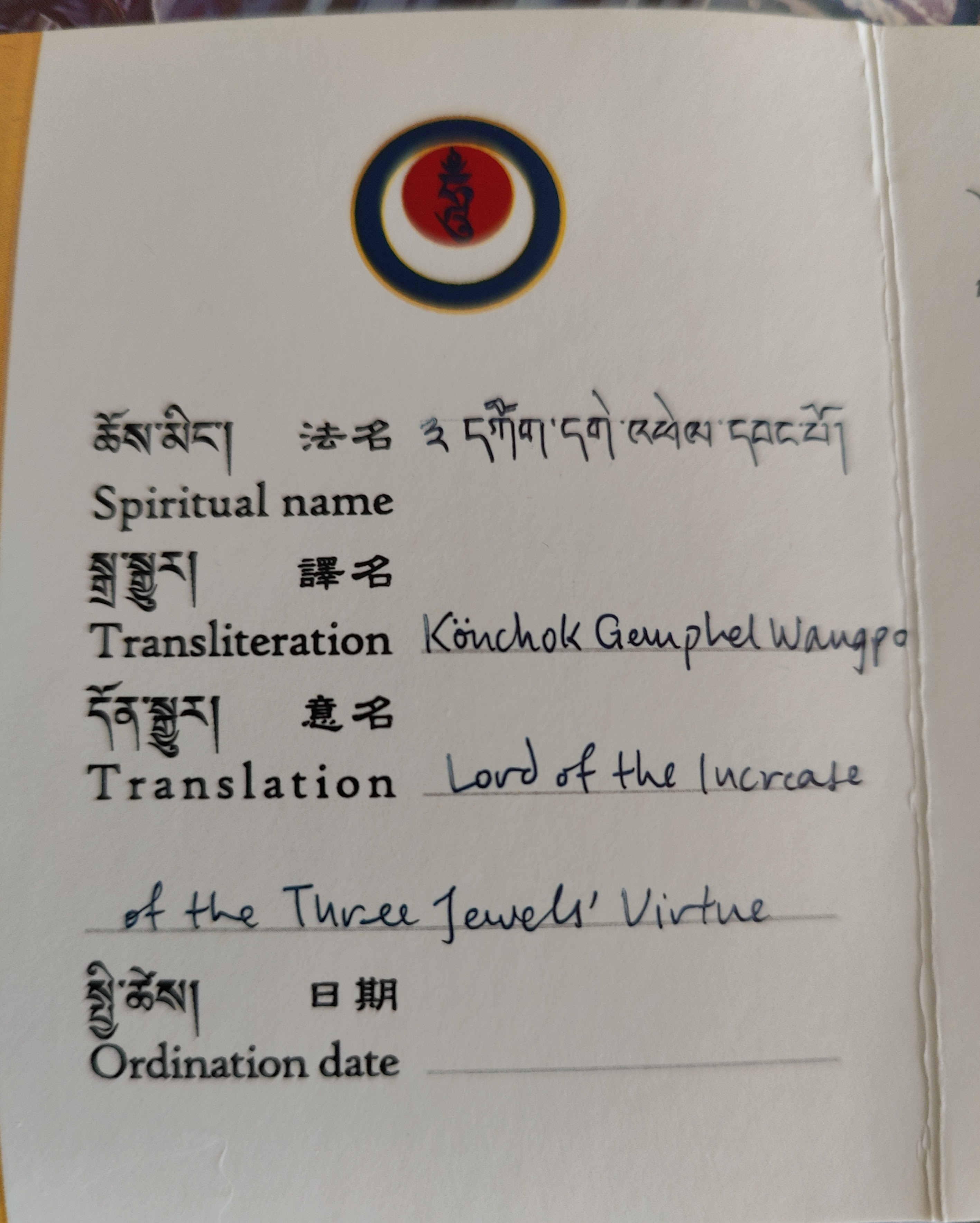
A picture of my refuge card

So I’m a Buddhist, but definitely a layperson (note the lack of ordination date, so I’m no monk!), and please take anything I say with a massive grain of salt. My hope is that reading this will help you learn some basics, and ultimately take you to teachers much more qualified than myself!
Tagged , , , , , ,

Understanding Buddhism, Part I: The Diversity of Buddhist Practice

As I wrote in my critique of Todd May’s Death there are some misconceptions about Buddhism and its philosophy and practices that are widespread in Western sources.  Much of this is probably due to the works on Buddhism produced by Western scholars in the late 19th/early 20th centuries, which viewed Buddhism through a colonialist lens, with everything they perceived being positioned against a Judeo-Christian conception of reality.  These sources often viewed Buddhism as a nihilistic faith, a perception that would have been proven false had they engaged more deeply with Buddhist literature.  

Today, misconceptions of Buddhism have taken some additional forms, often inspired by a modern view of Buddhism as a ‘philosophy’ more than a religion.  There is a tendency to view Buddhists as largely secular, rational thinkers — introspective scientists probing the depths of the human mind.  Figures like the Dalai Lama present to us as benign, kindly monks promoting generally-acceptable ideas like the power of compassion, and they explicitly support other types of spirituality rather than positioning Buddhism as the One True Path.  As a consequence we believe that Buddhism sits comfortably within our Western materialist tradition, and some even go so far as to propose that core Buddhist concepts like rebirth and karma are metaphors rather than actual beliefs.  This way of thinking has led to the rise of Secular Buddhism, spearheaded by writers like Stephen Batchelor. 

Adding to the confusion, millions of people now practice Mindfulness-Based Stress Reduction — essentially Buddhist meditation stripped of all of its wider context; this further colours our perceptions, leading some to confuse these reduced practices with the whole of Buddhism.  In positioning Buddhism in this way we implicitly deny many centuries of Buddhist scholarship, the importance of esoteric practices and mysticism in Buddhism, and the deeply-rooted cultural influences that give each regional expression of the Buddha’s teachings their own vibrant traditions.

As another outgrowth of my own studies of Buddhist history, philosophy and practice, I decided to start putting together a summary of some common misconceptions about Buddhism found frequently in popular culture and Western scholarship.  I hope this may be useful for some of you out there who are interested in Buddhist traditions and practices, but mainly it will serve as a living reference document for myself, as my own understanding of Buddhism continues to evolve and deepen over time (hopefully).

Before I get started, a note about style.  When speaking of concepts drawn from the teachings of the Buddha as recorded in the Sutta Tipitaka, I will use terminology from the Pali language in which the suttas (sutras) were written.  When speaking of Mahayana and Vajrayana traditions, I will use terminology derived from Sanskrit, as these terms are more commonly used in these contexts.  This is primarily for my own convenience, so that on later readings and edits I can quickly identify what sources are being discussed in any given passage.

One more note about books on the Dharma (the teachings of the Buddha), since I recommend a number of these below.  Traditionally any book containing the Buddha’s words or any Buddhist teachings should be treated with particular respect.  Such books should not be placed on the floor or stepped over, have other books or objects placed on top of them, and they should be kept on high shelves and preferably away from non-Dharma books.  When reading them, you should only do so while sitting upright or standing.  Whether you do all this or not is up to you, there are no Dharma Police to arrest you and there are no gods in Buddhism around to punish you, but just bear this in mind in case you have visits from serious Buddhists someday, who may notice this kind of thing.

Before getting to the misconceptions themselves, in this first article I’ll quickly summarise the major Buddhist traditions and their differences.  I will provide much more specific details here than in my previous introductory article on Buddhist thought and meditation.  In the second part of this series, we’ll build on these foundations and explore some common misconceptions about Buddhism.

Just to lay out my position up front: throughout these articles, I will make an argument that capital-B Buddhism is built on a foundation of an incredibly comprehensive, internally-consistent philosophy, and that anything we call ‘Buddhism’ must include, at a minimum, a coherent subset of that philosophy.  The Buddha himself urged his followers not to be fanatics, and to test all his statements using their own critical faculties; so in that respect, there is nothing wrong with being a Secular Buddhist, or with being a Christian who practices mindfulness meditation, or whatever else.  Problems do arise when we claim that these patchwork Buddhist practices *are* capital-B Buddhism, or that our own interpretation of Buddhist thought is the correct one, and that we have some special insight into the Buddha’s teachings that 2,500 years of Buddhist scholarship somehow missed.  Ultimately I feel we need to re-examine how Buddhism is taught in the West; have more respect for the Buddhist scholars who precede us; and make more efforts to learn how Buddhism is actually practiced by the cultures in which it thrives, rather than simply presenting it as an abstract philosophical framework.

The Buddhist Path to Liberation

Many of us, Buddhist or not, are familiar with His Holiness the Dalai Lama.  The Dalai Lama is an incredibly charismatic person, and has single-handedly made the world aware of the fraught political situation in Tibet and has helped spread Tibetan Buddhism across the world.  His influence is so pervasive that many non-Buddhists perceive him as a sort of Buddhist Pope.

In reality, of course, there is no Buddhist Pope.  Buddhism takes many different forms in the numerous countries where it is practiced, and the Dalai Lama is connected only to Tibetan Buddhism.  Within the Tibetan context, the Dalai Lama comes from the Gelug tradition, which historically has been the most powerful and influential of the Tibetan Buddhist schools, but there are several other schools that have existed for just as long (or longer) and which have significant differences in how they practice compared to the Gelugpas.  

Before we dig deep into the complexities of Buddhist thought, we should start by clarifying what types of Buddhism exist, and develop some basic concepts of how each of these traditions view the teachings of the Buddha and the nature of existence.  In this way we can better appreciate the incredible diversity of Buddhist life in different traditions, and better understand how evolutionary steps in Buddhist doctrine have lead to very different approaches to practice.  Buddhism is traditionally divided into three ‘vehicles’, each of which builds on the foundation of the previous and extends it with new philosophical concepts and practices; below I will describe each of these vehicles in turn.

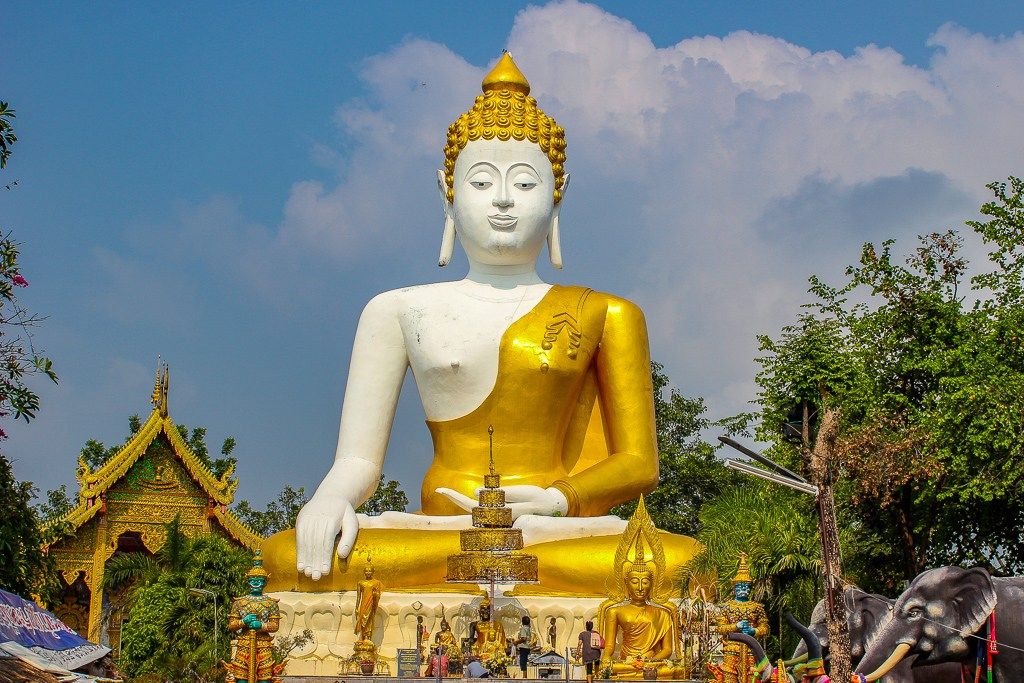
chaing-mai-buddha

A huge statue of the Buddha in Chiang Mai, Thailand.

Early Buddhism (previously called ‘Hinayana’):

The first ‘vehicle’ in Buddhism is Early Buddhism, formerly known as Hinayana (‘the Lesser Vehicle’), which follows the original teachings of the Buddha as laid out in the very extensive suttas (sutras, or discourses) given by the Buddha during his lifetime, and subsequently recorded in the Tipitaka, which were written in the ancient Pali language.  These suttas focus primarily on the Buddha’s fundamental realisations about the nature of suffering, which he codified in the Four Noble Truths, and his prescription for ending suffering, The Noble Eightfold Path.  The early Buddhist practitioner seeks to become an arahant, an enlightened being who perceives the true nature of existence, is free of the ignorance that leads to suffering, and will reach nibbana (nirvana) and thus ultimate freedom from suffering at the end of their life.

Core philosophical concepts:

The Buddha’s original teachings gave us the Four Noble Truths, the Buddha’s explanation of the nature of human suffering, and the Noble Eightfold Path, his prescription for ending that suffering and achieving nibbana (nirvana).  The Four Noble Truths can be expressed as follows:

  1. Suffering (dukkha) is an innate characteristic of existence in samsara.
  2. Suffering is due to attachment and desire — the desire for pleasure; the desire for existence; and the desire for non-existence.
  3. Suffering can be ended, by ending this attachment and desire.
  4. The way to end suffering is to practice the Noble Eightfold Path.

So, dukkha arises due to our desire for identity and constancy in a world that is constantly changing, and this desire and attachment causes us to perpetuate this suffering, in the form of continued existence in samsara — the endless cycle of life, death and rebirth that all sentient beings experience.  Samsara leads to endless suffering, as each rebirth is doomed to eventually age, decline, and die, only to start all over again.  By cutting off this desire and attachment, and by curing our ignorance of the nature of reality, we can end this suffering and free ourselves from cyclic existence.

The nature of each rebirth is determined by our kamma (karma), which is the only aspect of each life that persists to the next; in Buddhism each rebirth is a separate being and consciousness from the preceding one, as there is no soul or essence that transfers over (as would be the case in Hindu reincarnation, for example).  Kamma is understood as a cause-and-effect process; bad actions lead to suffering, good actions lead to a reduction of suffering.  Kamma is not a divine judgment on our behaviour imposed from outside, but instead exists in the outcomes generated by our actions that affect the world around us.  The only beings that may change our kamma are ourselves, by understanding the action of kamma and following the Noble Eightfold Path.

The Noble Eightfold Path provides the eight means by which we end craving and attachment:

  1. Right View — we must understand the functioning of kamma and the nature of dukkha (the Four Noble Truths), and avoid holding views of existence which enable attachment and craving.
  2. Right Intention — we must cultivate an intention of renunciation (abandoning craving), an intention of good will (metta, loving-kindness), and an intention of harmlessness (a compassionate wish that all beings be free of suffering).
  3. Right Speech — we must not lie, speak unkindly, or use our words to cause discord and suffering.
  4. Right Action — we must not kill or injure others, steal anything which is not ours, or engage in sexual misconduct (abuse, adultery, assault, etc.).
  5. Right Livelihood — we must earn our living legally, peacefully, without coercion or violence, and without trickery and deceit.  Our livelihood must not cause suffering for others.
  6. Right Effort — we must abandon our existing unwholesome mental states, and prevent the arising of other unwholesome mental states.  We must maintain and perfect our wholesome mental states, and generate wholesome mental states that have not yet arisen.
  7. Right Mindfulness — we must cultivate serenity and insight in the mind through the contemplation of the four foundations of mindfulness: the body; feelings; states of mind; and phenomena.
  8. Right Concentration — we must cultivate single-pointed mental concentration, progressing through four successive stages of increasing meditative absorption called the jhanas.

Note that the Noble Eightfold Path contains three elements focussed on meditational practice — Right Effort, Mindfulness, and Concentration — but the rest of the path consists of actions we must take in everyday life and in our relationships with other people.  So the image occasionally presented of the Buddhist as a detached, cold, robotic meditator is not accurate; Buddhists must cultivate positive actions and qualities in all aspects of life, as well as within their minds.  Part of the path is to demonstrate good will and compassion for others, as well as refining our internal mental states.  The Noble Eightfold Path must be practiced in its entirety if one wants to achieve liberation.

The truth of suffering in Early Buddhism leads us to the three marks of existence: dukkha (suffering), anicca (impermanence), and anatta (not-self).  Dukkha is the concept that all existence leads to suffering, due to our fundamental ignorance of the nature of reality and our grasping for solidity and changelessness in a world forever in flux.  Anicca is the concept that everything is impermanent and subject to decay and dissolution; on a human level we experience this as the reality of mortality, that all of us are born, will age and decline, and eventually die.  Anicca extends this to all things, including our own thoughts, which continually arise and disappear again from moment to moment.  Finally, anatta denies the existence of a permanent self.  This means not only that humans, and all sentient beings, do not have a permanent, changeless essence like a soul, but also that our perception of self is fundamentally illusory.  We perceive single unified selves, but in fact each of us is a constantly-changing bundle of perceptions interacting with the world, and on a fundamental level all phenomena are dependently arisen — they are the consequences of the interactions of various causes and conditions, rather than singular entities with an independent, absolute existence.

In modern times some Western scholars choose to believe that the Buddha talked about rebirth symbolically, but this is definitely not the case.  The suttas are nothing if not scrupulously clear, and whenever rebirth is mentioned it is described carefully and precisely, often with the phrase ‘after death and upon the break-up of the body, [thing happens]’.  Rebirth is very explicitly discussed throughout the suttas as a real process.  Some have argued that the Buddha included rebirth in the suttas simply because that was the default position in India at the time; this is also incorrect, and part of the reason rebirth is described so carefully and extensively in the suttas is that the Buddha’s position was novel and controversial.  Kamma likewise is often misinterpreted as a system of supernatural reward and punishment, but in the suttas it is simply portrayed as cause and effect, a spiritual equivalent to gravity or electromagnetism.  Kamma is determined only by our own actions and is not imposed by outside agencies or deities.   

In the early days of Buddhism, there were 18 schools of Buddhism with varying interpretations of the suttas.  Today only the Theravada tradition remains.  Theravada is widely practised in Thailand, Sri Lanka, Burma, Cambodia, and in the West.  Mahayanists used to refer to Early Buddhism as Hinayana, which literally translates as ‘the Lesser Vehicle’, but today this term is considered derogatory because all three Buddhist ‘vehicles’ are capable of achieving enlightenment for their practitioners, and therefore none can really be characterised as inferior.  I will use the term ‘Early Buddhism’ to refer to the general category of traditions focussing purely on the Pali Canon, and ‘Theravada’ to refer to Early Buddhism how it is actually practiced today.  According to various sources, about one third of all Buddhists in the world today are Theravadins.

Within the Theravada tradition, there is a fairly widespread belief that achieving enlightenment is almost impossible unless one chooses to become a monk or nun.  As a result, in countries dominated by Theravada traditions like Thailand, lay practitioners are extremely reverent of the monastic community, and go to great efforts to pay them respect and help out with donations and so forth.  Many lay Theravada Buddhists focus on cultivating good karma so that they may be reborn as someone who is in a position to become ordained, and thereafter can focus on achieving enlightenment.

However, in the suttas there are prominent lay practitioners who are portrayed as arahants, or at least on the path to arahantship, which suggests that enlightenment is very much still achievable for laypeople with families, homes and jobs.  Naturally, becoming a monk and devoting onself to constant, unceasing practice of the Dharma makes achieving enlightenment much easier, but the suttas do suggest that laypeople can become enlightened as well.  This is also very much the case in the Mahayana sutras and the tantras; the Mahayana sutras feature numerous laypeople who are portrayed as just as wise as enlightened monks, and the history of Buddhist tantra is littered with lay yogis who are revered as enlightened beings.

Recommended Reading: 

In the Buddha’s Words, by Bhikku Bodhi: a complete, detailed and readable introduction to the core of the Buddha’s teachings in the Pali Suttas.  Perhaps the best introduction to the Pali Canon available today.

The Pali Canon, by the Buddha: the Pali Canon, or Tipitaka, includes three parts:

  • Vinaya, a collection of teachings outlining the conditions under which monks and nuns should live.  The Vinaya justifies each rule of conduct in detail, and in essence aims to be a comprehensive document illustrating how a spiritual community should function. 
  • Sutta Pitaka, a huge collection of discourses delivered by the Buddha during his 45 years of teaching.  These are subdivided into various collections called nikayas.  Together they form an extremely clear and internally consistent statement of the core of Buddhist philosophy, and taken as a whole the suttas provide a complete path for liberation from cyclic existence.
  • Abhidhammaa collection of seven books that systematise the principles outlined in the suttas into a staggeringly complex and ambitious framework for analysing all conscious experience.  Reading commentary on these is absolutely essential in order to develop a useful understanding of the dense theories contained here.

All of these texts are freely available to read on Access to Insight or Sutta Central, or in hardcopy form in the series of fantastic hardcover volumes from Wisdom Publications.

Mindfulness in Plain English, by Ven. Henepola Gunaratana: the best guide to insight meditation (vipassana) practised in the Theravada tradition, but equally usable and applicable in all traditions.  The author’s related books on samatha, or single-pointed concentration (Beyond Mindfulness in Plain English), and metta, or loving-kindness meditation (Loving-Kindness in Plain English: The Practice of Metta) are equally excellent, and owning these three books will give you a very comprehensive and practical guide to some of the most important meditation practices in Buddhism.

Teachings of the Thai Forest Sangha:  The Thai Forest tradition is quite popular in the West, and at the link you will find a huge collection of free ebooks with teachings from a number of monks in that tradition.  Ajahn Chah is particularly popular, but there’s tonnes of good stuff in there.  I recommend checking out some of these books to get a sense of modern Theravada practice.

Teachings of Thanissaro Bhikku:  Another treasure-trove of Theravada books and essays, including complete translations of the Vinaya and the Sutta Pitaka.  Thanissaro Bhikku is a very good communicator, so again I highly recommend these for some very readable explanations of Theravada philosophy and practice.

For more on Early Buddhist history, check the Buddhology section of the library at A Handful of Leaves, which includes a huge number of free downloadable books.

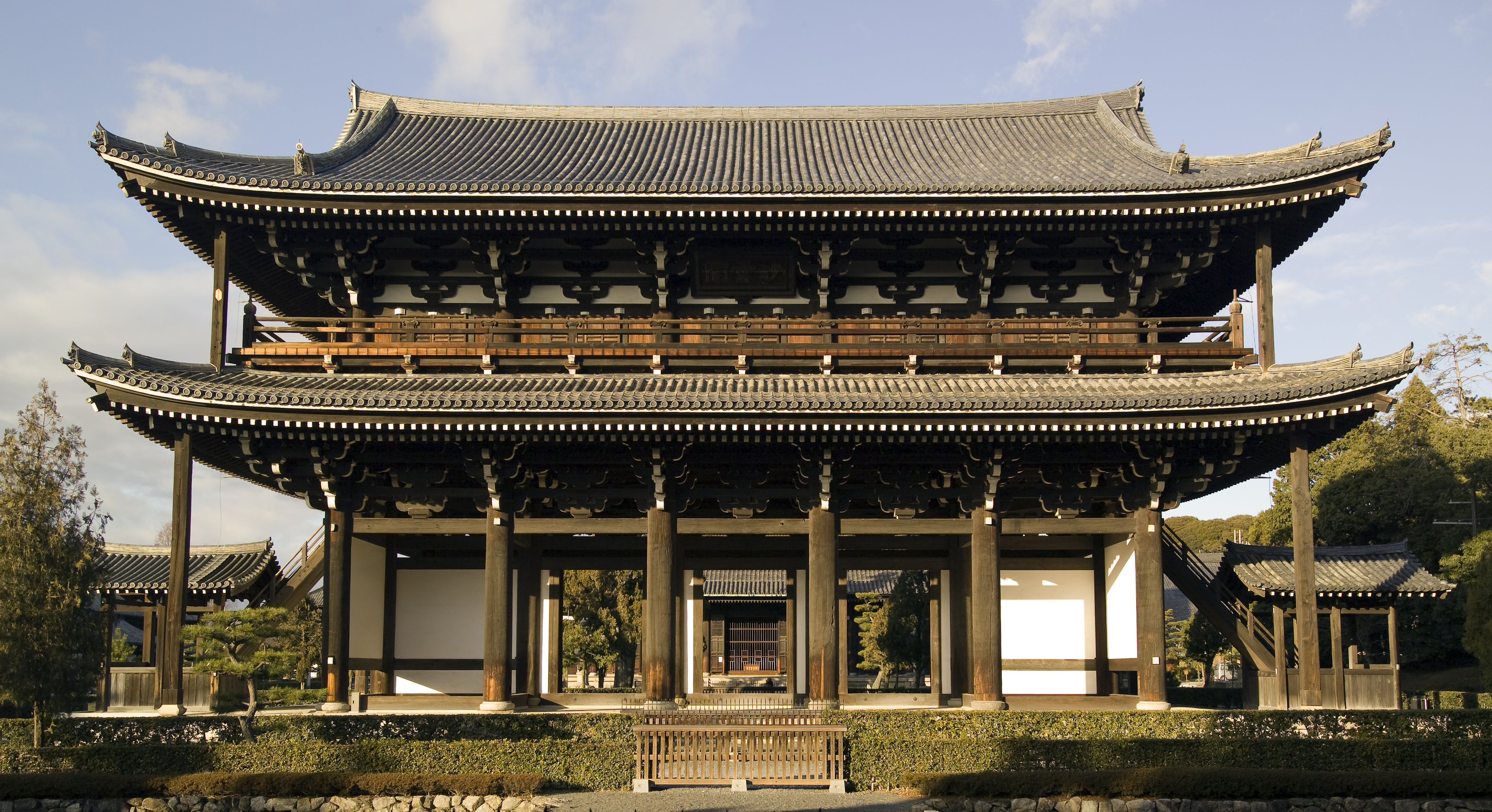
Tofukuji-Sanmon-M9589

Tofuku-ji, one of the five great Zen temples in Kyoto, Japan.

Mahayana Buddhism:  

Mahayana, like Early Buddhism, evolved in India and is believed to have first arisen around the 1st century CE.  The Mahayana traditions accept the entirely of the Early Buddhist teachings, but add to these numerous additional teachings in the form of the Mahayana Sutras.  The name ‘Mahayana’ means ‘Greater Vehicle’ in Sanskrit, and refers to the fact that Mahayana traditions go beyond seeking purely individual liberation and becoming an arahant.  Instead the Mahayanist strives to become a bodhisattva, a fully-enlightened being that remains in the suffering of cyclic existence (samsara) to help others, until all sentient beings are likewise liberated.  This altruistic motivation was seen by adherents as being of higher aspiration and quality than the individual liberation promoted in Early Buddhism, hence the name Mahayana (and the subsequent disparagement of Early Buddhism through the ‘Hinayana’ label).  In modern times most Mahayanists avoid such statements, and view Early Buddhism/Theravada as a valid path to liberation, and acknowledge the Pali Canon as being central to all Buddhist traditions.

Core philosophical concepts:

The Mahayana sutras build upon the foundations laid by the Tipitaka and incorporate some additional concepts that end up substantially evolving the Buddhist view of reality and mental factors.  However, the Mahayana traditions include a wide range of views, so here I will only outline a couple of critical concepts, and leave some of the finer doctrinal distinctions up to the reader to discover.

The Buddha outlined the concept of dependent origination in the Tipitaka, in which all phenomena arise through the interaction of causes and conditions.  The Mahayana texts extend this concept significantly, and explore the metaphysical consequences of this framework.  The resultant concept of shunyata (emptiness) is hugely important in the Mahayana literature, and has lead to the development of two major interpretations:

  • Madhyamika: Meaning ‘the Middle Way’, this school is largely credited to the incredibly influential texts written by Nagarjuna, great Buddhist scholar and sage (150 – 250 CE).  Nagarjuna used dependent origination to systematically refute any theories that proposed an inherent existence to any phenomena, including the Buddha and the Dharma themselves.  What makes this the ‘Middle Way’ philosophy is that the inherent emptiness of all phenomena does not mean they do not exist at all, but instead proposes that they have no inherent independent existence.  This concept is often presented as a dichotomy between relative existence — for instance, my sofa relatively exists because I can see it with my conceptual mind — and absolute existence, where we cannot find any specific property that absolutely defines a sofa, since they exist only as a confluence of causes and conditions, labelled by our conceptual mind.
  • Yogacara: Attributed to the Indian philosophers Asanga and Vasubandhu, Yogacara proposes that all conditioned phenomena have no inherent existence but instead are simply outgrowths of the dependently-originated course of mental phenomena arising and falling.  In other words, external objects only apparently exist, but are in fact generated by mind alone.  For this reason Yogacara is often called the ‘mind-only school’.  This is a significant simplification of course, and numerous alternative interpretations have been proposed.  A ‘mind-only’ approach to existence has some fascinating repercussions when discussing other aspects of Buddhist thought and practice, such as karma and nirvana, so I highly recommend reading more on the topic.

Mahayana also introduces the concept of the tathagatagarbha (lit. ‘essence of the Thus-Gone one’), or the Buddha-Nature.  This idea asserts that all sentient beings share a fundamental nature which allows all of us to become Buddhas.  This stands somewhat in contrast to the Madhyamika philosophy, which focusses so directly on the emptiness of all phenomena, and some have proposed that tathagatagarbha edges perilously close to endowing all sentient beings with an independently-existing ‘self’ of sorts, which of course would go against the word of the Buddha himself.  In practice the tathagatagarbha serves more as a positive and hopeful expression of the capacity for all beings to achieve Buddha-hood, and suggests that we all may glimpse this fundamental purity of all beings when we clear our minds of defilements and obstacles.  Key sutras for further reading include the Tathagatagarbha Sutras, Nirvana Sutra, and Uttaratantra Sutra. 

Prominent Mahayana traditions:

Perhaps the most well-known Mahayana tradition for most Westerners is Zen Buddhism, a Japanese school of Buddhism that originated from Ch’an Buddhism in China, which was heavily influenced by Daoist philosophies.  Zen practice emphasises rigorous meditational practices, namely zazen (seated meditation) and shinkantaza (‘just sitting’, a form of meditation aimed at emptying the mind and not using any meditation object), and challenging one’s perceptions via koan practice (stories or questions designed to test a student’s understanding).  Zen practitioners generally value examination of mind and the nature of existence through direct experience above all;  encyclopaedic knowledge of doctrine and sutras is often de-emphasised in Zen practice.  Zen is said to be one of Japan’s largest cultural exports, and has had significant influence on Western popular culture. 

These days we tend to use ‘Zen’ as a term expressing a sort of ‘going with the flow’, but in reality Zen practice is very disciplined and often heavily ritualised (at least this tends to be the case in Japanese Zen centres, less so in Western ones).  Zen appears in two varieties: Rinzai, a school of Zen that focusses more on zazen, koans, and is known for being quite severe (as in, expect to be hit with a stick if you don’t sit properly); and Soto, which emphasises shinkantaza and is generally more accessible and a bit less formalised.  The experiential and minimalist approach of Zen has made it remarkably popular with Western practitioners, and its undeniable results lead to it being highly respected by other Buddhist traditions as well.

Of particular note is the Plum Village community of globally famous Vietnamese Buddhist monk Thich Nhat Hanh.  Plum Village is a community of engaged Buddhists who reinforce the importance of expressing loving-kindness for others through charitable works.  Thich Nhat Hanh is very good at communicating the Buddha’s words to Westerners; in particular his book on the life of the Buddha Old Path, White Clouds, and his summary of Mahayana principles The Heart of the Buddha’s Teaching are worth reading.  Plum Village is of course inspired by Thich Nhat Hanh’s Vietnamese Zen (Thiền) background, but has adopted its practices very skilfully to make them more compatible with Western lifestyles.  Some argue that Plum Village is perhaps too Western-friendly, and honestly I agree to an extent, but Thich Nhat Hanh’s expressions of Buddhist thought, mindfulness and compassion are superb even if I differ with him on some finer points.  

Alongside Zen and its variants, there are numerous Mahayana schools that developed in China, Korean, Vietnam and elsewhere; far too many to name here.  My experience of the Mahayana is largely defined by my experience of Zen and Zen-adjacent practices, so I will refrain from saying too much about other traditions.  Tibetan Buddhism is often referred to as Mahayana, but generally is classified separately as Vajrayana due to the focus on tantric practices.

Recommended Reading:

Mahayana Buddhism — The Doctrinal Foundations, by Paul Williams:  This excellent book summarises all the key points of Mahayana Buddhist doctrine and practice in detail, with exhaustive notes.  Highly recommended as a broad overview of the core of these traditions.

Mahayana Sutras:  There are hundreds of Mahayana sutras, and many of them are exceedingly long, so I do not recommend necessarily trying to read all of them unless you are seriously motivated.  However there are a few categories of sutras that are very valuable in terms of understanding Mahayana doctrine, and also are full of fascinating imagery and astounding cosmologies filled with Buddhas, bodhisattvas and their Buddha-fields.  For background on the bodhisattva ideals and the six virtues, check out the Prajnaparamita Sutras.  The Lotus Sutra is widely considered one of the most important sutras in East Asian Mahayana, and states that all paths in Buddhism eventually lead to Buddha-hood.  The Yogacara Sutras are critical for understanding the Yogacarin view of reality (unsurprisingly).  The Tathagatagarbha Sutras expound on the Buddha-Nature inherent to all sentient beings.  The lengthy Vimalakirti Sutra expresses numerous critical concepts in the Mahayana, including emptiness and the non-dual nature of phenomena, and explores them via debates between various powerful beings and the lay practitioner Vimalakirti.  This is possibly my favourite sutra.  A close second would be the Surangama Sutra, which is well over 400 pages long but covers an enormous amount of ground, from Buddha-Nature to 50 mental states that interfere with meditation and all kinds of other stuff.

Zen Mind, Beginner’s Mindby Shunryu Suzuki:  This was one of the first books I read about Zen proper, and I still believe it’s an excellent first book on Zen thought and practice.  This book to me epitomises the Zen approach — austere, minimalistic, and focussed on developing wisdom through the practice of zazen.

Shobogenzoby Eihei Dogen (1200-1253):  The Shobogenzo is the masterwork of Eihei Dogen, father of the Soto Zen school.  This is a very long (1100+ pages) and deeply challenging work, so perhaps not for Zen beginners, but certainly should be read at some point by anyone with a substantial interest in the tradition.  Numerous commentaries and teachings on the text are available as well.  Dogen’s work is dense, poetic, and challenging, but it also expresses non-dual awareness and the experience of impermanence better than anything else I have read.  Well worth reading and contemplating.  Many Shobogenzo experts prefer the Gudo Nishijima translation, which is available in hardcopy or as 4 free PDF volumes from BDK America.

Vajrayana Buddhism

Vajrayana, also referred to as Mantrayana or Secret Mantra, is the third ‘vehicle’ of Buddhist practices for achieving enlightenment.  The vajra is a powerful, mythical weapon found in the ancient Indian vedas, and is said to be indestructible, so Vajrayana is sometimes translated as ‘the Diamond Vehicle’ or ‘Indestructible Vehicle’.  Vajrayana is most associated with Tibetan Buddhism, though it also appears in other traditions such as Shingon Buddhism in Japan.  The Vajrayana builds on the foundations of the two previous vehicles — Early Buddhism and Mahayana — and incorporates all of their core ideas, but further extends on these concepts, particularly in relation to the tathagatagarbha (Buddha-Nature).

Practitioners of Vajrayana follow the Four Noble Truths and the Noble Eightfold Path (like Theravadins), and they aspire to be a bodhisattva and take vows to achieve enlightenment for the benefit of all sentient beings (like Mahayanists), but they add to this a substantial, intricate body of esoteric ritual designed to achieve Buddha-hood far faster than the Theravada or Mahayana.  Indeed, Vajrayana is said to be able to lead to enlightenment in a single lifetime, whereas becoming a bodhisattva in a Mahayana context may take ‘three incalculable eons’ (Buddhism loves talking about extremely long periods of time).  Vajrayana practitioners achieve this by following the teachings of the tantras, Buddhist texts laden with symbolism and unusual, often transgressive practices.  Tantric practices diverge from more traditional Buddhist practices by embracing mental states and behaviours normally considered negative — anger, desire, intoxication — and harnessing those states to generate realisations.  As stated in the Hevajra Tantra:

“Those things by which evil men are bound, others turn into means and gain thereby release from the bonds of existence.”

Origins of Tantra

The true origins of tantra are shrouded in mystery.  The earliest Buddhist tantras appeared in around the 7th century CE, with most of those early texts focussed on the use of mantras and rituals to generate useful real-world consequences.  In the 8th and 9th centuries, the tantras developed toward higher ends, aiming to harness our innate Buddha-Nature and reach enlightenment at breakneck speed.  The Kalachakra Tantra, an incredibly comprehensive text that includes detailed descriptions of mystical cosmologies and astrological practices along with tantric ritual, appeared around the 10th century.  The Dalai Lama has given numerous initiations into Kalachakra Tantra practices for very large audiences.

According to Tibetan Buddhist scholars, Vajrayana was actually taught in secret by the Buddha himself to his closest disciples, and was kept hidden from the wider world until Padmasambhava, also known as Guru Rinpoche, revealed the tantric teachings in Tibet in the 8th century.  Some Tibetan historians claim that the appearance of Padmasambhava was foretold by the Buddha; others claim Padmasambhava was himself a reincarnation of the Buddha.  Academic historians question the veracity of these claims, of course, and propose that the Buddhist tantras emerged gradually from around the 1st century CE as an evolution of earlier Vedic practices.

Some Buddhist scholars have developed a narrative for how the Buddha may have taught the tantras during his lifetime.  They claim that the concepts and methods outlined in tantra likely derived from earlier practices, which the Buddha would have experimented with during his long search for enlightenment.  Tantra by nature is esoteric and kept secret by practitioners, and while Tibetan tantric practices are widely known today, some tantric practices are still highly secretive and virtually unknown to outsiders (as in Shingon Buddhism).  This suggests that the Buddha’s disciples may indeed have been able to keep tantric teachings secret for centuries after his death.  So if we accept these premises, perhaps it is possible that the Buddha may have developed tantric methods, transmitted them secretly, and left his later disciplines to determine when the time was right to reveal them.  Textual evidence is hard to decipher and nearly impossible to date, so quite possibly we may never be able to prove or disprove this account or the academic historical account.

In any case, there are numerous tantric texts and systems in evidence today, with around 3,000 tantric texts currently in the Tibetan canon.  Tantra remains a hugely active area of study and practice, and with Tibetan Buddhism having now spread across the globe, it is quite possible there are more tantric Buddhist students and practitioners now than at any other time in history.

Tantric practices

Tantric practices and texts are esoteric, meaning that many of them are not accessible to the average student of Buddhism.  Aspirants must be initiated into these practices by qualified teachers, gurus, who hold direct connections to lineages of tantric transmission going back centuries.  Traditionally these practices are kept secret so as to avoid damaging unprepared minds; tantric practices are considered very powerful, and require in-depth knowledge of complex symbolism and difficult philosophical concepts in order to be practiced correctly.  If someone practices tantra without the appropriate instructions and guidance, they may inadvertently create bad karmic results for themselves or others, including their guru.  Tantric texts themselves are typically very dense and cryptic, and often intentionally obscure their meanings with coded statements and metaphor, making them incomprehensible without the guidance of a guru.

Secrecy in tantra is further upheld by the vows taken by initiates called samaya.  Samaya requires that initiates undertake specific practices transmitted by the guru during the initiation in order for the practice to stay effective, and further demands that the initiate maintain strict spiritual and ethical discipline in perpetuity.  Breaking samaya is said to lead to severe karmic consequences for both the initiate and the guru, so gurus tend to be cautious about giving initiations to students they feel may not be able to keep samaya.  Typically samaya is only required for the two highest levels of tantric practice (there are four levels); for the lower two levels the initiate must take the bodhisattva vows.

Some specific lower-level tantric practices are fairly accessible, and may be practiced by even novice Tibetan Buddhists.  Typically these practices are mantra recitations, visualisation practices, or varieties of deity yoga.  In deity yoga, practitioners visualise themselves as specific enlightened beings in an effort to cultivate characteristics of enlightened beings in themselves.  Initiated tantric Buddhists may conclude these practices by visualising themselves taking the form of the deity directly (‘self generation’), whereas the uninitiated will be restricted to visualising the deity in front of them or on the crown of their head (‘front generation’).

A common question about deity yoga is whether Tibetan Buddhist deities are ‘real’ deities — do they really exist out there, ready to help us refine our minds and achieve liberation?  When we call them to being in our visualisations, are they really appearing in some way, or are we just fooling ourselves?  Most who ask that question end up being dissatisfied by the answer, given that producing an answer requires us to determine what is ‘real’ in Buddhism in general, and for Buddhists all things, including ourselves and the deities, are empty of inherent existence.  Asking if the deities are ‘real’ implies a materialist, dualist framework in which things are either fundamentally existent or non-existent, but Tibetan Buddhist thought doesn’t really support that view.  So perhaps we might just say that the deities are as real, or unreal, as the yogic practitioner — both are empty of inherent existence.  Of course there is a lot more to say on this topic — this is always the case with any topic in Buddhism.

Tantric practices also focus on the visualisation and manipulation of the ‘subtle body’, a complex psycho-spiritual ‘map’ of the body which includes numerous channels that direct energies throughout the body, and points of focus for these energies known as chakras.  The form of the subtle body varies widely between different tantras and practices, and sometimes has the seven chakras we may know from yoga and sometimes not, but in any case it’s not seen as a concrete map of our spiritual form, but instead a collection of useful symbols for aspects of phenomenal experience/consciousness that the tantric practitioner wishes to apprehend and manipulate.

Tantra in Tibetan Buddhism

Tibetan Buddhism is the most known and most developed tradition of Vajrayana Buddhism, with each major Tibetan school incorporating numerous tantric texts and practices.  The intense imagery associated with the Tibetan traditions is derived from tantra, including the trappings used in rituals at all levels of practice, and devotional art like thangkas (detailed images of tantric deities used as an aid to visualisation) and mandalas (maps of the celestial dominions of tantric beings).

For the newcomer to Tibetan Buddhism, first encounters with the intensive ritual practices can be quite intimidating.  We are accustomed to the Dalai Lama and his extremely calm and light-hearted demeanour and his simple robes, so we can quite easily find ourselves taken aback when confronted with imagery like this:

dandapani-mahakala

“Hey what’s up? Don’t mind me, I’m just chillin’, wearing a crown of skulls and a belt of human heads, standing on a fresh corpse, surrounded by an aura of flames. You know, the usual.”

Couple these scary deities with rituals involving intensive chanting, lots of smoke and drums and bells, people waving daggers around, and drinking wine from skulls (yes, really), and it can all come across pretty weird and cult-ish.  But the imagery and ritual objects are not just intended for shock value — they are dense with layers of symbolism, and are all defined in reference to core concepts of Buddhist philosophy.  So in the image above, the deity’s crown of five skulls represents mastery of the Five Buddha Families; his flaming aura represents the light of the Dharma (the Buddha’s teachings); the corpse under his feet represents his conquering of attachment; and so on.  By visualising oneself as this being, with precise and detailed knowledge of all the qualities it represents, tantric practitioners believe we can cultivate these enlightened qualities within ourselves.  Similarly, mantra repetition cultivates states of mind that are receptive to the Dharma; prostrating ourselves repeatedly in front of symbolic deities generates humility, and so on.

All told, Tibetan Buddhism is quite a bit more Extreme Death Metal Buddhism than most outsiders commonly expect — ‘I just wanted a chill meditation session, what’s with all the skulls?!’  But this transgressive imagery and practice is the core of the tantras, where enlightenment can be reached not only by cultivating knowledge of suffering and non-self and the nature of emptiness, but also by harnessing our afflictive emotions and redirecting them in a positive way.  The tantras have in turn influenced the everyday practices of Tibetan Buddhism, even those that do not require initiation.  Thus, in the Tibetan traditions, we see the influence of tantric themes: meditation on death using very direct and visceral imagery is very common; many Tibetan meditation practices are highly ritualised and involves mantra recitations, dedications of merit, and prostrations; and rich visualisations are used much more than in other traditions in practices like guru yoga and tonglen.  Whether one is explicitly practicing tantra or not, Buddhist practice in the Tibetan traditions is often rich with vibrant colours, powerful imagery, intricate ritual objects and complex procedures.

This intense take on the path to enlightenment has appeared in Tibetan Buddhism since its early days.  Tibetan legends have long portrayed Buddhist practice as powerful but at times risky, compassionate but sometimes fierce.  Padmasambhava’s biography makes for incredible reading; according to Buddhist historians he was essentially an ancient Dharma sorcerer, flying all over Tibet like a yogic Superman, subjugating the local spirits and demons and swearing them into service of the Dharma.  Milarepa, another Tibetan Buddhist saint, began his life by using black magic (!) to murder his aunt and uncle for stealing his family’s fortune, along with numerous other people, only to later achieve enlightenment through Vajrayana practice.  In the Tibetan view, enlightenment is something fought for with intensive, powerful methods, and these practices are so powerful that even murders and black magicians can still use them to achieve enlightenment (assuming they also stop murdering/evil-wizarding, of course).  In taking on these commitments we also take greater risks, but the payoff is significant if one can truly reach enlightenment in a single lifetime.

The Effectiveness of Tantra

As we have seen, Vajrayana practitioners believe that these powerful tantric rituals enable them to potentially reach enlightenment in a single lifetime, as opposed to the three incalculable eons of following the bodhisattva path in standard Mahayana practice.  There are a number of arguments out there for why tantric practice is considered so effective, of which two in particular seem to recur in numerous sources.

First, tantric practices are transgressive — they use visceral imagery with images of corpses, skulls and severed heads; tantric deities are frequently depicted in sexual union with other deities, and visualisations of ritual sex are part of some high-level tantric practices; and other behaviours that go against the usual Buddhist moral precepts, like ingesting alcohol and meat, are also seen in some rituals.  This is not only because the tantras advocate the harnessing of afflictive emotions and behaviours for positive ends, but also because the very act of transgressing moral codes in this way promotes non-dual awareness.  We are conditioned to think of existence in terms of dualities: this thing exists or doesn’t exist; this behaviour is good or bad.  In tantra, flagrantly violating those categorisations forces the practitioner to abandon dualistic thinking, and in this way move closer to the pristine, clear light of the Buddha-Nature, which knows no such divisions between phenomena, as they are all empty of inherent, absolute existence.

Second, tantra is said to ‘take the result as the path’, as opposed to sutra Mahayana, which focuses on causes.  In sutra Mahayana, practitioners focus on developing the causes of awakening — the Thirty-Seven Factors of Awakening, the Six Perfections, and following the Bodhisattva Path.  In tantra, practitioners assume they have already achieved the goal of the path — they contain a Buddha-Nature, as do all sentient beings.  Visualising oneself as an enlightened deity and developing ‘divine pride’, in which the yogi sees themselves as inseparable from the deity and hence fully awakened, aims to remove the obscurations that hide their inherent Buddha-Nature from view.  Thus, the tantric practitioner makes Buddha-hood part of their practice directly, and in that way they ‘take the result [of Buddha-hood] as the path [to enlightenment]’, rather than patiently developing karmic seeds to allow that nature to ripen over many lifetimes.

Of course there is much more to say about all of these aspects, but I leave that to the experts who are capable of studying these arcane texts and unraveling the tangled history of tantric practice.  Weirdly, Buddhism studies at the turn of the 20th century largely ignored tantra, as biases in the Western scholarly community considered it in a way ‘impure’ compared to the crystal-clear, logically-consistent framework for enlightenment developed in the Pali Canon.  As a result, the academic study of tantric Buddhism is actually quite new, only really becoming a serious area of enquiry after the Dalai Lama’s escape into exile in 1959 and the subsequent spread of Tibetan Buddhism across the world.  If you want to learn more about the fascinating history of tantra, and about the evolution of these practices over the centuries, Buddhist Thought by Paul Williams has a concise summary of Vajrayana history and practice in the closing chapters, and The Origins of Yoga and Tantra by Geoffrey Samuel goes into intense detail on the development of tantra from its earliest appearances to the 13th century.  

Recommended reading:

Tibetan Buddhism is packed to the brim with complex imagery and symbolism, and has a seemingly endless supply of mind-boggling esoteric literature to study, so it’s a real joy to dive into if you like such things.  

Indestructible Truth and Secret of the Vajra World, by Reginald Ray: This two-volume set of detailed, yet approachable summaries of Tibetan Buddhist history, doctrine and practice are essential for the newcomer to the subject.  Reginald Ray has been a practicing Tibetan Buddhist for a very long time, worked with many of the most famous lamas and teachers, and is an excellent source in general.  Check out his podcast and other stuff too.

The Lotus-Born: The Life Story of Padmasambhavaby Yeshe Tsogyal: this spiritual biography describes the incredible life of Padmasambhava, AKA Guru Rinpoche, who brought tantric Buddhism to Tibet.  His life story as depicted here is filled with fantastic deeds and the demolition and subjugation of ornery spirits and demons.  Guru Rinpoche’s influence on Tibetan Buddhism today remains prodigious, so understanding his life and teachings can be very insightful for the student of Vajrayana.

The Library of Wisdom and Compassionby His Holiness the Dalai Lama and Thubten Chodron:  This remarkable series is intended to provide a comprehensive introduction to the whole of the Buddhist path, from the basics in volume 1 through to deep and complex investigations of core Buddhist philosophical issues in the following seven volumes.  Books 1 through 5 are available now, and book 6 is coming next summer.  The detailed academic investigation of Buddhism is broken up by chapters from both the Dalai Lama and Thubten Chodron sharing quite personal reflections on their own experiences in Buddhism, which gives the books a personal touch and a strong connection to real-world practice.  Highly recommended.

Library of Tibetan Buddhist Classics:  This series of books collects new, comprehensive translations and commentaries on crucial Tibetan texts ranging across a variety of traditions.  The texts include foundational commentaries for all the major schools of Tibetan Buddhism, and tantric texts previously unavailable in English.  Just be aware that some volumes will contain material and rituals that should not be practiced without the guidance of an experienced teacher; indeed, some will insist that one should not read them at all without receiving the appropriate tantric empowerments from a guru.

Three Turnings of the Dharma Wheel

Hopefully now you can see that the three main ‘vehicles’ of Buddhism are connected, with each subsequent vehicle building directly on the previous one.  Throughout the many Buddhist traditions, at a minimum they share the original teachings of the Buddha, as laid out in the Pali Canon — the Four Noble Truths, the Noble Eightfold Path, and the Three Marks of Existence, among other things.  The Mahayana extended this foundation, developing the Path of the Bodhisattva, sunyata (emptiness), and tathagatagarba (Buddha-Nature).  Vajrayana extended this further, with deeper examinations of the concept of emptiness, and working directly with the fundamental nature of mind and the innate Buddha-Nature of all beings.   

This three-part hierarchy of the Buddhist path to enlightenment is further reinforced by the common expression of these three vehicles as being Three Turnings of the Dharma Wheel.  Each turning corresponds to one cycle of teachings by the Buddha, each revealing extensions to the core teachings of the previous turning.  The Dalai Lama in Approaching the Buddhist Path defines the critical concepts the Buddha taught in each Turning of the Dharma Wheel as follows:

  1. The First Turning (Early Buddhism): defining the nature of suffering (the Four Noble Truths), the path to eliminating suffering (the Noble Eightfold Path), the Three Marks of Existence (dukkha, anicca, anatta), and the Thirty-Seven Aids to Awakening.
  2. The Second Turning (Mahayana): the Prajnaparamita Sutras (Perfection of Wisdom Sutras), revealing that all phenomena are empty of inherent existence; defining the Six Perfections (generosity, ethical conduct, fortitude, joyous effort, meditative stability, wisdom) and the Bodhisattva Path.
  3. The Third Turning (Vajrayana): further interpretation of emptiness in all categories of phenomena; the pure, ‘clear light’ nature of mind, and the Buddha-Nature.

We can see from the clear connections between the three vehicles/turnings that while the Buddhist traditions differ hugely in their practices and approaches to enlightenment, there are core teachings common to all of them that all Buddhists accept, and these lie in the original teaching delivered by the Buddha.  For practicing Buddhists of any tradition these elements are essential to all paths to enlightenment.

amitabha-statue

A statue of Buddha Amitabha.

Pure Land Buddhism

Pure Land Buddhism is somewhat hard to categorise in the typical three-vehicle structure, and is practiced in a very different way than the other traditions I have outlined above.  Many Mahayana and Vajrayana traditions have practices related to the Pure Lands — these are celestial realms linked to Buddhas and Bodhisattvas.  These practices can allow one to aspire to rebirth in a Pure Land, rather than the human world, which makes practice of the Dharma in that future life much easier, thereby accelerating the path to enlightenment.

However, Pure Land Buddhism takes this idea as the sole focus of practice.  In Jodo Shinshu, one of the most popular Buddhist traditions in Japan, adherents believe that the human world is simply too corrupt for any of us to have any hope of practicing enough Dharma to achieve enlightenment.  Therefore, our only salvation is to be reborn in a Pure Land where there is no such corruption, and at that point we can focus entirely on practicing the Dharma and achieving Buddha-hood.  As a consequence, Jodo Shinshu adherents do ‘the practice of no practice’, where they do not practice anything other than the repeated recitation of the mantra of Buddha Amitabha — namu Amida Butsu or ‘I take refuge in the Buddha Ambitabha’.  They believe that Buddha Amitabha made a Primal Vow to allow any beings that recite his mantra with true intentions to be reborn in his Pure Land, and thereafter practice Dharma in a pristine environment.

Essentially, this tradition is a kind of ‘faith alone’ form of Buddhism, in which meditation, the Noble Eightfold Path, and so on are left aside, and one simply relies on the grace of Buddha Amitabha to save them from this corrupt world in the next life.  This idea became very popular with people who did not want, or were not able, to practice intensive Buddhist activities like meditation, or those who had committed serious crimes and could see no way to redeem their karma in this life.

Jodo Shinshu and similar Pure Land sects can be considered Mahayana traditions, as they do believe that the Dharma is effective (just not here), and they certainly believe in the Buddhas, Bodhisattvas, and Pure Lands found in the Mahayana Sutras.  But then, they do not actually practice anything else in those sutras, or in the Pali Canon for that matter.  Also, the Buddha was very explicit that blind faith was to be discouraged, and one should test all Dharma teachings (and teachers) for themselves and determine whether they were effective; this is of course impossible with Pure Land traditions like Jodo Shinshu, since the effectiveness of these beliefs cannot be determined until after death, whereas practices like meditation have benefits in this life that can be experienced and tested.  With all that in mind, to me Pure Land Buddhism of this type is a very different animal from anything present in the three vehicles, and is more akin to Christianity than any of the other forms of Buddhism.

I have to admit to a personal bias here, of course.  What attracts me to the teachings of the Buddha is that the practices they outline are accessible to everyone and described in a coherent and clear way, and they are testable and are subject to our own discernment and critical analysis.  While the truth that ‘everything is suffering’ sounds bleak, the Buddhist is ultimately empowered to change this state of affairs, and can do so without relying on any external teacher or authority if they so wish.  Not only that, but human existence is seen as very fortunate, even though many of us suffer immensely, because we have opportunities to improve ourselves and to end that suffering for ourselves and others.  In Jodo Shinshu the outlook is far bleaker, as even the Dharma cannot save us, since the world is simply too corrupt for us to be able to practice it successfully.  We have no power at all to change this — in fact, the tradition explicitly lays out a distinction between ‘self power’ and ‘other power’, and only other power can save us from suffering, in the form of Amida Butsu’s vow.  So in essence, Pure Land traditions eliminate the most meaningful element of Buddhism to me, which is the practice of the Noble Eightfold Path, and that means I tend not to engage with them. 

I hasten to add though that many Pure Land practitioners are heavily engaged in the study of Buddhist philosophy, and supplement their faith in Amida’s Vow with additional study of Buddhist principles in preparation for that future life in the Pure Land.  I also fully understand the difficulties Buddhist practices present for many people; not all of us are capable of meditation, or have the time and resources available to study the Dharma.  Across all Buddhist traditions there is broad agreement that practicing and studying the Buddha’s teachings to even the tiniest extent is better than not doing it at all, and one should simply try to do what they can in this life according to their own limitations.  So in that sense, even the ‘practice of no practice’ is still striving to create the conditions for future study of the Dharma, and is providing a connection to the Buddha’s teachings that is accessible to everyone, regardless of their circumstances.

The whole concept of Pure Lands in general is valuable to Theravada/Mahayana/Tibetan Buddhist practice, too.  In Tibetan Buddhism, Pure Land elements exist as part of the typical framework of Buddhist practices — meditation and visualisation.  Visualising the Pure Lands reinforces the power of the Buddha’s teachings, by portraying planes of existence where Buddhas and Bodhisattvas have transformed reality into blissful reflections of pristine Buddha-Nature.  Some Pure Land practices also function as ‘karmic parachutes’, where one can perform them at the time of death to shunt your mindstream off to a Pure Land if enlightenment has not been reached.  If there’s one thing Tibetan Buddhism loves, it’s optimising their practice to achieve powerful results, so Pure Land practices fit right into that.  

dalai-lama-gifu-soto

His Holiness the Dalai Lama joins two Soto Zen monks in paying respects to the Buddha, before addressing a meeting of 1,600 Soto Zen priests in Gifu, Japan in 2015.

A Note About Sectarianism

A natural question that may arise after reading all this is: what happens if someone follows the Buddha’s advice, studies the teachings and investigates everything for themselves, and discovers that none of the traditions out there completely match what works for them?  Alternatively, what if they want to participate in multiple traditions at once?

I’ll defer here to Drubwang Tsoknyi Rinpoche, a Tibetan Buddhist lama of the Driking Kagyu tradition:

Seen from my point of view, the Buddha taught what we call Three Vehicles. Each of them contains a complete path for sentient beings to eliminate their negative emotions—desire, hatred, ignorance, pride, and envy—with all their 84,000 proliferations and variations. It is therefore entirely possible when someone practices free of laziness and procrastination any of these three paths to attain the same level as Buddha Shakyamuni.

Moreover, it is possible for any person to practice all three vehicles in combination without any conflict whatsoever. This is often the case in the Tibetan tradition of Buddhism, where many practitioners have practiced the three vehicles either separately or unified into a single system.

In the present time, when we see a growing interest in Buddhist practice all over the world, I find it important that people come to understand the primary emphasis and special qualities of each of these three vehicles. Free of bias, and with clarity, each person is then free to adopt what is closest to their inclinations — whether one of the vehicles alone or the three in combination.

In other words, Buddhists believe that all three vehicles can lead to liberation, and thus each is a worthy path to take.  As a consequence, Buddhists are welcome to partake of elements of some or all of the vehicles simultaneously.  There is no issue with going to a Zen temple for zazen one day and a Tibetan Buddhist puja on the next.  Buddhists often say that the Buddha taught 84,000 versions of the Dharma, each one adapted to the needs of a different audience.  He adapted his teachings to ensure that the truths of existence he offered could be put into practice, and made accessible to as many people as possible; he speaks in the suttas as well of the importance of testing all teachings we receive with our own experience and critical faculties, and not engaging in fanaticism.  With all that in mind, we might imagine that the Buddha himself would have had little patience for sectarianism.

Of course, if you venture into Buddhist forums around the internet and social media, you will certainly see infighting between traditions, and seemingly interminable debates on finer points of doctrine.  But when you venture into real-world Buddhist centres of all stripes, you are likely to find Buddhists being quite accepting of varied points of view.  When I attended three days of teachings by the Dalai Lama in Glasgow in 2004, I saw monks in the yellow robes of the Thai tradition, in the red and orange of Tibetan traditions, and the austere black and grey of Zen.  The Dalai Lama has been a strong supporter of unity across Buddhist traditions, and speaks often of the need to pay equal respect to the teachings of all three vehicles.  

The quote above comes from the foreword to a book by Ajahn Amaro called Small Boat, Great Mountain, a series of talks comparing the Tibetan teachings of Dzogchen, the Great Perfection, with similar concepts in Theravada Buddhism.  This book is a nice example of a fascinating dialogue between Buddhist traditions.

Next Steps

So, now that I have outlined some of the core elements of the three main Buddhist pathways to enlightenment, in the next article I will examine some of the more common misconceptions about Buddhist practice one tends to find in the media and popular culture.  Over time I will add more to this article, although it is already so long that I will try to avoid extending it to ridiculous levels.  At present I am planning to add some details on the Bodhisattva Path to the Mahayana section at some point, and after that I will see where it goes.  


Tagged , , , , ,