Category Archives: Games

Connection Games VII: Onyx

Today I’m going to talk about a game with a highly unique visual presentation and capture mechanism: Onyx.  I’m really fascinated by this game, which is helpful, because making all the boards and diagrams for this post took a lot of time!

Onyx was published by Larry Back in the year 2000 in Abstract Games Magazine Issue 4.  The board geometry immediately stands out — the game takes place on the intersections of an Archimedean tiling of squares and triangles (well, technically all triangles but the squares are important in this game):
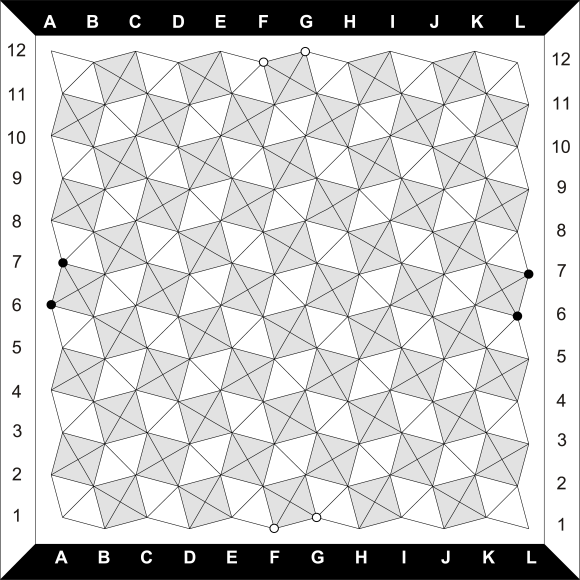
onyx-12x12-plain-dots

Besides being immediately visually interesting, this board tiling creates interesting variations in connectivity for different points on the board.  The intersections at the centres of the squares are relatively weaker points, as they only connect to four adjacent points — but as we shall see, playing at these weaker points is sometimes essential.

How to play Onyx

Onyx is part of the relatively small portion of the connection games family that includes a capture mechanic, whereby enemy pieces can be removed from the board.  The capture rules are unique and need some explanation via diagrams, so first I’ll cover the basic rules and then explain capture in detail.

The basics:

  1. Two players, Black and White, compete to form connections across the surface of the Onyx board.  Black must form an unbroken chain of pieces connecting the top and bottom edges of the board; White must form an unbroken line of pieces connecting the left and right edges of the board.  Intersections at the corners of the board are considered part of both sides to which they are connected.  Draws are not possible in Onyx
  2. Before the game starts, the players can choose whether to play the standard variation, where four White pieces and four Black pieces are placed on the marked points of the appropriate colour at the start of the game.  In the open variation, the game board starts empty.  (Note: both variations are very playable; the standard variation has the advantage of increasing the importance of the sides and corners of the board during the game).
  3. Black moves first, placing a single stone on any empty intersection of the board.  The swap rule is in effect for the first move of the game, so the second player may either swap and take Black, after which the first player is now White and plays a White stone in response, or the second player may stay as White and play a White stone.
  4. Each turn, a player may place one stone of their chosen colour on any empty intersection of the board.  However, a piece may not be placed on the intersection in the centre of a square if any pieces are already placed on the corners of that square.
  5. Once placed, stones may not be moved.  Pieces can be removed from the board via capture (explained below).  Captured pieces are removed and returned to the player of that colour.  Points on the board vacated by captured pieces are free to be played on subsequently by either player.

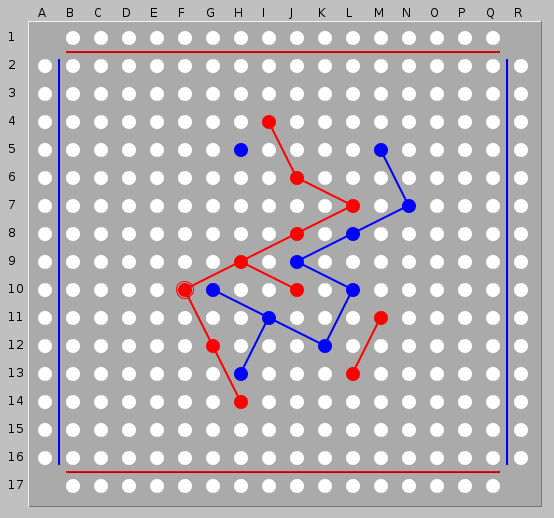
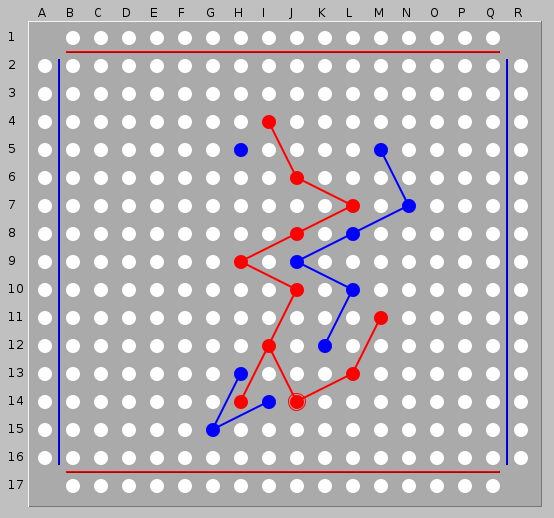
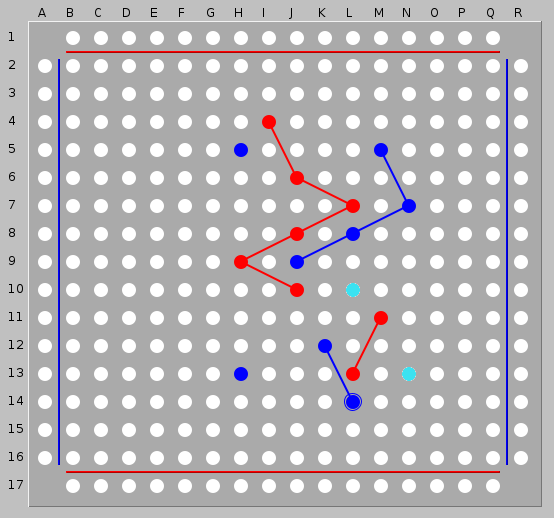
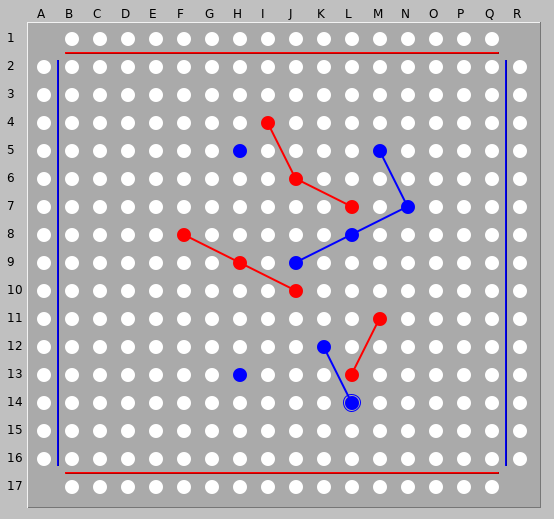
Here’s a completed game of Onyx won by Black.  The pieces highlighted in red show the winning vertical connection:

onyx-12x12-sample-game-1 -completed

Capturing Rules

Capturing in Onyx is about forming a particular pattern.  Basically, if on your turn you are able to complete a pattern in which a square area on the board has two of your pieces at diagonally adjacent corners, and two of your opponent’s pieces on the other diagonally adjacent corners, and the centre point of the square is unoccupied, then your opponent’s pieces on that square are captured:

onyx-capture-diagram-01

Here White places a piece on the corner of the square, which completes the capturing pattern. The two Black pieces are captured and removed from the board.

Double-capture is also possible, if a single move leads to the completion of this capturing pattern on two squares at once:
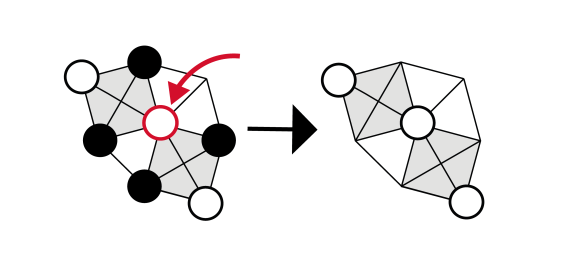
onyx-double-capture-diagram-01

In a double-capture White places a piece at the intersection of two squares, and manages to complete the capturing pattern on both squares simultaneously.  All four Black pieces are then removed from the board!

The capturing mechanic in Onyx leads to some interesting consequences.  Recall that you may only place a piece at the centre point of a square when no pieces have yet been placed on the corners.  This means that capture can be prevented, but requires you to place a piece on a weaker point.  The possibility of capture also prevents a player from easily blocking the other on the diagonals, and prevents deadlocks in general from grinding the game to a halt.

You might notice that after a capture, the captured player can immediately threaten a re-capture by placing a piece on one of the newly-emptied corner points.  As a result you’ll often see a sequence like this:

onyx-capture-diagram-sequence-01

White starts the sequence by capturing.  Black responds by making a re-capture threat on one of the vacant points.  Finally, White ends the threat by placing a stone on the remaining empty point — now no more captures can happen on this square.

Making connections in Onyx

Given the unique board geometry and the capturing mechanism in this game, there are some novel types of connections that you don’t see in other connection games.  I will summarise some key connection types and show some examples of sequences of play that can result.

Onyx has a basic connection between pieces that is the equivalent of the bridge in Hex — the diamond, a simple but strong connection where any attempt by the opponent to break it can be answered easily:

onyx-diamond-01

Here White establishes a diamond connection.  Black’s attempt to break it is easily answered on the other empty point of the diamond.

Less secure than the diamond is the square — an attempt to break this connection can result in a secure connection as seen below, but a clever opponent might find a way to divert your attention elsewhere and capture your two pieces instead.
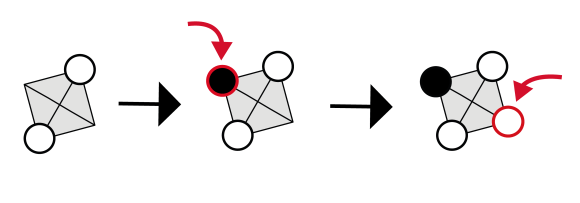
onyx-square-01

White establishes a square connection.  Black attempts to cut across the diagonal, but White answers by filling the last remaining corner.

Next up is the housewhich is very secure.  There is no threat of a capture here, so only a deadly double-threat forcing a response elsewhere on the board can allow this connection to be broken.

onyx-house-01

White builds a house.  Black’s anaemic attempt to break it is easily countered by playing on the remaining empty point.

Unusually, Onyx has a connection that benefits from the presence of an opposing stone.  Larry Back calls this a duplexbecause it resembles a house containing two different families.  In isolation this connection can be secure, but the presence of the opposing piece makes it a bit easier for the opponent to generate threats that require a response outside the duplex formation.  If the threat of a cut is stopped by a capture, the opponent can also threaten recapture, which gives another opportunity to generate threats elsewhere.
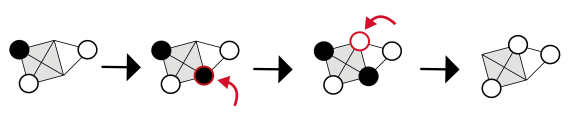
onyx-duplex-01

White builds a duplex.  Black attempts to cut, but that simply leads to a capture by White and a complete connection (for the moment).

Most importantly we have the long diamond connection.  This connection initially looks precarious — there’s a long distance between the connected pieces.  However, the long diamond is actually quite strong:

onyx-long-diamond-safe-01

White forms a long diamond connection.  Black attempts to block a connection, but that leads to a capture by White.

However, here we see an instance where playing on the weak point at the centre of the square pays off.  Black can break the long diamond connection, but at the cost of three moves, one of which is on the weak centre point:

onyx-long-diamond-broken-01

Black successfully breaks the long diamond connection with a play to the centre of the square.  White has no way through.

The long diamond can also be used defensively.  If a player plays their stone at the end of what could be their opponent’s long diamond connection, this is called an opposition long diamond.  Here’s an example of how the opposition long diamond can be effective, assuming White attempts to bludgeon their way through directly rather than playing around the obstruction:

onyx-opposition-long-diamond-01

Black plays an opposition long diamond formation.  White attempts to push through, but Black can simply capture.

This is a very simplistic continuation — for more sophisticated discussion of the opposition long diamond, please see Larry Back’s article in Abstract Games Issue 11.

The long diamond connection is a very important part of Onyx.  Understanding this connection allows you both to play these connections effectively and to block them.  Given that the long diamond allows connections to grow more quickly across the board, it’s very important to know how to deal with them.


Tips for playing Onyx

Bearing in mind I’m very much a beginner in this game, from my reading and my early experiences getting absolutely ruined by Larry Back on the Gorrion Server I can offer a few tips that might help you get started.

  1. Know your connections!  Get familiar with the basic types of connections outlined above.  Play around with different attempts to make or break connections in these formations.  The more comfortable you are with these basic connections, the more quickly you’ll be able to recognise effective moves in a given board position.
  2. Don’t ignore the sides and the corners.  Particularly in the standard variation, where pieces are placed in the centres of the board edges at the start of the game, pay attention to the sides and corners of the board.  Playing in the centre is valuable too, but if you don’t take care of the sides and corners, your opponent can get a lethal head-start on a strong connection along the side of the board.  In the early game, balance your plays in the centre with plays in the corners (but not too deep in the corners).
  3. Don’t forget — your own stones can be a liability! Unlike in games like Hex or Y, where having extra stones around is never bad for you, in Onyx carelessly-placed stones can help your opponent.  As we saw above, the strong duplex connection can be formed using an opponent’s stone!  A badly-placed stone might also hurt your later attempts to connect stones by opening you up to a capture.  Try to avoid placements that open up tactical advantages for your opponent!  Conversely, if you can force your opponent to play a move that weakens their position — say, by giving you an opportunity to build a duplex — then go for it.
  4. Watch the diagonals!  Like in other connection games, in Onyx you can end up in ladder formations, where both players are matching each other move-for-move as they make their way across the board.  In Onyx these ladders have been dubbed snakes by designer Larry Back, and look like this:
onyx-ladder-01

A typical snake formation.  Both players are writhing their way across the board, playing solely along opposing edges of the squares to avoid the possibility of a capture.

Because of the possibility of a snake forming, and the dire consequences if your opponent gains an advantage in these situations, it’s important to pay attention to the development of play along crucial diagonals on the board.  Don’t just let your opponent set up shop along the diagonals!

Again these are very basic tips, but if you keep these ideas in mind while playing you can at least find some semi-sensible moves to play and get a feel for how the game works.  After working with these basic ideas for awhile, do check out Larry Back’s articles in Abstract Games — particularly the tactical tips in Issue 6 and the deeply-annotated sample 12×12 game in Issue 11.  Those articles go into much more detail on the concepts I’ve mentioned here.

From there, Larry’s article in Abstract Games 17 about edge templates will be valuable for the advanced player.  Edge play is complex in this game, and knowledge of these template positions will give you critical insight in these moments, where sometimes only one move will allow you to connect or to block your opponent.


Sample 16×16 game

Since Larry Back already annotated a 12×12 Onyx game in Abstract Games magazine issue 11 at a much deeper level than I could, I thought I’d do a quick walkthrough here of a 16×16 game.  Right from the start let me say that this is just my reading of the game — I’m sure I’m missing things here.  But, as with learning Go, reviewing games and trying to understand why moves were played is a great way to improve, so hopefully any future game reviews I do will get better over time!

Like other connection games, Onyx is highly scalable, and larger boards can be used to provide a greater strategic challenge.  The 16×16 game seems to have a nice balance between depth and game length — games are complex and interesting, but don’t wear out their welcome.  You can play 16×16 and 20×20 Onyx online at the Gorrion Game Server, or you can print out my PDF boards (16×16 and 20×20) and play face-to-face.

The game below was played on the Gorrion Server between the server’s founder, dashstofsk (playing Black) and larry_back (the game’s inventor, playing White).  Let’s pick things up 8 moves in:


onyx-16x16-sample game 1-move8

Position after 1. C6 (swap) 2. E12 3. K11 4. L5 5. H8 6. F4 7. H4 8. H9

This game is using the standard variation, in which Black and White start with four pieces each on the sides of the board.  Initially Larry opened with C6 in the lower-left corner, but dashstofsk elected to swap, so from this point on Larry played White.

In the opening phase here you can see both players staking out territory.  Black has laid claim to the lower-left and upper-right corners, while White is camping out in the upper-left and lower-right.  Note that all four of White’s pieces are sitting precisely on the board’s main diagonals!
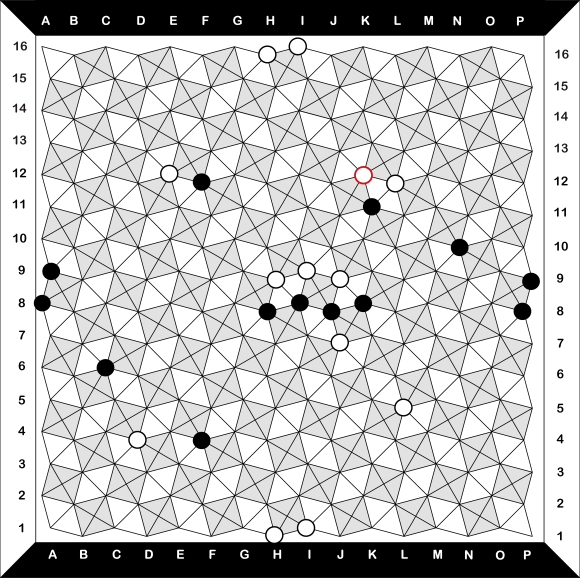
onyx-16x16-sample game 1-move18

Position after 9. K8 10. J7 11. I8 12. I9 13. N10 14. J9 15. J8 16. L12 17. F12 18. K12


Ten moves later, both sides have built up a bit of a wall in the centre of the board — some structure is starting to develop now after the opening.  Black has cut off any of White’s ambitions to connect J7 and J9, and at the end of this sequence White has blocked Black from venturing north from K11.  Still plenty to play for at this stage.


onyx-16x16-sample game 1-move26

Position after 19. G12 20. G10 21. M12 22. L11 23. N11 24. M8 25. K9 26. LM910

After 26 moves, both sides are starting to probe their opponent’s defences.  Black’s initial extension at G12 is promptly stifled by White forming a diamond at G10.  White follows up by venturing south from L11, further complicating Black’s hopes of heading north.  At the end of this sequence both sides have overlapping long diamonds over the square spanning the L and M files and the 9th and 10th ranks; White spends a move playing on the centre of that square, aiming to block Black from connecting their long diamond and securing a connection vertically for themselves.  From here Black needs to consider starting a new adventure elsewhere on the board.

A note about move notation — the central intersections in the squares on the board are actually located between the rank and file designations around the edges of the board.  However, we can identify a central point by the ranks and files covered by the square in question — so in this case, we can notate White’s move 26 as LM910.  For future reference, moves that lead to a capture are followed by an asterisk, and a double capture by two asterisks.

onyx-16x16-sample game 1-move38

Position after 27. I11 28. J12 29. J11 30. I12 31. H11 32. E15 33. FG1516 34. F15 35. G15 36. G14 37. I14  38.  G13

Following the last exchange, Black gamely heads west, eventually building a diamond connection to G12 with 31. H11.  Seeing no more profit to be made here, White suddenly jumps north, forming a long diamond with 32. E15 — but Black quickly responds by playing at the centre, blocking off the long diamond.  White, undeterred, veers south and links G13 to I12 with a duplex connection.  White now has a dangerous-looking chain stretching all the way from E15 to M8.

onyx-16x16-sample game 1-move46

Position after 39. O5 40. O4 41. N5 42. N4 43. L7 44. M4 45. M6 46. OP67

Seeing the danger, Black attempts to regain the initiative with 39. O5, starting a new front against the right edge of the board.  White quickly jumps in to block any attempts to connect further south, and after a few more exchanges White has a strong wall keeping Black hemmed in.  This culminates in White spending a move disrupting Black’s long diamond between O5 and P8.

So far Black’s attempts to make progress along this edge are not bearing much fruit.

onyx-16x16-sample game 1-move54

Position after 47. N7 48. F5 49. G4 50. E1 51. G2 52. G5 53. I5 54. I4

Black plays a final move along the right edge here, building a house with 47. N7, which also prevents White from forming a diamond at the same point and potentially making something useful out of the stone at OP67.  Sensing again that a change in focus is needed, White jumps over to the lower-left corner with 48. F5.

After a few more moves, Black has formed a second house connecting G2, F4 and G4, which also prevents a diamond from White between H1 and G2.  White remains resourceful, however, and jumps sideways with 54. I4, forming a duplex with the stones at G5 and G4 and reaching over toward his line of stones starting at L5.  We can see now that White’s opening moves are paying off here — by having some stones placed early in key corners along critical diagonals, he’s ensured he would have some options at this later stage in the game.  If Black had full control of this corner, White would not have much counterplay here and would need to start fresh elsewhere.

onyx-16x16-sample game 1-move60

Position after 55. L4 56. K5 57. K4 58. K7 59. L8 60. I6

Things are starting to get a bit desperate for Black.  White extends the line of stones on the lower-right with 56. L4, then jumps north with 58. K7, with a threat to punch through Black’s line of stones and connect to M8.  Black responds swiftly, closing that door with 59. L8.

But White’s response at 60. I6 looks strong — with that one move, he forms another duplex connection between G5, I5 and I6, and threatens to connect to the line of stones at K5.  Black’s interposing stone at I5 is an annoyance, but now White appears to have two possible paths around it.
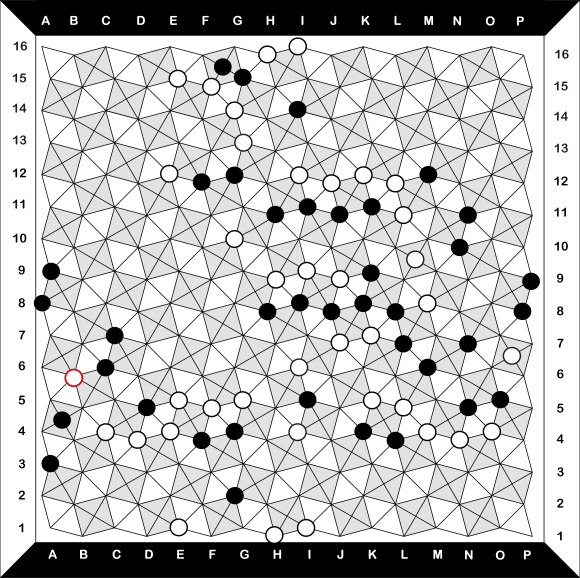
onyx-16x16-sample game 1-move68

Position after 61. D5 62. E5 63. C7 64. E4 65. A3 66. C4 67. AB45 68. B6

Black sees White is attempting to complete his chain across the 4th and 5th ranks, and mounts a defence with 61. D5, forming a diamond connection with C6.  White responds by strengthening his chain with 62. E5.  Black seems to anticipate a move northwards and blocks at C7, but that leaves White the opportunity to connect at E4.  Black attempts to wall off the edge with 65. A3 and 65. AB45, but White’s responses at C4 and B6 seal with deal.  White now has an unstoppable connection to the left edge from B6, a duplex connection from there to C4, an unstoppable connection to the right edge from O4, and two ways around the interposing stone at I5.  Black sees the writing on the wall and resigns.

If they’d played to the end, we might have seen a final position something like this:
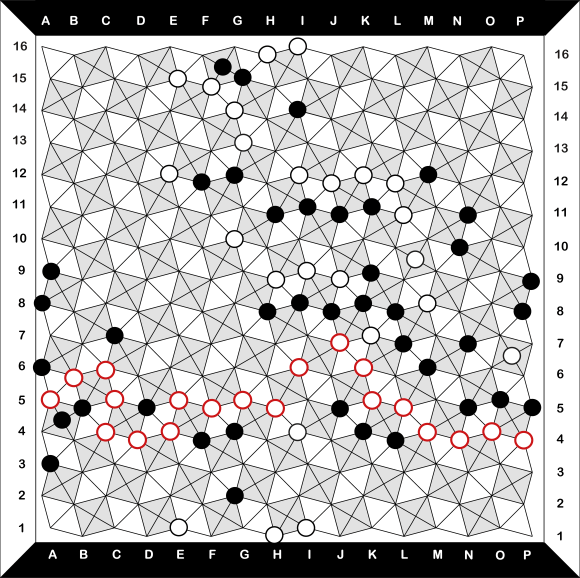
onyx-16x16-sample game 1-extended

Position after a possible continuation 69. A6 70. A5 71. B5 72. C5* 73. B5 74. C6 75. J5 76. K6 77. P5 78. P4 79. H6 80. H5, White wins

I’m not going to pretend my hypothetical continuation here is by any means best play in this situation, but I think we can be reasonably confident that there was not too much Black could do here.  White has enough options for connection at each key point in the chain to fend off Black’s defensive tries.  Ultimately I think White’s strong opening, securing key points along the main diagonals, and later the deft manoeuvring near the lower-left edge and around the Black stone at I5 secured the win.  With that clear path through the centre and all the way to the left edge, White ends up with a completed connection between A5 and P4.

Hopefully this sample game gives you some idea how an Onyx game feels in play.  On the 16×16 board I think the game really shines; more strategic options open up, play often bounces around disparate parts of the board, and yet each move still feels consequential.  My currently ongoing 20×20 game with Larry is, to my knowledge, the first one ever played, so I’ll reserve judgment on that board size until we at least finish one game!  If pressed, I’d probably say it seems interesting thus far, but definitely too large for a beginning player like me to have much of a chance against Larry.  Nevertheless I’m enjoying myself.


Next steps

As mentioned above, if you want to play Onyx I recommend the Gorrion Server, which offers 12×12, 16×16 and 20×20 boards, all with either the standard variation or the open variation.  The web interface also allows you to play out moves for both sides on the board to check variations, which is very convenient.  The server needs more players, so please join us!

Alternatively, you can play Onyx on Richard’s PBEM Server — however, here you can only play 12×12 (standard or open variation).

To learn more about the game, your best port of call is definitely Larry Back’s articles in Abstract Games magazine.  He offers basic tactical advice, annotated games, and puzzles to sharpen your tactical vision.  Other than that we don’t have much more strategic advice out there — so please come play with us online, and help us discover more about what this fascinating game has to offer!

I’m not 100% sure what I’ll feature next in this series — at the moment I’m leaning toward covering ConHex and Phil Bordelon’s related meta-rules.  At some point as well I’ll cover Gonnect, then circle back to cover Christian Freeling’s two predecessors to Starweb, YvY and Superstar.  He apparently doesn’t like either of those games very much anymore, but I’m interested in the various descendants of Star so I’d like to write up something on these games.

Thanks for reading — if you know of a connection game that might fit my tastes that I haven’t mentioned, do get in touch and I’ll investigate it and write about it further down the line.  Part of my motivation for doing all of this is to open my mind up to new games, so I’m very happy to take suggestions!


Tagged , , , ,

Connection Games Part VI: Twixt

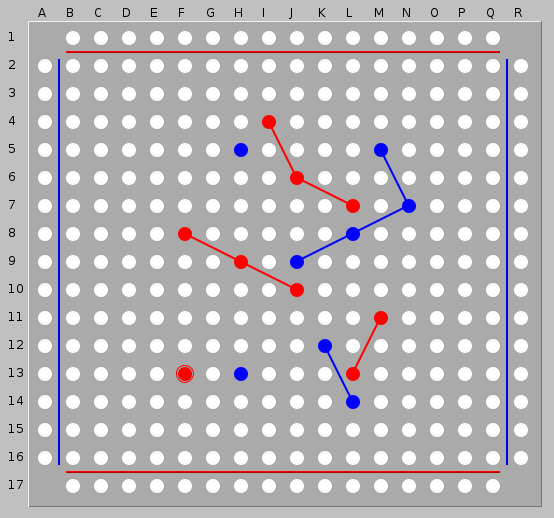
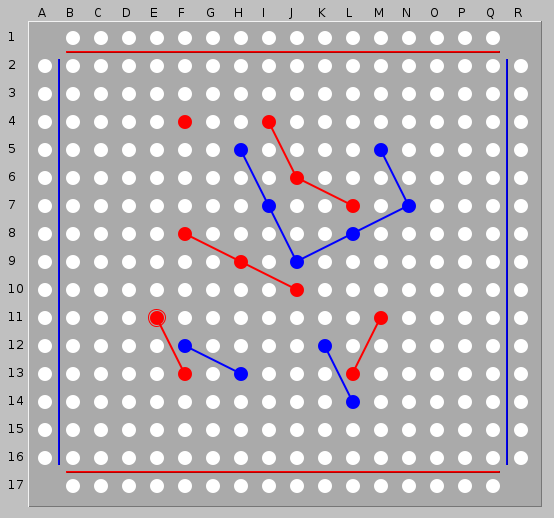
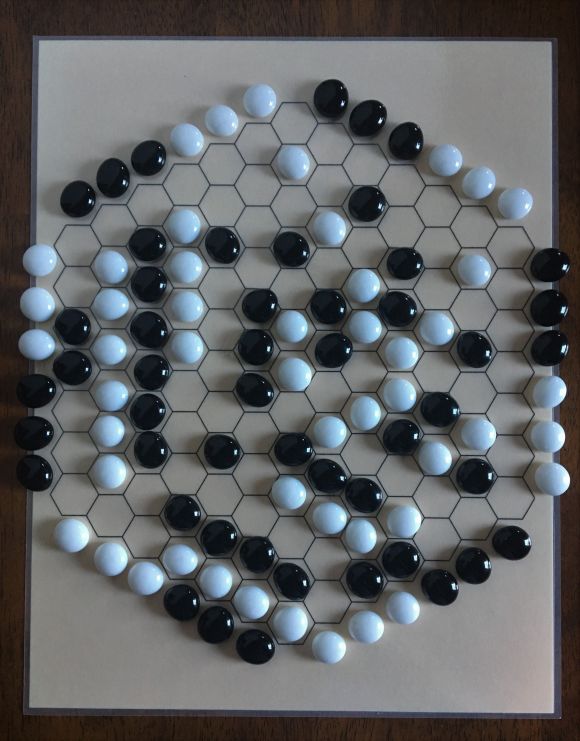
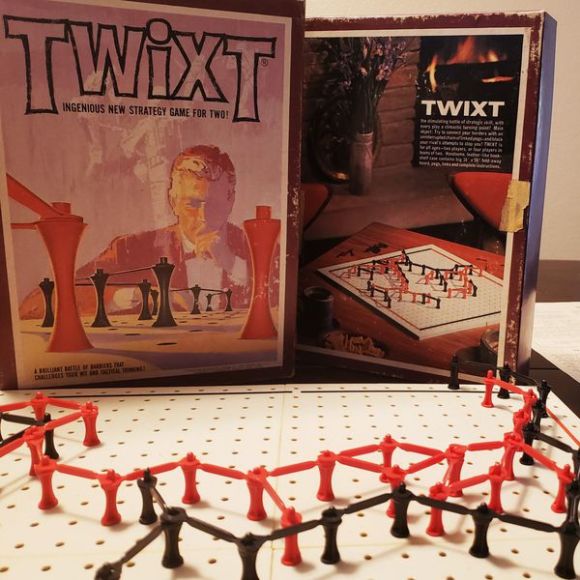
As promised, today we’re going to take a look at TwixT — a classic connection game designed by Alex Randolph in 1962.  Twixt (I’m giving up on the second capitalised ‘T’ because I’m just going to keep forgetting it anyway) is one of the relatively rare connection games that actually was released in physical form — and copies are still readily available via Ebay and used board game sites.  I have a copy of the 1962 3M bookshelf edition, which looks like this:

twixt-pic2

twixt-pic4

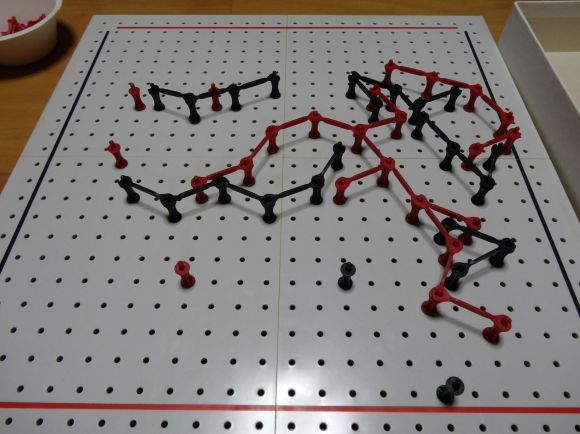
The game is played on a 24×24 square pegboard, and each player is armed with 50 pegs of their colour — Red or Black — and 50 bridges that span between those pegs, as in the photo above.  Each player strives to complete a continuous path of linked pegs reaching connecting their sides of the board.

So far, so similar, right?  But what sets Twixt apart is that, despite the seemingly enormous size of the board, games resolve quickly — and fiercely.  Twixt is a highly tactical game — David Bush estimates that the game is about 80% tactics on the standard-size board — and the tactics are razor-sharp.  By that I mean a single mistake can be very costly in this game, and sometimes what constitutes a mistake isn’t immediately obvious.

The upshot of this is that Twixt rewards careful play, deep calculation of possible continuations of each move, and substantive study of tactical principles.  It’s a tense and exciting game, and in my opinion one well worth learning.  I can’t possibly cover all of the myriad complexities of Twixt in one post, of course, and I’m only a beginner myself, but luckily 3-time Mind Sports Olympiad Champion David Bush has helped me tremendously by providing general tactical tips — with examples! — and a fully-annotated game on a small board.

We’ll start with the rules and an overview first, then we’ll move on to tactics, and finally the annotated game.

The Rules of Twixt

Like the other connection games we’ve covered, Twixt is quite easy to learn.  This is how it works:

  1. The Red player plays first.  After Red makes their first move, Black may invoke the swap/pie rule on that move only — if Black chooses to swap, they are now Red, and Red now becomes Black and makes Black’s first move.  Alternatively, players may swap and keep their initial colours by reflecting the opening move across the main diagonal and replacing the peg with a Black one, then playing on from there.
  2. Each turn, players may do the following:
    1. Remove as many of your own links from the board as you like — usually not necessary, but sometimes helpful to clear up the play area somewhat.
    2. Place one peg of your own colour in any vacant hole on the board, except your opponent’s border rows (the single rows behind the lines of your opponent’s colour, as seen in the picture above).
    3. Place as many legal links of your own colour as you like.  A legal link is available when two pegs are one ‘knight’s move’ apart — in other words, they are at opposite corners of a 2×3 six-peg rectangle.  No links may cross each other.
  3. The first player to connect the sides of the board marked in their colour with an unbroken chain of links wins the game.  If neither player is able to do this, the game is a draw.  Draws are very uncommon in Twixt, generally speaking.
  4. Players of different skill levels may elect to play a handicap game, in which the stronger player concedes a starting advantage to the weaker one.  The smallest handicap, for use between two players rather close together in strength, would be to allow the weaker player to take the first move while denying the stronger player the option to invoke the swap/pie rule.  From there, players may elect to use row handicapping — here the weaker player’s two sides are moved closer together by removing some rows from the board, making their task easier.  In these games the weaker player is always Red and always plays first.

Note that the annotated game from David is a row-handicapping game, which will nicely show off this excellent feature of Twixt.  Relatively few connection games have straightforward options for handicapping between players of disparate ability; Twixt’s row handicapping makes these kinds of matches just as tense and exciting as any other!  Row-handicapping is supported in real-time Twixt play on igGameCenter, too.

Another nice property of Twixt that it shares with most connection games is its scalability.  The default board is of course the 24×24 pegboard shown above, but the game plays well on both smaller and larger boards (within reason).  Little Golem has recently added options for play on 30×30 and 48×48 boards, and as with other games like Hex, larger board sizes add extra strategic wrinkles to a game of Twixt.  For a very detailed preview of 30×30 Twixt, do take a look at this deeply annotated game by David Bush on BoardGameGeek.  David says this about 30×30:

In a standard game, a player might make four or five moves, usually in the opening, which are based mainly on intuition. The rest of the game is spent attempting to tactically justify the plan you are now stuck with. A larger grid allows a much greater variety in the shape of your strategical plan, and offers a better balance between intuition and calculation.

Having said that, for the beginning player, it may be worth starting first at a smaller size — say 18×18, or a handicap game with a stronger player — before graduating to standard 24×24, then think about trying games on larger grids once you become well-acquainted with the standard board.

As has become my custom in this series lately, I’m going to show you a few final positions of some Twixt games below so you can get an idea how a game might look.  First, let’s take a look at a 24×24 game from Richard’s PBEM Server:

twixt-sample-24-1708

In this game Red resigned after 41 moves, and we can clearly see why — Black has a continuous, unbroken connection across nearly the entirety of the board, and will easily finish a complete connection within a few moves.  Red made a fairly scattershot attempt to block Black’s progress, but ultimately Black was undeterred and deftly slithered straight across the middle of the board.

Here’s another 24×24 game, this time a more intense tactical battle:

twixt-sample-24-1487

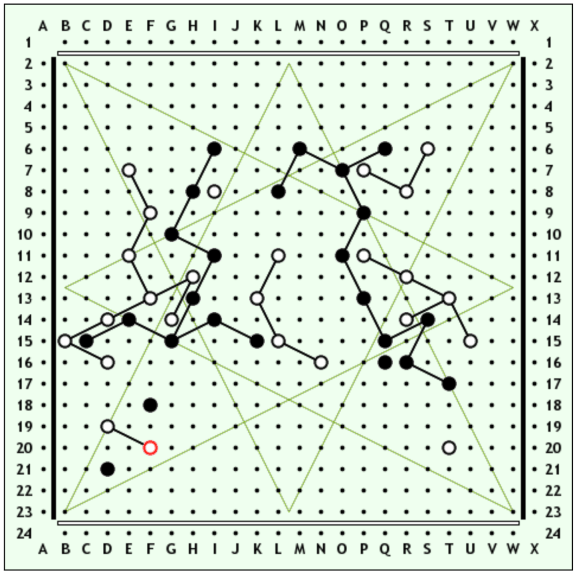
This time Red resigned after 57 moves — this is quite long for a Twixt game!  Clearly both sides made several abortive attempts to get a strong connection going, and the battle raged across most of the board.  Ultimately Black was able to find some order amongst the chaos, building up the circuitous connection we see at the bottom of the board.  Red sensibly threw in the towel at this point, as by this point Black has a stronger connection as well as numerous ways to stymie any attempts by Red to get something going.

Let’s take a quick look at one more 24×24 game — this one was played on Little Golem between David Bush and a strong AI called TwixtBot.  This game was played at a very high level, far beyond my ability to talk about sensibly, but you can take a look at some detailed analysis of this game on its entry at the Twixt Commentator website.

twixt-sample24-twixtbotvDB

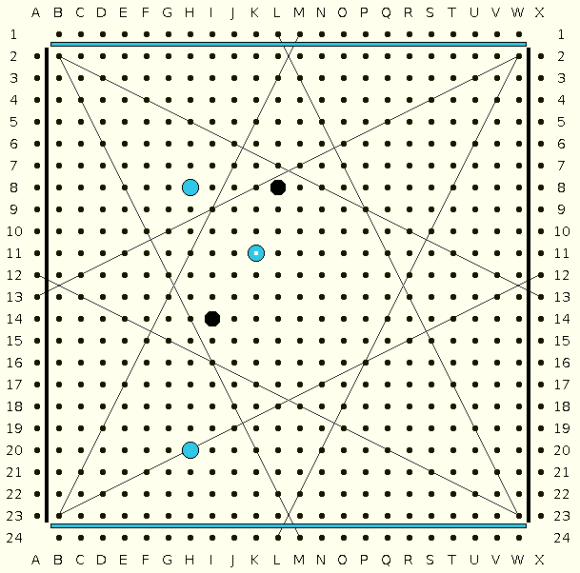
Twixtbot is playing White — Little Golem uses White and Black instead of Red and Black –while David is playing Black.  Black resigned here on the 50th move of the game (White’s last move is highlighted in red).  Again I’m not able to analyse this game in detail, but you can see that despite Black’s hold on the centre of the board, White has been able to cut off Black on the left and prepare the ground for a connection along that edge of the board.  I recommend taking a look at the game via the link to Twixt Commentator above — when you step through the moves one by one, and click through the variations in the comments as well, you can get a taste of how intricate Twixt tactics can be at high levels of play.

Finally, since I’ve already linked you through to David’s deep commentary on a 30×30 game, I’ll briefly show off a sample game at 48×48.    Now, 48×48 games are long, and not commonly played, and this particular game has nearly an 800-point rating difference between the two players, but nevertheless you can get an impression of how challenging games at this size will be:

twixt-sample48-2

White was the player with the sizeable rating advantage, and in the end Black resigned after 72 moves.  White clearly had the upper hand here from the beginning, and lived up to their rating by methodically winding their way through Black’s defences.  48×48 has yet to achieve the growing following we see for 30×30, but I hope at some point it does take off a bit more — I’d be fascinated to see what pitched battles between strong players would look like on this enormous playing area.

Twixt Tips for Beginning Players

Now I’m going to turn things over to David Bush, who has kindly offered up some useful core principles for new Twixt players:

  • The ONLY way to win is to block your opponent on the whole board. More so than with most other pure connection games, there is a difference between making a nice pattern for yourself and blocking your opponent. The latter should always take priority.
  • Play lightly.  Just because you put some pieces on the board does not mean you have to use them in your final winning path. Be ready to start a new path if the opportunity arises.
  • Focus on tactics.  Try our hand at these interactive puzzles which can occur in a real game.  In my opinion Twixt is at least 80% tactics.
  • NEVER play Twixt before breakfast.

Let’s take a bit of a deeper look at some of these points.  Note that these examples below are quite sophisticated, and perhaps challenging for a new player.  I recommend following along with some helpful Twixt software like JTwixt (needs Java to run), which will allow you to place moves on the board and try possible alternate variations, or T1j (also needs Java), which is less full-featured when it comes to analysing games but includes a computer opponent to try your moves against.

The Only Way to Win is to Block

Here is a typical opening position:

must_block1

Black has just played i14. In the game, Blue answered with K11.

must_block2

This 3-3 relationship with H8 is called a tilt setup — Blue can make a single move that connects these pegs in two different ways. This is all well and good, but it’s too slow for Twixt. Black played N16.

must_block3

This 5-2 relationship with i14 would take two moves to complete a connection, but such a connection can form in a variety of ways. You can see the network of possible linking paths is like a diagram of a cube. This is a very resilient pattern. It is difficult for Blue to find a way to attack through that gap. Blue tries to block on the right with P16.

must_block4

You can see that P16 is on a line that leads to W2. Black could start a race toward the upper-right corner with P15 — a ladder chase — but Blue could simply follow that line to W2 and win the chase.  But Black N12 is much stronger.

must_block5

Black has a commanding advantage here. Instead of K11, blue might have played O13.

must_block6

This is not as well connected to H8 as K11 was, but that’s not as important as stopping black from achieving an easy win through the middle of the board. Blue has threats now to connect O13 to the top and to the bottom. This is a much more balanced position.

Play Lightly

This position is from a game between two versions of a Twixt bot. The bots are crushing heads these days. At least one human is probably still stronger as of Spring 2020.

play_lightly0

Black abandons its pegs at F4 and L5 to start a new battle along the bottom. A couple moves later we get this:

play_lightly1

To a player with some experience, S21 looks doomed. But that’s the point. S21 is a feint, a threat that blue has to respond to. As blue keeps adding pegs to the bottom right, black will improve its connection to the left, and then switch to an attack elsewhere along the right edge. Here is the game several moves later:

play_lightly2

Blue’s group in the bottom right is almost useless. Black gave up pegs at F4, L5, and S21 for the sake of gaining an overall advantage across the board.

Here’s a more typical example. Note that the blue borders are on the left and right here.

play_lightly3

This 4-1 blocking pattern between i6 and E7 is often the best way to conduct a corner battle. Black is willing to abandon the i8 group in some variations, in order to gain an attack down the left edge. A few moves later we get:

play_lightly4

For black, a win via E16 is just as valid as a win via J11.


Hopefully you could follow along with David’s examples here — as you can see, Twixt has a steep learning curve due to the sharp tactics involved, but the end result is a game with dynamic and exciting play.

Annotated Game — Zurround vs David Bush

This is a handicap game on a small grid, annotated by David Bush.  Red (Zurround) has to connect across 17 rows; Blue (David) has 18 columns to deal with.

A quick note on the move notation — for each move, we simply write the location of where the new peg was placed on the grid.  Since links are generally added automatically in most Twixt online clients or software you might use, it’s normally not necessary to specify which ones are added.  On occasion though you may need to change links around depending on the server — Game Center for example — so in those cases, if you need to understand the notation there is a quick guide on the page of interactive Twixt puzzles.

1. H9   2. H13

3. M11

handicap01

M11 is an excellent way for red to press his advantage. It makes many threats to connect to the top and to the bottom.

4. L8

5. J10   6. H5

handicap02

Blue is forced to open up a new front, but he may be able to use H13 later.

7. J6       8. K12

9. L13   10. M5

11. L7   12. N7

13. i4    14. J9

handicap03

Blue threatens to punch through along the top, at i7, or along the bottom, at L10. Red might be tempted here to play J8 which is a double linking move. But this does not answer both threats that blue is making.

handicap03a

I said that blue was threatening L10, and he is, but it would be a mistake to play there immediately.

handicap03b

Here red can win with H14.

handicap03c

Red threatens to double link at i12. We look at three variations here. The first is i11 G12 G10 F10:

handicap03c1

The second is i15 G12 G14 F14:

handicap03c2

and the third is G15 i12 i14 J14:

handicap03c3

So, instead of L10, blue should play at L14.

handicap03d

This is better than L10 because it still makes two threats to connect to the right, L10 or N13, and guards against red’s H14 threat. We will see how later in the game continuation. We return to the position after blue J9.

handicap03

In order to win here, red needs to play the same sort of trick that blue played with L14 in the previous variation. Blue used the space available on the bottom right. Red needs to use the space available on the left.

15. F8

handicap03e

Very good move. Red covers both of blue’s threats with a single move. The F8 group threatens to connect to the top in two ways, and to the bottom in two ways.

16. L14

handicap04

Red could have won here with F13.

handicap04a

One possible continuation is i7 F4 F12 E11:

handicap04b

It almost looks like blue could do a “pincer attack” here with E8. But it doesn’t quite work after E8 D7 G9 E9:

handicap04c

Returning to the game:

17. H14    18. G15

handicap05

Now blue is winning.

19. i12    20. i14

21. C14   22. D12

23. N14

handicap06

Red sets a trap. If 24. L10:

25. i14   26. K15   27. L15

handicap06a

But blue sidesteps the trap.

24. M16

25. D11    26. E10

27.Resign

handicap08

Next steps

From here, I suggest getting out there and playing some games!  After gaining some experience and putting these tips to the test, a good way to continue learning would be to check out David’s articles in Abstract Games magazine — in Issue 2, he provides the rules and a deeply-annotated game; in Issue 4, he covers basic tactical concepts and setups; and in Issue 7 he covers more details on how to battle for dominance in the corners.

There are several good options for playing Twixt online.  Probably chief among these is Little Golem, a correspondence game server which houses a dedicated Twixt community full of strong players, and the site supports the 30×30 and 48×48 variants as well.  Every game has a link next to it to enable you to analyse it on the Twixt Commentator website, which is also a convenient feature.

Note that Little Golem uses the TwixtPP rule set; PP stands for ‘pen and paper’, and these rules are actually the original rules for Twixt before the physical sets were produced.  In TwixtPP, your own legal links are placed automatically after each move by the server and are never deleted, and your links can cross over each other — but note that crossed links do not count as connected!  In practice, these minor rule differences don’t have a huge impact on play, but there are some rare situations where they do change things somewhat, so keep an eye out for those.

Also, this serves as a helpful reminder that you can play Twixt using pen and paper!  Just download and print some boards on a sheet of paper and draw your pegs and links using different-coloured pens or pencils.  This is a great way to try out the game without investing in a set.

You can also play Twixt on Richard’s PBEM Server — you’ll need to read the various FAQs and such to get started, but once you get past that you can play games graphically via the web interface.  This server supports games up to 40×40, and row handicaps of up to 18 rows.  Here the rules are those of the physical game, not Twixt PP; however, the server does automatically place legal links for you, which is helpful.

If you’d rather play Twixt in real time, igGameCenter is a great option, as mentioned above.  GameCenter supports row-handicapping as well, which is great for new players — David and I have played a few handicap games there and they were profoundly educational.  The board by default is drawn in a rather tiny resolution, but pressing Ctrl and +/-allows you to change the display size.  You can step back through your games afterward by clicking around in the move list, though analysing games in detail is probably best done by entering the moves into JTwixt on your own.  On the whole it’s a great place to play real-time games.

Summing Up

So that, in a nutshell, is Twixt.  I’m very much a newcomer to the game, and faced a trial-by-fire in my first matches by facing David right off the bat!  However, our games were not only educational, but also showed me that Twixt is challenging, filled with tension, and clearly can be a ‘lifestyle game’ just like Chess, Go, Havannah, or Hex.  I highly recommend trying it — the steep learning curve means it may not be for everyone, but if it is for you, there is a tonne of depth for you to discover and enjoy.

In future posts I’ll be covering some other interesting connection games with some unusual qualities: Onyx, a connection game played on an Archimedean tiling with captures; Gonnect, a connection game played using the rules of Go; and Slither, a recent invention combining placement and movement to generate shifting, snakelike connections across the board.  I’ll also be covering ConHex and the related meta-rules — rules that can modify almost any connection game — invented by Phil Bordelon.  Please look forward to those!


Tagged , , ,

Connection Games V: Side Stitch

We’re back looking at connection games again, and this time we’re going to cover a game invented in 2017 by Craig DuncanSide Stitch.  Side Stitch is a game reminiscent of Star and *Star, where players must make connections between groups touching key cells along the edges of the board.  Where Side Stitch differs from its predecessors is that it incorporates a recursive group-scoring mechanism that ensures there are no draws, rather than using a scoring penalty to encourage the formation of larger connected groups as in Star and *Star.

How to play Side Stitch

Side Stitch is played most frequently on hexhex boards (hexagonal boards tesselated with hexagons — examples below), on which the edges have coloured borders (although other shapes are possible — see the game’s image gallery on BGG for examples).  The number of colour-sides does not necessarily match the number of sides of the board!

The rules are very simple:

  1. Two players, Black and White, take it in turns to place a single stone of their colour on any empty hexagon on the board.  Once placed, stones do not move and are never removed.  Players may also pass their turn.  The game starts with the pie rule/swap rule.
  2. The game ends when both players pass in succession, or when the board is full.
  3. Once the game is over, the winner is determined by the scores for the players’ groups.  Each connected group of same-colour stones gives a score equal to the number of colour-sides that group touches (cells adjacent to two colour-sides count as touching both of them).  Each player finds their highest-scoring group, and the player with the highest-scoring group wins.  If both players have the same score at that point, then they compare second-highest-scoring group, then third-highest, and so on.  Draws are not possible in Side Stitch.

Here are some sample boards I made in Adobe Illustrator based on Craig Duncan’s designs, available for download on BGG:

Side Stitch 7-9-notation-01

Side Stitch hexhex-7 board with 9 colour-sides.

Side Stitch 8-7 big borders-01

Side Stitch hexhex-8 board with 7 colour-sides.  This is Craig Duncan’s pick for the ‘standard’ Side Stitch board, as he feels the 169 hexes allow for a suitably complex game without it overstaying its welcome.

Side Stitch 10-01

Side Stitch hexhex-10 board with 9 colour-sides.

From these sample boards you can see that Side Stitch plays well on wide variety of board shapes and sizes, and with different numbers of colour-sides.  The colour-sides also give the boards a lively and appealing visual aspect.  Craig Duncan recommends the hexhex-8 board with 7 colours-sides as the ‘standard’ Side Stitch board; I tend to agree with him that this board allows for deep and challenging play without dragging on too long.  Having said that the hexhex-10/9-colour board allows for a bit more of strategic battle, and to me is equally as good as the standard board.

The recursive group-scoring mechanism — comparing highest-scoring groups first, then second-highest, and so on until any ties are broken — has appeared in a few recent connection games and related titles, most notably Nick Bentley’s highly successful Catchup (easily my favourite game of his at the moment).  This mechanism works particularly well in Side Stitch — draws are impossible and the winner is very easy to determine.  In combination with the board’s brightly-coloured sides, it makes a strategically and tactically complex game highly readable in play — following who’s ahead is very straightforward.  As a whole, Side Stitch is a fun, elegant and fundamentally flexible game that scales really well.


Side Stitch in play

Despite its simplicity, players discover very quickly that Side Stitch has enormous depth and variety.  As players attempt to stitch the colour-sides together to form the highest-scoring group, they’ll need to pay equal attention to interfering with their opponent’s plans as well.  The need to connect widely ensures that play spans the entire board surface, and strategic concerns remain paramount even on smaller boards.

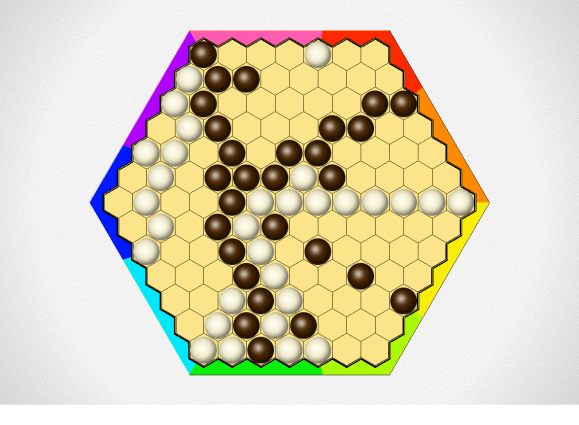
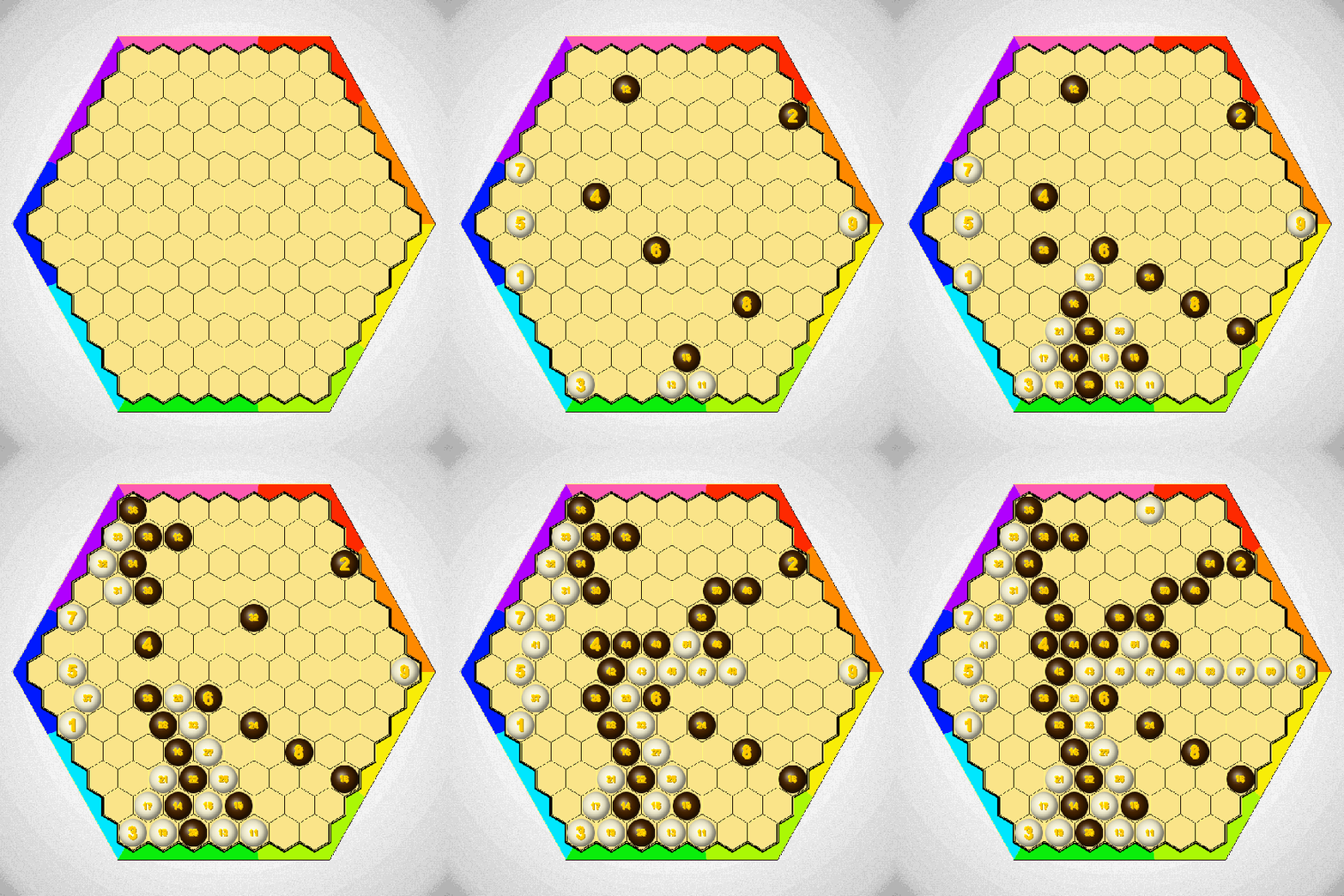
Here’s a sample game, one of my early attempts against Ai Ai’s MCTS player on the hexhex-7/9-sided board:

sidestitch9-loss1-end

The AI is playing Black here, and won with a board-spanning group in the centre connected to five colour-sides.  As this was an early attempt at the game, I was too wrapped up in my own attempts to connect in the opening phase, and failed to counteract Black’s efforts to split my stones in two.  Here’s a GIF so you can see my shame step-by-step:

sidestitch9-loss1-num

After several more losses, I took a game from the AI on the hexhex-8/7-sided board.  By this time I’d learned how to balance my attack and defence obligations more appropriately and to manoeuvre a bit more cleverly across the board.  The AI (Black) resigned in this position:

sidestitch8-win1-end

You can see that Black made a valiant, and ultimately successful, effort to block me from the left side of the board entirely.  However, I was able to extend all the way to the top-right corner, which together with the connections on the right and bottom netted me a group scoring 5 points — an insurmountable margin for Black.  Here’s a GIF of the full game:

sidestitch8-win1-num

Now this game is still young, and I’m by no means an expert myself, so it’s difficult to give detailed tactical and strategic advice.  But hopefully these sample games can give you some idea of how Side Stitch feels in actual play.  For me it’s a standout amongst the many recent connection games — it’s easy to understand but affords some very intricate play.  The colourful boards are really appealing, too, and so far the game retains its character and excitement on all the boards I’ve tried.

At a tactical level, connection game basics from Hex et al. will serve you well here; for strategic considerations, you can take some inspiration from games like Star and Starweb.  What’s key in Side Stitch, as in other connect-key-cells games, is to impede your opponent’s progress as well as furthering your own connections.  You also have to keep in mind the recursive scoring mechanism — if you and your opponent are fighting a close battle, then your second- or third-best group may well decide the game!  So don’t forget to develop additional scoring groups, in case the board situation may require a tie-break with your lesser groups.


Side Stitch 6

In response to thread on BGG, Side Stitch designer Craig Duncan designed a way to play Side Stitch using the six sides of the hexhex board, rather than having a different number of colour-sides.  In order to keep the play the same and avoid draws the board ends up being a bit different:

side-stitch-6-v1

The rules of Side Stitch 6 are the same as in normal Side Stitch, except that the missing corner cells obviously aren’t playable, and each player starts with stones already in contact with each of the six colours.

Personally I’d rather just play regular Side Stitch and try lots of interesting colour combos, but it’s nice that the game still holds together with six sides or other even numbers of sides, with some small adjustments.

IMPORTANT UPDATE: Side Stitch is now playable at the Gorrion Server!  Here’s how the game looks over there — note that scoring is not yet implemented so players have to do that on their own.  So far we have the hexhex-8 board with 7 colour-sides available (Craig’s standard board).

side-stitch-gorrion1

UPDATE 2: Side Stitch 10 — hexhex-10 board with 9 colour-sides — is now also available on Gorrion!

gorrion-side-stitch-10


Exo-Hex

The discussion on Side Stitch 6 eventually lead to the development of a sister game, Exo-Hex.  Exo-Hex takes the next logical step from Side Stitch 6 and eliminates the colour-sides entirely.  Instead, black and white stones are placed outside the boundary of the board — these are called ‘exo-stones’ — and players compete to build groups connected to the largest number of exo-stones.  The win condition and scoring mechanism are the same as in Side Stitch.  The result looks like this:

exo-hex-7

This new arrangement creates some new wrinkles — the sides are no longer neutral, but are already colonised by pieces of both players.  Also, since the sides consist of stones themselves, the sides are connective — in other words, a chain of stones coming in one end of a given side is still connected to a chain of stones coming out the other end.

Speaking personally, I’d still rather play Side Stitch — it has a level of personality and flexibility/extensibility that Exo-Hex doesn’t.  But as a consequence of this more focussed design, Exo-Hex is easily playable with any standard hexhex board and two colours of stones, and it’s elegantly simple.


Iris

Our last game of today is Iris, another 2019 invention from Craig Duncan with links to elements of Side Stitch.  Iris also has a colourful visual presentation and uses recursive group scoring, but uses a different movement protocol.

iris-game-1

An Iris sample game — check the game’s image gallery for more of Craig’s attractive board designs

Iris works like this:

  1. Two players, Black and White, take it in turns to place stones of their colour on the board.  Black goes first, and in their first turn may place one stone on any grey interior cell of the board.  After that, players may place two stones of their colour on the board subject to these restrictions:
    1. If a stone is placed on a coloured cell on the outer rim of the board, the second stone must be placed on the corresponding same-coloured cell on the opposite side of the board.
    2. If a stone is placed on an empty grey cell, the second may be placed on any non-adjacent grey cell.  If no non-adjacent cells are available, the second stone may not be placed.
  2. The game ends when both players pass, or the board is full.  Then players score their groups of same-coloured stones; the score of a group is equal to the number of coloured stones included in that group.  The highest-scoring group wins, and the scoring is recursive — if the highest-scoring groups have equal values, then we compare the second-highest, and so on.

I haven’t yet had the pleasure of playing Iris, but the prospect of a connect-the-key-cells game with two moves per turn (this is known as the 122* move protocol) is quite appealing.  The additional move would allow for some complex threats to be made and answered during play, and might further encourage the players to attempt adventurous cross-board connections.  A nice side-effect of the 122* protocol is that the pie rule isn’t necessary; the first player’s single placement at the start balances out the first-move advantage.


Summing Up

Side Stitch and its kin here show us that the design space surrounding the Star/Starweb connect-the-key-cells concept is rich with possibilities.  Side Stitch’s adoption of the colour-sides and recursive group scoring gives it a distinct character from its ancestors, and in play it shines as one of the better connection games I’ve played in recent years.  Exo-Hex and Iris are a bit more focussed in design, which has pluses and minuses — of the two, Iris stands out as having some interesting potential.  The 122* move protocol with placement restrictions adds an interesting wrinkle to this sub-genre of games.

All told, Craig Duncan’s had a productive couple of years!  Out of the three Side Stitch is clearly my favourite design, but if the others become playable via Ai Ai or other venues then that may change.  For now I think Side Stitch offers personality, playability and flexibility, and it’s certainly made it to the ranks of games for which I plan to print a mat and encourage others to play.

Next time, we’re going down a somewhat different route.  I’ll be covering a single game, the classic Twixt, in significantly more detail than the other games I’ve presented here.  This will be possible thanks to David Bush, three-time Mind Sports Olympiad Champion in Twixt, who has not only sent me fantastic content for that post but has given me a Twixt trail-by-fire in some very challenging games.  So do look forward to that post — hopefully you’ll come to the end of it packed with Twixt knowledge and ready for the tactical challenges the game has to offer.


Tagged , , , , ,

Connection Games IV: Unlur

I promised last time to cover two of my favourite connection games, Unlur and Side Stitch , but you may notice the title of this post only mentions Unlur.  I should clarify that my plans haven’t changed as a whole, I’ve just decided to devote an entire post to Unlur instead of covering both games at once.  Unlur is a deep and challenging game, so it deserves a bit of explanation — and if I cover Side Stitch separately as well, I can also cover a couple of related games by the same designer (Craig Duncan).

Unlur came about as a result of a game design contest in the Abstract Games magazine back in 2002 — the Unequal Forces Design Competition.  The competition challenged designers to create games where the two sides are asymmetric — having different goals and/or different tools with which to achieve the game’s win condition. Designer Jorge Gomez Arrausi won by creating Unlur, a game that took on a very difficult design challenge: how do you create a connection game where the players have unequal goals, yet the game remains balanced?

The Rules

As with most connection games, the rules of Unlur are appealingly simple, but the elegant rules enable remarkable complexity to emerge in play.  The first phase of the game, the contract phase, is particularly unique in Unlur, so after introducing the concept here I’ll illustrate how it works in practice with some brief discussion of several real games.

A game of Unlur is played on a hexagonal board tesselated with hexagons —  the classic ‘hexhex’ board we’ve seen a few times now.  The designer originally recommended playing on a hexhex-6 board, but hexhex-8 is more common — for a deeper and more subtle contest, try hexhex-10 or larger.   The game works like this:

  1. Two players, Black and White, compete to form connections between different sides of the board:
    • White wins if they connect two opposite sides of the board
    • Black wins if they connect three non-adjacent sides (corner cells are considered part of both sides to which they are adjacent)
    • If either player achieves the other player’s goal without simultaneously achieving their own, they lose the game immediately
  2. Black’s goal to connect three sides is significantly harder than White’s goal, so a game of Unlur is structured so that the players balance the game themselves before they start playing in earnest.  At the start of the game, players are not assigned colours — instead they begin with the contract phase.  In this phase, the two players take it in turns to place a single black stone on any empty hex that is not on the outer edge of the board.  When one player judges that Black has enough stones in the right positions on the board to give them an equal chance against White, they may pass their turn — from that point they play Black, and the other player is White.
  3. White then makes the next move by placing a White stone on any empty hex, and the players then take it in turns to place a single stone of their colour on the board.

Here’s the final position for a real game of Unlur on a hexhex-8 board played on Richard’s PBEM Server: unlur-8-example

Black won this game by resignation — White gave up because Black’s three stones on the bottom right of the board completely cut off White’s attempt to connect the top and bottom sides, and also ensure an unstoppable connection for Black.  Ultimately Black will win by connecting the bottom right corner and top left corner to the bottom left side — remember that corner cells count as part of both sides they’re adjacent to, so Black will achieve their goal of connecting three non-adjacent sides.

The genius of Unlur lies in the contract phase.  Essentially the contract is somewhat like an extended form of the pie rule used in many other games, except here players are not assigned colours initially and have complete freedom to decide at what point Black has equal chances.  Since neither player has chosen a side at this point, both are invested in making sure that the board is equal at the start, so both will add stones in such a way as to ensure whoever elects to pass and take Black will be competitive but not dominant.  The contract phase is of course hugely important to the ultimate outcome of the game, and the completely open nature of it means that opening play in Unlur is both unusual and extremely varied.

The rule enforcing a loss if either player achieves the other’s win condition serves to ensure that draws are impossible in Unlur.  In practice this rule affects Black more than White — after all, White’s goal is more economical in terms of stone placement, so it’s less likely they will end up forming Black’s more difficult connective goal before achieving their own.


The contract phase in action

The contract phase is not only ingenious, it’s also complex — how do we decide when Black as equal chances?  What sort of moves for Black should we play to ensure equal chances without unbalancing the game?

There are basic rules of thumb we can infer from our experiences with other connection games: the centre of the board is very valuable, so central stones for Black are strong in the contract phase; and conversely, stones closer to the edges of the board are weaker.  So as a starting point, we can say that a contract with several central stones for Black would be quite strong, while a contract consisting only of stones close to the edge would require more stones to be placed before we’d consider passing.

The designer adds to this that stones that are widely dispersed are more powerful than stones placed closely together.  This often leads to players cautiously adding more stones for Black adjacent to already-placed stones — this still increases Black’s chances but changes the position less drastically than placing stones elsewhere.

Even with these basic ideas in place, judging when to pass in Unlur is difficult, and our decision will have to change depending on the size of the board — on larger boards, Black would need a larger contract to have equal winning chances.  Let’s take a look at a few example games on different board sizes, and see how different players have addressed the contract phase in actual play.

First we’ll look at a tournament game played on a hexhex-8 board in 2006 on Richard’s PBEM Server.  Black ultimately won this game, and the contract certainly proved important in this case — here’s the game position when the winning player chose to pass and take Black:

unlur-8-diag-contract


In this game the contract consists of just six moves for Black — given that the designer’s analysis on the smaller hexhex-6 board suggested that up to ten stones for Black could still constitute a fair contract, we might conclude that Black’s contract was too weak here.  However, remember our rules of thumb — Black’s stones are close to the edge, but also widely dispersed, so they provide a framework for later connections across the board.  The stones are also close to several corners, which count as part of either side they’re adjacent to, which again is helpful for Black.

Black’s win in this game made very good use of these contract stones, as we can see:

unlur-8-diag-end

Note that all of the contract stones save the stone on H11 played an important role in subsequent play.  The two stones in the bottom left were ultimately blocked by White, but Black nevertheless slipped through the centre to connect the contract stones on the left and upper right with the bottom of the board.  So in this case Black’s judgement of the contract proved correct — the number of stones was small, but they formed a framework for connection that Black could exploit well enough to take the win.

Now let’s jump up to a hexhex-9 game and see how the contract phase evolved:

unlur-9-diag-contract

Now this contract seems even more risky than the last one!  The winning player took the contract after just three moves — this despite playing on a hexhex-9 board which has 217 hexes, far more than the 169 in the hexhex-8 board of the previous game.  Given our rules of thumb we can see that these moves are quite powerful for Black, however; two of them are quite central, and while the stones aren’t widely dispersed they do provide good coverage of the top and top-right of the board.

As it happens, Black was able to construct a nice win here:

unlur-9-diag-end

Note that the two central stones from the contract phase formed a crucial part of the winning player’s connection — in fact the winning Y-shaped configuration spreads out directly from those two stones.  Clearly more centrally-placed stones are quite powerful for Black, and can enable Black to form a strong core for a board-spanning connection.

I’d argue though that taking this contract after just 3 moves was still quite a risky play — after all, the board is large and there was still ample room for White to manoeuvre and possibly isolate those stones.  We should remember though that the contract is only the first stage of the game, and skilful play can still make up for a less-powerful contract.

In that sense the contract phase in Unlur could also function as an interesting way to balance the game between two players of very different skill levels.  I suspect with some detailed analysis we’d be able to develop a reasonably granular system for constructing contracts that help bridge skill gaps between players — perhaps by constructing some pre-set contract placements tailored for different skill levels, or by giving one player additional stones to place in the contract phase.  As far as I know this hasn’t really been investigated in detail, but I’d be interested to see some testing of possible handicap play rules.

So far we’ve seen a couple of relatively small contracts — let’s take a look at some more generous ones.  First we’ll jump up in size again to this game on a hexhex-10 board, where Black takes a contract four times larger than the last one we studied:

unlur-10-diag-contract

Here Black took the contract after 12 moves.  The distribution of stones suggests both players were playing carefully, looking for a balanced and relatively straightforward position — all 12 stones are placed near to the edge of the board, and we see two large clusters of adjacent stones, which as we know are less impactful on the position than more widely-scattered ones.  Given the size of the board — 271 hexes, much bigger than the previous game’s 217 — 12 stones in this kind of configuration seems a reasonably fair contract, giving Black a strong framework around the edges but leaving the centre open.  We might expect play to focus on that open centre as Black seeks to connect these disparate islands of stones, and White tries to wind their way through the maze to build their own connection.

This ends up being pretty accurate, as we can see in the final position:

unlur-10-diag-end

Black ends up building several strong walls around the centre, blocking White from easily connecting through the middle of the board.  White resigned at this point, as it’s clear Black can stop them from connecting to the top, while Black’s structure ensures unstoppable connection between the bottom, right and top sides.  In the end Black played cleverly here and utilised the strong points of this contract well — the contract stones helped restrict White’s playable territory along the edges, and Black’s subsequent play largely blocked them out of the centre.

Finally let’s take a look at another well-balanced contract, this time on a rather gargantuan hexhex-11 board (331 hexes):

unlur-11-diag-contract

Here Black took the contract after 15 stones were placed.  Note again how many of the stones are clustered together, reducing the overall impact of each placement on the position.  However in this case we have a stone placed right in the centre of the board, which is certainly helpful for Black.  Given the size of the board and the fact that there’s just one central stone, 15 stones seems like a reasonably fair contract for Black.

The resulting game, another Black win, develops in an interesting way.  In issue 12 of Abstract Games, the designer of Unlur explores this kind of opening position and a resulting position called the arrow opening, which we can see in supersized form in this game after the above contract:

unlur-11-diag-end

In this arrow game, White is in quite an unfortunate bind — their long wedge of stones on the bottom-right is completely hemmed in.  If we were speaking in Hex terms, we’d say that nearly all of White’s stones are dead — unable to take part in any winning connection.  Black has blocked the corner at U11 and constructed a vast wall as well, making a White connection between the lower-left side and the upper-right completely impossible.  White’s attempt to snake around the right side to connect to the top is easily stymied by Black using the group of stones on and around D14, so White’s position is utterly hopeless.  Black can easily win by connecting to the upper-right side — note this also forms a line, but since Black already connected the bottom (using the corner cell) and the upper-left, Black’s stones would form a 3-way Y connection at the same time, securing the win.

Hopefully these few examples can serve as a useful preview of what a sound contract for Black can look like in Unlur on some of the possible board sizes.   The number of possible contracts on any given board size is absolutely enormous — contract length can vary a lot, as we’ve seen, as well as the positions of the stones.  In the face of all this variability,  a few rules of thumb and experience are the best we can hope for; there are so many ways the contract phase can evolve that set opening sequences are not particularly useful.  Besides, your set opening can easily go awry if your opponent decides to go another way — after all, you’re building the contract together, not separately!

After the contract phase, you’ll find yourself using some of the same basic concepts you might use in other connection games like Hex or Y — bridges and so forth.  However Unlur is significantly different in one very important aspect: your own stones are never a liability in Hex or Y, but they definitely can be in Unlur!  You lose the game if you form the opponent’s connection before your own, so having poorly-placed stones scattered around the board can make this outcome more likely.

During the middle- and end-game of Unlur, it’s also worth keeping in mind some key configurations that ensure a win for one player or the other:

Unlur-config1-edited

In the above pattern, Black completely controls three sides of the board.  In this configuration White cannot win — White would need to connect to one of the sides controlled by Black.  White will lose either when Black successfully connects or when they are eventually forced to make a foreign connection.

unlur-config2-edited

When White completely controls two opposite sides, Black is completely lost.  In order to connect three non-adjacent sides, Black would need to use one of White’s controlled sides, which is impossible.  Meanwhile, White still has several different ways to make a winning connection.unlur-config3-edited

This pattern is another one that hands a certain win to White.  White can still connect to the top to form a winning line, but Black can’t break through — he can only form a losing line in the attempt.

During the game, watch out for your opponent working toward these configurations — don’t let them get away with it!  We can easily forget the ‘foreign connection’ rule and end up in a situation where we’ve unwittingly entered a board position where the foreign connection is the only one available to us.


Resources and where to play

Despite being a relatively well-known connection game and widely respected for its elegance and uniqueness, strategic advice on Unlur is rather hard to come by.  Your first stop should be issues 11 and 12 of Abstract Games — the game is introduced in issue 11, and the designer provides some background on his design decisions and some strategic advice in issue 12.  Note that he only covers hexhex-6 boards, as he felt that larger boards were too complex:

“…Unlur over a board with eight cells per side becomes very complex and difficult to understand, so now we prefer to play on a board with six cells per side.”

However, since those articles were published many players have come to prefer larger sizes, because there is greater scope for strategic intrigue.  I personally prefer larger boards as well, partially because the contract phase takes up a bit less of the overall play time on a larger board, which to me feels a bit better balanced in terms of the playing experience.

From there, you can check the archived version of the designer’s website for further tips, but unfortunately none of the images appear to work anymore.  Other than that I can’t really find any detailed strategic discussion anywhere, which is quite a shame.

That being the case, the best way to learn is to try playing some games.  Unlur is well-known enough that there are a few options for online play: Gorrion (supports hexhex-8, 10 and 12), Richard’s PBM Server (supports from hexhex-4 all the way up to 13!), igGameCenter (supports hexhex-8 and 10), and Ludoteka (supports hexhex-6 and 8).  Unfortunately all these servers are somewhat lacking in Unlur activity, but I’m sure you could rustle up a game or two via BoardGameGeek… or simply contact me if you want to arrange a few!

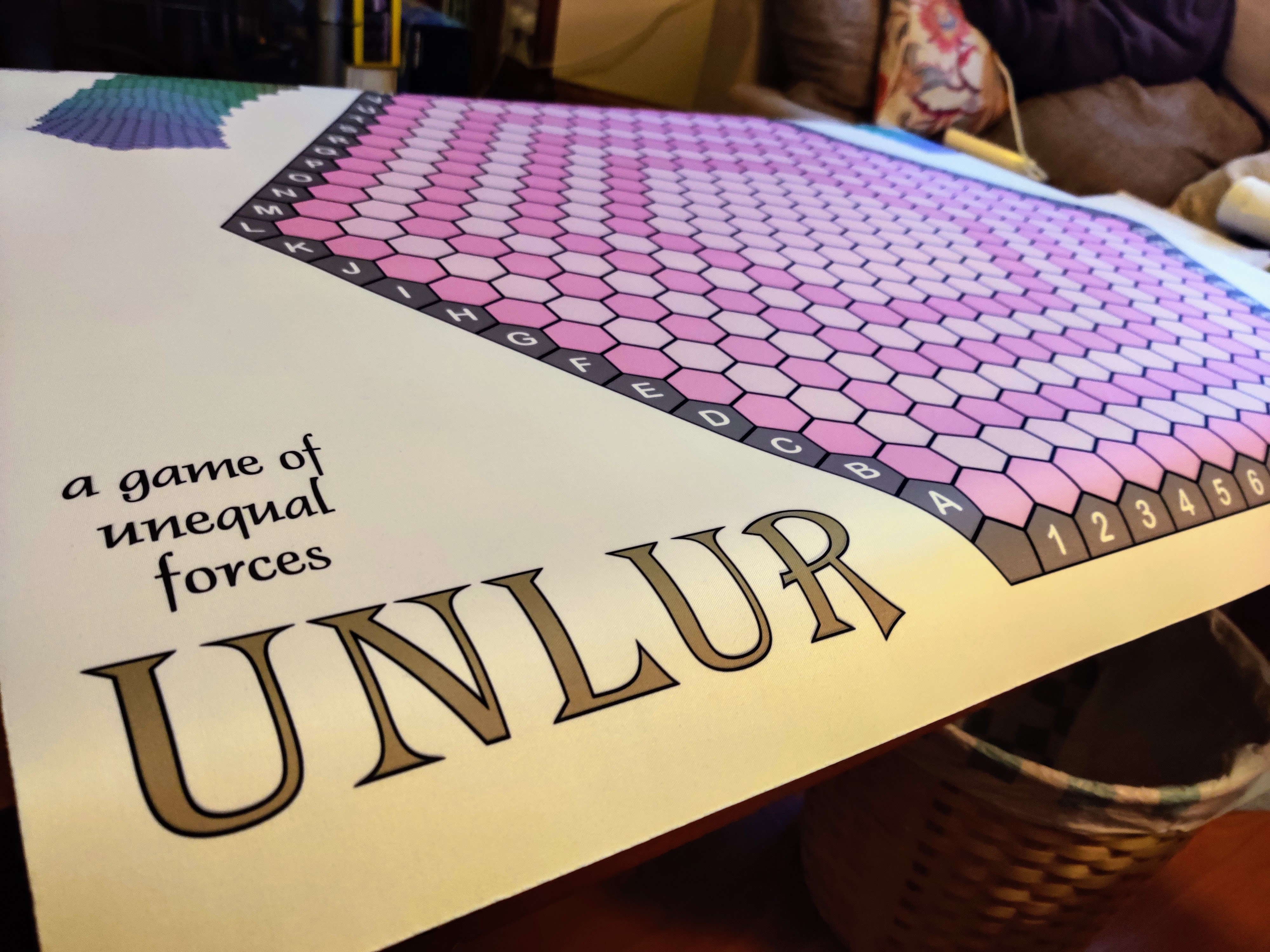
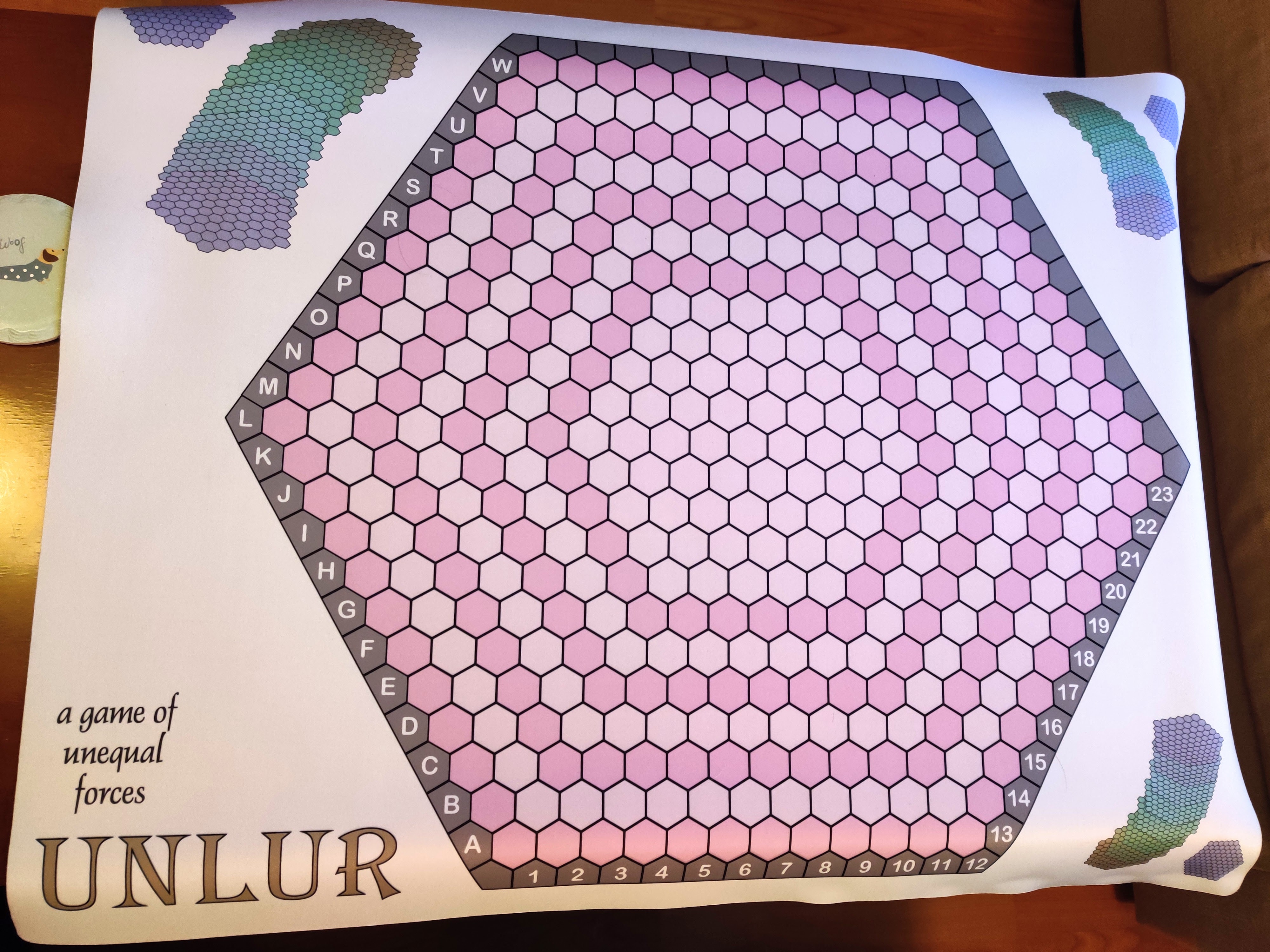
If you want to play in real life, I’ve made some Unlur boards in a range of sizes — hexhex-6, 7, 8, 10 and 12 — which are directly derived from the original Unlur hexhex-6 board offered in Abstract Games magazine.  I posted them on BoardGameGeek with permission from Kerry Handscomb of Abstract Games.  There are two versions — one with the original muted bronze board colour and grey background, the other with a white background and lighter board colour.  Both are in PDF format and look great printed out on a gaming mat — you can see my own neoprene-printed version below!

Summing up

Unlur is a game of genuine ingenuity, and it offers unique wrinkles you won’t find in any other connection game.  The contract phase is a fantastic addition, artfully accomplishing the difficult design goal of a balanced asymmetric connection game.  Finally, it’s fun — the contract phase is tense, forcing you to constantly second-guess your opponent and think carefully about each stone and how it will affect the coming game; and the subsequent connection battle feels even more consequential than in other games, given that your own misplaced stones can come back to bite you, potentially forcing you to make your opponent’s connection and lose the game.  I give this game my highest recommendation and hope some of you might consider giving it a try.

Related Games

Before I move on I’d be remiss not to mention Cross, Cameron Browne’s connection game inspired by Unlur.   Cross is also a connection game played on a hexhex board, but here there is no contract phase — instead, players both are striving to connect three non-adjacent sides of the board, and either player will lose if they make a line connecting two opposite sides of the board.  The game plays very differently than Unlur, but the shared element of the Y-connection wins/line connection loses dynamic leads to some tense situations, much like the middle/late-game of Unlur.

Conveniently, you can buy a physical Cross set with a hexhex-7 board from Nestor Games — and the components are generic you can play Unlur on that set too if you want!  Nestor also offers hexhex-8 and hexhex-10 boards via the games Iqishiqi and Omega respectively, if you want to play larger games.  Cross is also playable on Richard’s PBEM Server.

While I’m here I should also mention Coil — an intriguing game by Nick Bentley that adopts Unlur’s contract phase mechanism.   In Coil, players start with a contract phase as in Unlur, except the board starts with black stones in each corner cell, and stones placed during this phase cannot be placed adjacent to one another.  Once someone passes and takes the contract as Black, that player must then try to form a loop of Black stones (a loop being defined here the same way as in Havannah), while White tries to prevent the loop from being formed.  If Black forms a loop, they win; if the board fills up without a Black loop, White wins.  Coil is an interesting take on the asymmetric connection game, and ends up feeling quite different from Unlur.  Again it’s playable on any hexhex board with black and white stones, so definitely give it a try after your Unlur games!

Nick Bentley also designed another game with a loop-formation win condition and an Unlur-esque contract phase — Bobina, where players bid not with the black stones but instead with grey neutral stones that can help either player form a winning loop.  The concept is very clever but a bit hard to explain briefly here — I’d recommend you go have a read of Nick’s blog post to get a clear picture of it.  This is another interesting take on the contract phase, and definitely worth a try if that aspect of Unlur appeals to you.  I have to say I slightly prefer Coil due to the simplicity of that game and the asymmetric aspect, but Bobina does offer a unique twist with the neutral stone element.

That’s it for our in-depth look at Unlur — next time I’ll cover Side Stitch and sister games Exo-Hex and Iris.


Tagged , , , ,

Connection Games III: Havannah and Starweb

In keeping with Part II, today I’m going to introduce two games by one designer — Christian Freeling, who maintains an invaluable website full of his creations including versions playable in your browser.   Christian has invented a tonne of well-regarded games over the years, and he has his own opinions on the most essential ones — namely Grand Chess, Dameo, Emergo, Sygo, Symple and Storisende.  Although I’m not sure I can agree with most of them, personally speaking — that list is mostly games I certainly admire, design-wise, but don’t particularly enjoy playing.

However, there are two of his games that I find completely, indisputably brilliant:  Havannah and Starweb.  Both are fantastic additions to the connection game family.

Havannah

Havannah is a connection game that offers a completely unique take on the genre.  Connection games are typically characterised by a sense of absolute clarity — the goal is simple, singular, and direct.  Connect a thing to other things, and there you go.  But in Havannah, players can win in three different ways — and to play well, you need to threaten to do all of them and defend against all of them simultaneously.  The consequence is a game of intense depth and richness, and substantial challenge.

Here’s the basics:

  1. Two players, one with black stones and one with white, play Havannah on a hexagonal board tessellated with hexagons (known as a ‘hexhex’ board).  The commercial Havannah release used a hexhex board with 8 hexes on a side (169 playable hexes), but Freeling considers a hexhex-10 board to be ideal (271 playable hexes).
  2. The game starts with the swap/pie rule.
  3. Each turn, a player places one stone of their colour on any empty space on the board.  Once placed, stones do not move and are never removed.
  4. A player wins when they achieve one of the following configurations (these examples are from real games on Little Golem) —

ring — a chain of pieces that completely surrounds at least one hex, which can be empty or occupied (by opposing stones or your own):

havannah-bigring1

Rings can get quite elaborate — can you see how White’s convoluted ring formation here?

havannah-ring1

Rings can also be tiny and enclose just one hex!  These are easier to spot so it can hurt when you lose this way….

fork — a chain of stones connecting three non-corner hexes on three different sides of the board:

havannah-fork1

Black completes a fork here.  Note that it includes a corner hex, at the bottom, but also includes a non-corner one there too, so it still works!

havannah-elaboratefork

A rather impressively labyrinthine fork here from Black.  A clever win from what looks like a hard-fought game.

A bridge — a chain of stones connecting two corner hexagons:

havannah-bridgeproper1

White constructs a fairly convoluted bridge here from the top-right corner to the bottom corner

As you can see already, Havannah puts a lot on your plate as a player.  The rules are hardly any more complicated than any other connection game, but the objectives are many and varied.  The consequence of this is that at every turn you must be aware of the many possible implications of your opponent’s stones, and you have to learn to catch the signs of key strategic and tactical threats.

In fact the game is so strategically rich that in 2002 Christian Freeling instituted an AI challenge, betting €1000 that no computer could beat him even one game out of 10 on a hexhex-10 board within a decade.  Predictably, he lost that challenge in 2012 and lost 3 games of his ten-game match against the machines.

Now one might feel disappointed somehow when computer players surpass humans in games, but honestly having superhuman AI for a newer game is a good thing — it accelerates the decades- or centuries-long process we normally need to really probe how our games hold up at a high level of play.  That aside, to be fair to Christian Freeling, his game lasted nearly the full decade; these days, if anyone with some decent computing power is paying attention, any game would be lucky to last a few months.  Especially now that AI doesn’t even need to know the rules first to master a game!

Basic Havannah Tips

Havannah, even more than other connection games, really comes alive once you’re armed with a few key strategic and tactical concepts.  I’m by no means an expert here — at the end of this section I’ll link you to some people that are — but there’s a few tips I can offer to get you started:

  1. The game plays kind of like a combo of Go and Hex — a certain Go feel is apparent in how important whole-board strategic vision is, and that groups of stones can be ‘alive’ or ‘dead’ depending on their capability to form part of an attacking threat.  The Hex side manifests in the moment-to-moment tactics and the importance virtual connections (bridges, in Hex terms) between stones.
  2. Perhaps the most important strategic concept to learn is the frame — a set of stones forming the backbone of an unbreakable winning formation, regardless of the opponent’s response.  Check the guides I link below for some examples, and keep an eye out for your opponent threatening to make a frame!
  3. The one-hex ring enclosure — the mill — is a really important tool in Havannah.  Rarely will you beat an experienced opponent that way, but building a mill can force a response from your opponent, gaining you initiative — and can interfere with their plans for their own stones, as well.  Conversely, it’s important to learn how to defend against mill threats so you don’t fall prey to the same outcomes.
  4. Board size matters!  On smaller boards, bridges and forks are powerful.  On larger boards (hexhex-10 and up), bridges and forks are harder to build and rings become somewhat more prominent.
  5. Draws are possible in Havannah — but just barely.  Out of tens of thousands of online games, there are single-digit numbers of draws that have ever happened!  Therefore, don’t think an attempt at a drawing strategy will save you when things go bad — it’s extremely unlikely to work!


Havannah frames

An example of a ring frame (Black) and a fork frame (White)

To really dig into the complexities of Havannah, I strongly recommend the brief but comprehensive guide by David Ploog, available in PDF format here (and please see his other amazing guides for other games in the BGG thread here), which covers all the key concepts and includes numerous examples and some problems to test your comprehension.

For a bit of discussion and strategic and tactical guidance for Havannah from the creator himself, do check Christian Freeling’s Havannah website, and his articles in issues 14, 15 and 16 of Abstract Games Magazine (that link takes you to their back-issue archives).

Finally, when you feel up to the challenge, you can play Havannah via Stephen Tavener’s Ai Ai program, the Mindsports website, on Little Golem, Richard’s PBEM Server, igGameCenter, and probably other places too!  There’s a physical version of Havannah published by Ravensburger in 1981 that goes for very little on Ebay, but that only has a hexhex-8 board — for larger ones you’ll need to print something up yourself or repurpose another set, like Omega from Nestor Games.

While I’ve been on strike, my wife has helped me to learn Adobe Illustrator so I could make some nice hexhex-10 and hexhex-12 boards usable for Havannah and numerous other games.  The final results are available in three colour schemes from the BoardGameGeek Havannah files section.  These are sized for printing on 25 inch by 25 inch neoprene playmats, which are a popular way to get sturdy game boards made these days.  If you printed them on mats of that size you can use standard 22mm Go stones on these boards.

I also made hexhex boards of size 7, 8, 10, 11, and 12 in the style of the board used on Little Golem, which is probably the most popular place to play Havannah.  I like the random splash of colours across the hex grid, so I decided to create a range of print-and-play boards in that style.  You can find these boards at my BGG filepage for Havannah along with the other versions.

hexhex-10_RED-01

Hexhex-10 board, with highlighted borders to allow players to use this one board as a hexhex-9, 8, 7, etc. as well.  Two other colour schemes are available on BGG, too.

hexhex-12_LG style-01

Hexhex-12 board in Little Golem style.  I really am proud of this one, as it took some doing to replicate that colour pattern. 

Laika-hexhex10

Showing off how the game works on my neoprene-printed hexhex-10 Havannah board.  My dog Laika is fascinated.

However you go about playing it, Havannah is an absolute gem among the connection games.  It’s tactical and strategic, mind-bending, and always enticing to play.  If there were any justice in the world it’d be getting played by millions of people like Chess and Go, but alas, we’ve got to dig up players the old-fashioned way.  But Havannah’s worth the trouble.


Starweb

One thing you’ll notice about Christian Freeling if you start following developments in the abstract strategy games community is that he has claimed he was retiring from game design about 100 times, yet he always comes back.  Starweb appeared during one of these ephemeral retirements — he says the game came to his mind suddenly, basically fully-formed almost out of nowhere.  Lucky for us that it did, as in my opinion it’s another masterpiece.

Starweb is a clear descendant of Star/*Star, being a connection game that incentivises connecting certain key points on the board with as few groups of stones as possible.  What makes Starweb stand out is both the shape of the board, which creates 18 key corner hexes that drive the gameplay, and the triangular scoring mechanism.

Starweb’s simple and elegant rules lead to board-spanning strategic play, in some ways reminiscent of Havannah.  Here’s what the standard board looks like:

starweb-regular-01

Starweb standard board (dubbed size 10 in Ai Ai).  It’s a hexhex-7 board with six added chunks of 15 hexes on each side, giving us 217 playable hexes in total, and 18 corner hexes (highlighted in brown).  And yes, that is the font from Star Trek — bonus nerd points if you know what language that is underneath the Trek-style logo!

Play is appealingly simple, although the scoring mechanism takes a moment to sink in:

  1. Two players, Black and White, play on the standard Starweb board or one of its smaller variants.  The board starts empty.
  2. Play starts with the swap/pie rule.
  3. Each turn, a player places one stone of their colour on any empty hex on the board.  Once placed, stones never move and are never removed.  Players may also pass their turn and not place a stone.
  4. The game ends when both players pass in succession.
  5. Once the game ends, players calculate their score as follows:
    1. Players identify each group of their stones that contains at least one corner cell (a ‘group’ is a connected bunch of like-coloured stones)
    2. The score for a group containing n corners is the sum of n and all positive integers less than n.  In other words, a group containing 1 corner is worth 1 point; 2 corners = 2 + 1 = 3 points; 3 corners = 3 + 2 + 1 = 6 points; 4 corners = 4 + 3 + 2 + 1 = 10 points; and so on.
    3. The player with the highest score wins.  In the event of a tied score, the player who placed the second stone wins.

So, to win Starweb, you have to occupy corner cells and connect those corners together into united groups of stones to score more points — the more corners in your group, the more points you score.  At the start of the game the players will normally go back and forth occupying corner cells, and from there proceed to wind their way across the board trying to connect them together.  This leads to dense, complicated webs of connected stones — hence the name Starweb!

I have to admit I’m not a huge fan of the second-player-wins-draws rule, since there’s already a swap rule in place at the start — that reminds me of Armageddon Chess, where Black wins in the case of a draw, which is pretty widely disliked.  But the abstract games community generally seems very adamantly against draws, and designers tend to go to significant lengths to avoid them.  That seems somewhat strange to me, since that means the game is by definition unbalanced as one of the players will have a winning strategy with perfect play; I personally slightly prefer Havannah/Shogi scenarios where draws are possible but just quite rare.  In any case equal scores in Starweb are going to be pretty uncommon, so it’s not a big issue particularly, but the rule may influence your decision whether or not to swap your opponent’s opening move when going second.

Playing Starweb

The richness of Starweb becomes apparent once you discover that preventing your opponent’s connections between corners can be just as vital as connecting your own.  Early on Christian Freeling realised that a minority strategy — in which one player declines to take all the corners they could and instead works to invade the opponent’s territory and deny them connections — is quite viable.

Here’s an example game against AI on a small board that he posted on BoardGameGeek:

starweb-8-corners-small

You can see here that White (the AI) holds more corners (10 vs 8), but Black (Freeling) managed to cut several of them off, denying his opponent the ability to make big-scoring groups.  Meanwhile he was able to slice through the centre of the board, leading to a winning score despite holding less corners.

This game also shows off other nice properties of Starweb: the games tend to be intricate and long; and the game plays well even on much smaller boards.  The Starweb implementation in Ai Ai allows for boards even smaller than the above, and the game still holds up.  It’s definitely more fun on the normal-sized board though.

The minority strategy still works on the large board, too:

starweb-minority-strategy-large

After connecting stones 86 and 6 in the bottom right, Black will extend his lead by 5 more points. White is completely lost.

Freeling (Black) again takes less corners here, but manages to sprawl all the way across the board for a big-scoring connection.  White has no hope of catching up, as the AI’s largest groups are split down the middle by Black’s connection across the centre of the board, and the extra White corners elsewhere are completely walled off.

Through these sample games we can see that Starweb admits a variety of strategic approaches; when first learning the game we might think grabbing every corner is essential, but as we see above, denying your opponent scoring opportunities can compensate.  And by declining corners you can gain the initiative, exchanging turns you’d have spent on building a group for turns you can spend on attacking your opponent’s strategic goals.

At first the game might seem overly mathematical, in that counting corners and calculating scores seems so critical.  But in actual play that doesn’t really interfere; once corners are occupied, you don’t need to track them anymore, and that normally happens very early in the game.  Subsequently you just need to be aware of how many corners you need to connect to keep your opponent at bay.  So the numbers come into play when planning your approach to a particular early-game board situation, but after that you can focus mainly on tactics and trying to connect your groups and execute your plan.

For detailed and enlightening discussion on Starweb’s strategic complexities, you can check out the discussion from Freeling and others on BoardGameGeek.  That thread goes into more detail on the sample games I posted, and numerous others as well.  There’s also some useful discussion on the Arimaa Forums in this thread, starting at post #104, although sadly the image links are all broken now.  Starweb is still a young game, so as more people discover it perhaps we will see start to see guides on strategy and tactics on the level of those we can find for Havannah.

I highly recommend Starweb — you can play on Freeling’s MindSports site, or you can play against AI and human opponents on various board sizes via Stephen Tavener’s AiAi software of course.   In my opinion it’s an underrated gem, right up there with Havannah as one of the most strategically satisfying connection games.  It’s still early days for Starweb, as it was only developed in 2017, so hopefully as the years go by the game will develop the following it deserves.

Where next?

So, we’ve taken a look at the connection game titan Hex, the quirky and influential family of games by Craig Schensted/Ea Ea; and now two strategic masterpieces by Christian Freeling.  Already you could easily spend a lifetime exploring these games and never unlock all their secrets.

Of course that’s far from everything the genre has to offer!  Next time I’ll cover one more excellent connect-the-key-hexes game, Side Stitch, and then I’ll spend a fair bit of time talking about Unlur, an ingenious asymmetric connection game where the two players have different winning conditions.


Tagged , , , ,

Connection Games II: Y, Poly-Y, Star and *Star

Welcome to part II of my series of posts about games, part of my mission to keep my brain busy while I’m on strike!

Moving on from the last post about Hex, this time we’re going to explore a whole series of connection games, each by the same designer and each a clear progression from the last.  By the time we get to the final game in the series, we’ll see one of the more complicated and sophisticated connection games out there.

The Game of Y

First though, let’s start with something simple.  In fact, this game is even simpler than Hex, which scarcely seems possible!  Recall that in Hex, each player has a slightly different goal — both seek to connect across the board, but each player is connecting different sides.

In the Game of Y, created by Craige Schensted (who later renamed himself Ea Ea) and Charles Titus in 1953, players have the same goal — to connect all three sides of a triangular board made of hexagons.  To sum it up:

  1. Players take turns placing one stone of their colour in any empty hexagon on the triangular board.  Once placed, stones do not move and are never removed.
  2. The first player to connect all three sides of the board wins.  Corner hexes count as part of both sides to which they are adjacent.

And that’s it!  Winning connections spanning the three sides look kind of like the letter Y, hence the name.  Just like Hex, Y cannot have draws, one player will always win eventually.  The first player has a winning advantage here, as well, so using the swap/pie rule is recommended to alleviate this.

Y is sometimes thought to be even more elemental than Hex, given the greater purity of the win condition.  In fact, Hex can be shown to be a special case of Y, but in practice the games are pretty distinct in terms of the tactics required.

Here’s a sample game I played against a simple AI on a triangular board 21 hexes on a side; I used Stephen Taverner’s excellent Ai Ai software that comes with a plethora of great connection games:


y-win-1

Y benefits from playing on a larger board, given the shorter distances between sides when compared to a Hex board.

One issue with Y is that, even more so than Hex, the centre hexes are very powerful.  Whichever player controls the centre is very likely to win.  Schensted and Titus developed a number of ideas for new boards that would reduce emphasis on the centre, and eventually the ‘official’ Y board became this interesting geodesic hemisphere:

y-17-curvedThis board reduces the connectivity of the central points, giving the sides and edges greater influence on play.  Some theorise however that on this board basically every first move should be swapped by the second player, although I don’t believe there’s any hard evidence that this is true.  Kadon Enterprises sells a lovely wooden version of this board, albeit smaller than the one above, with 91 points available for stone placement. 

UPDATE:  Phil Bordelon reports in the comments below that the Kadon Y board is so small that the game feels like a trivial first-player win!  So perhaps if you want to try this board shape, play the larger one on the Gorrion server, or print the larger pattern on a mat for face-to-face play.  David Bush also wrote to say that he believes the geodesic Y board can’t be balanced with just the pie rule, and given his serious pedigree in the connection games world I think I will take his word for it!  He also says that three-move equalisation can be a solution.  In this method, one player creates a position with two Black stones and one White, with White to move, and the other then decides whether to play White or Black.

Another alternative option to the geodesic Y board is known as Obtuse-Y.  In this version of the game we play on a hexagonal board tessellated with hexagons (a ‘hexhex’ board), with three pairs of sides marked — first player to connect all three of those marked sides is the winner.  I like this version of Y since a large board in this format is more compact than a gigantic triangle of hexes, and it’s easier to have a balanced game than on the geodesic board.  I made two boards for this version, which you can find on BoardGameGeek — a hexhex-10 (10 hexes on a side) and hexhex-12.

hexhex-10_Obtuse-Y-01

My hexhex-10 board for Obtuse-Y — connect all three colours to win!  There are 271 playable hexes on this board.

In any case, Y is another simple-yet-deep experience and highly recommended.  You can play against the AI using the Ai Ai software linked above, or against humans in real time via igGameCenter, or by correspondence on Richard’s PBEM Server.  The geodesic version is only playable on Gorrion — definitely give it a try.

Finally, I want to note that Y has a ‘Misère’ version, much like Hex, where you try to force the opponent to connect all three sides before you do.  This variant of Y is called ‘Y-Not’.  I just love that.


Mudcrack Y and Poly-Y

The next step in Y’s evolution came when Schensted and Titus published a gorgeous little book called Mudcrack Y and Poly-Y (you can still buy it from Kadon), which contained hundreds of strange hand-drawn boards for Y players.  They intended for players to use these boards by marking spaces with their chosen colour using coloured pencils.  These weird little boards seem totally different from the normal Y triangle or geodesic hemisphere, and yet turn out to be topologically equivalent.  Here’s a sample page:

mudcrack y1

A sample page of Mudcrack Y boards.  Print them out, grab a couple of coloured pencils and give them a go!

As part of their continued quest to improve on the Game of Y, this book also reveals Poly-Y, a follow-up game intended to be a further generalisation of Y:

  1. Players take turns placing a stone of their colour on any empty space on the board.  Once placed stones cannot move and are never removed.
  2. If a player’s stones connect two adjacent sides and a third non-adjacent side, that player controls the corner between the two adjacent sides.
  3. If a player controls a majority of the corners on the board, that player wins.

As you might have guessed, once again this game permits no draws (as long as you play on a board with an odd number of corners), so one player will always win.   The pie rule is used to mitigate the first-player advantage.

Wikipedia and BoardGameGeek claim there is no ‘official’ Poly-Y board, but this isn’t correct.  On the archived version of Craige/Ea Ea’s website you can find his summary of the history of Y/Poly-Y/Star/*Star, where he says this:

“Craige tried boards with more and more corners, 5, 7, 9, 15 … . At first it seemed that the more corners the better — there were more points to contest and a beautiful global strategic picture emerged. But as the number of corners increased, of necessity the length of the edges decreased. When the edges became too short it was found that it was too easy to make a Y touching 3 consecutive edges, thus “capturing” the middle edge and the two corners bounding it. This “edge capture” tended to make the game more tactical and local, focused on quick gains along the edge, thus losing the elegant global strategic flavor . So the strategic depth increased at first as the number of corners increased, but then decreased. Finally a board with 9 corners and 7 cells along each edge was chosen as the ideal balance….  Craige chose the 208 cell board with the 7-sided regions halfway to the center as the standard Poly-Y board.”

The same document has a picture of the standard board compared to two other candidates:

poly-y-board-official

The ‘standard’ Poly-Y board is in the centre.  The highlighted spaces on each board are the heptagons, required to allow the board to have 9 corners and still consist mostly of hexagons.

Here’s an example Poly-Y game won by Black on a board with 106 spaces and five corners — note here that the other player is Grey, and the yellow spaces are unoccupied:

poly-y-sample-game2

Black controls the corners on the left side, and has blocked Grey from catching up.

While Craige/Ea Ea endorses the 208-cell nonagon as the best Poly-Y board, in Mudcrack Y and Poly-Y they also state the game plays well on any board with the following characteristics:

  • Equal numbers of spaces along each side
  • Mostly six-sided board spaces
  • An odd number of sides (they prefer 5- and 9-sided boards)

Here’s sample 5-, 7- and 9-sided boards to print and play on:

poly-y-5-sided

5-sided Poly-Y board

poly-y-7-sided

7-sided Poly-Y board

poly-y-board9

9-sided Poly-Y board


Poly-Y is a clever game, and very deep; the win condition pushes players to extend their groups of stones all over the board, linking corners together through the centre to block the other player from securing their corners.  The oddly-shaped boards are also fun to play on, and give the game a certain quirky aesthetic appeal.  However, perhaps due to the rapid-fire iterations on Y produced by Schensted, Poly-Y never got the same level of recognition as Y itself.


Star

Schensted wasn’t quite done yet — far from it.  His next invention was Star, which ramped up the complexity of the scoring system from Poly-Y and created a game that pushes players to connect all over the board.  Star is another very deep game, and even on a small board presents a considerable challenge.

Star is played on a board of tessellated hexagons with uneven sides — in the sample small board below, you can see that three sides are five hexes long, and the other three are six hexes long; this ensures that there’s an uneven number of edge cells so that draws are impossible:

Star

A small board for Star with 75 hexes and 33 border cells.

Here’s how to play Star:

  1. Players take turns placing one stone of their colour on any empty hex.  Once placed, stones do not move and are never removed.
  2. A connected group of stones touching at least three of the dark partial hexes around the edge of the board is called a ‘star’.  Each star is worth two points less than the number of dark border hexes it touches.
  3. When both players pass or when the board is full, the player with the most points wins.
  4. As per usual, the pie rule is used to mitigate the first player advantage.

This may sound a bit opaque, but the basic gist is: form as many stars as you can, but connect them together to maximise your points.  The end result of a game of Star is an intricate web of connections snaking across the board for each player, attempting to connect and block simultaneously wherever possible.  Since the entire edge of the board is available for scoring, the whole board interior tends to come into play as well, and unlike most connection games the board tends to be nearly full when the game finishes.

Unfortunately, despite pretty much universal praise for this game it’s very difficult to find sample games of Star, so here’s the only one I could find from Cameron Browne’s book Connection Games — I can’t emphasise enough that this is a great book that you should definitely buy!

star-sample1

In this example, the edge scoring cells are marked by X’s rather than a border of partial hexagons.  Note that the completed game takes up nearly the entire board, and the pattern of connections formed is quite intricate even on this small playing area.

As with other connection games, playing on larger boards amps up the strategy.  I found these boards lurking around the Wayback Machine, do give them a try:

Star2

This board has 192 interior cells and 51 border cells.

Star3

This board has 243 interior cells and 57 border cells.

I liked these boards so much that I made a range of Star boards — sizes 8, 9, 10 and 12 (the number being the number of hexes on the longer sides).  I hope a few folks might print them out and give Star a try sometime.

Star-8_PURPLE-01

My size 8 Star board in purple

Unfortunately, despite the coolness of this game it’s been thoroughly overshadowed by its successor; Star does appear to be playable at Richard’s PBEM Server, albeit only with an ASCII interface.


*Star

Finally we come to the last in the line of games spawned from our old friend the Game of Y.  *Star takes yet another leap up in complexity, and to be completely honest, I don’t fully understand how this game works.  This is partly because the instructions are written in what feels like an alien language — scoring refers to things called ‘peries’ and ‘quarks’ and it’s all a bit strange.  However the abstract strategy game community praises this game nearly universally, so I remain keen to try and figure it out.

My understanding, questionable though it may be, is that the game essentially takes the core concept of Star — connect groups of edge-adjacent pieces together to maximise your points — to the next level by adding a scoring bonus for controlling corner spaces, and a significant scoring penalty (equal to twice the difference in the number of groups between the two players) for the player with the larger number of groups.  This heavily incentivises the players to connect their groups, and the end result of this is some beautiful patterns of stones snaking across the board, as in these two sample games from the manual (one tiny one and one normal-sized one):

Here’s a closeup of that awesome board:

starstar-board1

The *Star board.  The centre star can be used by either player as a connection between groups — neither player may place their stones on it.

Note that the board has thicker lines to define smaller board sub-regions, which allows players to ease themselves into the full game.  The game is popular enough to be produced in physical form by Kadon Enterprises, who make a wooden board set for *Star that I absolutely must buy at some point:

star-wood-board2starwood

How cool is that!  Someday I shall own this game, and I shall figure out exactly how to play it.

Luckily there’s a simpler game also playable on this board — Star-Ywhere the players compete to be the first to complete a connection between two adjacent sides and one side not adjacent to either of those two.  For *Star veterans there’s also Double-Star, where players place two stones per turn and the other rules remain the same; this seems like a small change but it significantly alters the play.  New tactics and strategies are necessary to cope with the new threats that are possible with two stone placements.

So there we have it — a hectic journey from the elemental Game of Y through to the complex but highly-regarded *Star, courtesy of the brilliant minds of Craige Schensted/Ea Ea and Charles Titus.  Craige/Ea Ea has stated that *Star is ‘what the other games were trying to be’, so from his perspective each game was improving on the last, and *Star is the best of the lot.

While researching and playing/trying to play these games, I’ve found that Star and *Star are frequently compared to Go, despite having connective goals rather than territorial ones.  Given the much more flexible nature of the connective goals in these two games, I can see why — instead of connecting specific sides, players define for themselves the key parts of the board as they play.  This is much more ‘Go-like’ in that the board is more of a blank slate, and does not inherently define the direction of play as much as in other connection games.  So, if you’re a Go fan and skeptical of connection games, maybe try these two.

If you’re new to connection games in general, I’d start with Hex, then Y, then Poly-Y.  You might enjoy Star and *Star more after trying some other games with more freeform connective goals, but with easier-to-grasp rules.  I’d recommend maybe trying Havannah and Starweb for that purpose — and lucky you, they’ll be in my next post 🙂


Tagged , , , , ,

Connection Games I: Hex

As you all have probably figured out by now, I really enjoy complicated board games — dense modern board games with tons of special components, 500-year-old Shogi variants with hundreds of pieces, all that stuff.  But I also have a great fondness for games on the other end of the scale: elegant abstract games with minimal rules and maximal depth.

Now an oft-cited example of this category might be Go — it’s certainly an elegant game, with rules that are easy to summarise yet a level of depth nearly unrivalled in board games.  But Go is also hard to understand, in that the goal is clear — secure more territory than your opponent — but working out how to get there is hard.  Most beginning players, myself included, are completely flummoxed by the empty board at the start of the game, and have no idea where to start.  And at the end of the game, it’s very difficult for newbies to figure out when the game is actually over!  There’s a reason a common proverb for beginning Go players is ‘lose a hundred games as fast as possible’ — building familiarity with the basics takes time and repetition.  It’s worth it, though.

But what I’m going to talk about here are games that are so simple as to be almost elemental, as in, it’s hard to imagine games with rules simpler than these.  For my money the best examples of these types of games are in the category of connection games.  In a connection game, players vie to be the first to connect key points on the board with their pieces — a simple goal, easy to see and easy to understand.  But underneath that these games offer surprising depths of strategy and tactics.

Now, the current bible for connection games is the book by Cameron Browne called — wait for it — Connection Games, which summarises the genre beautifully and includes rules and examples of play for numerous games.  It’s a great book that I certainly can’t compete with, so in this brief series of posts I’m just going to give you some details of my picks for the best games of this type, along with some useful resources and links to where you can play.

Hex

Any discussion of connection games has to start with Hex, the originator of the whole genre.  Strangely, despite the simplicity of these games, they weren’t around until quite recently.  Hex has a tangled history — now unravelled in the recent, and excellent, book Hex, Inside and Out: The Full Storyso I won’t attempt to summarise it all here.  The game was invented by Danish mathematician Piet Hein in 1942, and was initially called Polygon.  Hein sought to create a game that reflected his interests in topological properties of the plane and the four-colour theorem, and was stuck on this idea for some time, as any attempts to build his imagined game on a square grid didn’t work, as the players could easily become deadlocked.  Eventually he realised that a hexagonal grid would prevent this issue, and thus Polygon was born:

polygon-board-1

The Polygon board, an 11×11 rhombus composed of hexagons.

The rules of Polygon are incredibly simple:

  • Players turns placing a single symbol of their chosen type — star or circle — in any empty hexagon on the board.  Once placed, symbols don’t move and can never be removed.
  • The first player to connect the sides of the board marked with their symbol with an unbroken line of their symbols is the winner.

Easy, right?  But once he started playing, Hein realised the game was far more complicated than the rules suggested.  Soon after he launched the game in the Danish magazine Politiken with the board, rules and a call for challenging Polygon puzzles from readers.  It wasn’t long before pen-and-paper Polygon pads were selling like hotcakes all over Denmark, and the game became a bonafide hit.

polygon-puzzle-1

The famous first-ever Polygon puzzle.  The circle player has the move.  How can they win?

Eventually Hein sold a 12×12 version of Polygon with a very nice wooden board called Con-Tac-Tix, which enjoyed some small success as well — and in fact you can still buy a version of this today from Hein’s grandson.  But the game didn’t really take off around the world until later, when famous mathematician John Nash (of A Beautiful Mind fame) rediscovered the game in 1948.

When Nash started sharing his discovery with colleagues at Princeton, the game rapidly gained adherents.  They often called it Nash, for obvious reasons, but legend has it some called it John instead — not because of Nash’s name, but as a nod to the fact they played it on the hexagonal tiles of the bathroom in the department!  Nash became Hex when Parker Brothers tried to market the 11×11 game with that name.  Around the same time Nash was attempting to market the game and was quite upset to discover he’d been scooped.  He wasn’t aware at that time that Piet Hein had in fact scooped him several years earlier anyway.

In any case, the game became an object of enthusiastic study by Nash and his colleagues, and they made numerous interesting discoveries about its properties.  Hex was largely just an object of interest for academics for the most part, as Parker Brothers’ attempt to sell the game didn’t amount to much.  A few years later the mathematician Martin Gardner played a pivotal role in the eventual worldwide popularisation of the game — his 1957 Scientific American column on Hex brought the game to a whole new audience.

Hex remains highly popular with mathematicians and computer scientists today, as well as with gamers, as it has some fascinating properties.  For example, draws are completely impossible in Hex — no matter how inept or random the players’ moves, eventually one of the players will always make a winning connection across the board.  This result is actually a consequence of something called the Brouwer fixed-point theorem, which I won’t get into here.  We also know that a winning strategy for the first player exists, but we have no idea what it is (well, we’ve found it by brute-force computer calculation for 9×9 boards and smaller, but not on the boards we actually play on).  A quick browse of the literature on Hex will reveal some fascinating contributions from big names in maths and computer science.

The current state of play

In the years since Piet Hein’s invention of Polygon, Hex has evolved somewhat.  The classic 11×11 board is still popular, since it has a nice balance of speed of play and intricacy.  Games on the 11×11 board are over relatively quickly, yet these 121 hexagons allow for a staggering 1056 possible board positions, 10 billion times more than the number of possible Chess positions (1046)!

However many Hex players nowadays are using larger boards, with 13×13 and 19×19 being particularly popular. 14×14 is fairly common as well, particularly as that was John Nash’s preferred board size. In any case, larger boards push the game further into the realm of strategy rather than tactics, allowing for deeper moves with greater subtlety. Here’s how a 13×13 Hex board looks today:

hex13-sample

A 13×13 Hex board.

And here is a 19×19 Hex board that I designed and just had printed on a 19×19 neoprene mat.  The mat is 93cm x 56cm, and the hexes are large enough for use with Go stones.

Hex19-1

My 19×19 Hex board.

In general we’ve abandoned the circles and stars of Polygon’s heyday and opted for the two players using black and white stones to mark their hexes, with the board edges marked accordingly.  Often you’ll see blue and red stones used instead.

More importantly, now that we know that Hex gives the first player a winning advantage, we play Hex using the swap rule, an ingenious way to even things out.  When the first player places their stone, the second player may choose to play one of their colour in response, after which the game proceeds normally, or they may choose to swap colours and take that move for their own first move!

This clever rule change means that the first player must intentionally play a weaker opening move to avoid a swap, thereby mitigating their first-player advantage instantly.  In practice the strongest opening moves are in the centre of the board, as these allow for connecting stones to extend in every direction, so generally the first player will play around the edges at the start to avoid a swap.  As you might expect, the first-player advantage is somewhat diminished on larger boards, given that the impact of individual moves is smaller in general.

Side note — the swap rule is often called the pie rule as well, as it mirrors the fairest way to divide up a slice of pie between two people: one person cuts, the other chooses which slice they will eat.


Playing Hex

So, once we’ve grabbed a funky rhomboid board of our preferred size, a couple piles of stones and sat round a table to play, how does the game actually work?  Here’s a quick sample game, showing me defeating a basic computer opponent on the 11×11 board:

hex11-win1

I played this game using a fantastic bit of free Java-based software called Ai Ai, which has numerous awesome abstract strategy games available to play with a variety of AI opponents — find it here: http://mrraow.com/index.php/aiai-home/aiai/


The play in this game was reasonably simple, but if you jump onto the most popular site for playing Hex, Little Golem, and check out the larger boards you’ll soon see that the end result of a Hex game can look pretty complicated:

hex13-sample2

A game played earlier today on Little Golem (https://www.littlegolem.net/jsp/game/game.jsp?gid=2145661)


Black resigned after 70 moves, admitting defeat.  The reason why Black resigned may not be immediately obvious; after all, Black seems to have made good progress along the left side!  However, we can start to understand how games of Hex evolve once we understand some basic positions, particularly the bridge:

hex-bridge

An example of a bridge: White’s stones 2 and 4 can be connected no matter what Black does.

The bridge means that connection between the two relevant stones is unstoppable.  As you can see above, if Black plays at A to attempt to break apart White’s stones, White simply plays at B, and vice versa.  The bridge is a simple example of a template, a formation of stones and empty hexes that facilitates an unstoppable connection.

If you look again at the sample games above, you’ll see several examples of bridges being used to establish connections between stones.  Using this formation is far more efficient than placing stones methodically next to one another, but the connection they provide is just as solid!  Using bridges and similar templates allows you to build connections in fewer moves.  As you learn more of these templates in Hex, you’ll be able to spot a win or a loss coming long before the final stone is placed.

By the way, now that you know what a bridge is, you should be able to solve Piet Hein’s puzzle above!

Another key concept of Hex is that defence and offence are the same thing.  Remember that in Hex one player will always win — from this we can work out that if we prevent any possible win by the opponent, that means we have to win instead!  So when playing Hex, don’t be focussed just on your own bridge-building and forget your opponent — spending your moves on blocking them still gets you closer to a win.  Sometimes the best offence is a good defence.

To get started with Hex, I suggest you just jump right in and start playing some games.  You can play Hex  on Little Golem, Richard’s PBEM Server, Amecy Games, Gorrion, Hexy.games and igGameCenter among others.  You’ll soon find that Hex is an intricate and precise game with enormous amounts of depth.  If you work on building bridges, blocking your opponent, and getting a general feel for the flow of the game, you’ll soon start to get the hang of the basics.

After losing a few times and hopefully stumbling across a win or two, go and visit Matthew Seymour’s incredibly detailed guide on Hex strategy.  His site is details key concepts like ladders and edge templates, walks you through some sample games, and provides lots of useful resources, plus everything is demonstrated through interactive diagrams!  It’s an incredible guide.  The bridge example above is a screenshot from this site, which I hope will encourage you to visit.  On the real site you can experiment and play moves on all the diagrams, which really helps cement the concepts explained in the guide.


Hex Variants

As you might expect with a game this elemental, numerous Hex variants have been devised over the years to spice things up.  There’s a tonne of these so I’ll just briefly highlight a few interesting ones:

Misère HexThink of this as Opposite Hex — the first player to connect their sides of the board loses!  It’s an odd style of play to get your head around, where you need to force the opponent to connect while avoiding making progress yourself.  Interestingly, it’s been proven that the losing player has a strategy that guarantees every hex on the board will be filled before the game finishes.

Pex:  The rules here are the same as Hex, but the game is played on an unusual board — instead of hexagons, the board is tiled with irregular pentagons.  This changes the tactics significantly, given that the board spaces now have different connectivity, and makes for an interesting change of pace.   You can play Pex online at igGameCenter.

pex-iggc

An 8×8 Pex board.

Nex:  This intriguing variant uses the standard Hex board, but alongside your White and Black stones you add neutral Grey stones.  Grey stones can’t be part of either player’s winning connection, so they are obstacles to both players.  But what makes this game brilliant is the new options available — a player’s turn now gives them two possible moves:

  1. The player to move may add one stone of their colour AND one neutral stone to any empty hexes on the board, OR
  2. They may swap out two neutral stones for stones of their colour, and then replace one stone of their colour with a neutral one.

This means that moves are not permanent in Nex — your stones can be recycled when the board situation changes, and seemingly innocuous neutral stones can suddenly become new threats for either side when they transform.

Just like in Hex, there are no ties and one player must win.  You can play Nex on igGameCenter.

nex-sample-game1

A sample Nex game from the book Mathematical Games, Abstract Games — Black resigned.

Chameleon: Another intriguing variant that significantly changes up the play, Chameleon decouples players from colours.  In Chameleon, one player is Vertical and must make a connection of either colour from top to bottom, and the other is Horizontal and must make a connection of either colour from side to side.  On each turn a player may place a Black stone OR a White stone on the board on any empty hex.

The consequence of this is that players have to be aware of threats in the opponent’s direction from stones of either colour, making each move feel incredibly consequential!  It’s a bit of a mind-bender.  Chameleon benefits from playing on larger boards, as connections can happen too quickly on smaller ones given that players use both colours.  You can play it online using Richard’s PBEM Server.


What next?

Now that you’ve had an intro to the original connection game, you’ll be well-equipped to try your hand at Hex’s many fascinating cousins.  The basic concepts of Hex are helpful in a lot of other connection games too, although each of them adds their own unique wrinkles.

Over the next few posts, I’ll highlight some more connection games with interesting properties that are fun to play, including the Game of Y, TwixT, Havannah, ConHex, Unlur, and more.

Tagged , , ,

An Introduction to Shogi

ANNOUNCEMENT:  There will be a special event at my workplace, the MRC/CSO Social and Public Health Sciences Unit, running at 5PM on 7 February 2020.  Dr Shuzo Sakata of the University of Strathclyde, Shogi player and teacher, will be showing us all how to play Shogi!  Sets will be provided — please RSVP to me directly if you plan to come, to ensure we have enough sets.  

What is Shogi?

Shogi is the Japanese form of Chess, the ‘royal game’, in which two players vie to be the first to checkmate their opponent’s King — meaning their King is unable to escape capture on the next move.  Many centuries ago, when the ancient ancestor of Chess called Chaturanga was developed in India, the game spread across Asia and Europe, spawning new variations in every region that embraced the game.  Shogi is first recorded in the Heisei Era in ancient Japan — around the 11th century — where it rapidly developed into its own, unique take on the royal game.

shogi-set-cropped

My traditional Shogi set — a Shin-Kaya board, with hand-carved pieces made from Japanese maple, with the kanji (Japanese characters) carved in the Minase calligraphy style in lacquer

How is Shogi different from Chess?

Shogi does share the same goals as Chess — checkmating the enemy King — and shares some of the same pieces.  However, many of the fundamentals are quite different:

  • The Board: a Shogi board is a 9×9 playing area of 81 squares, compared to the 64 squares of the chessboard.  The board is not chequered either.
  • The Pieces: Chess has six types of pieces: Pawns, Knights, Bishops, Rooks, Queens, and Kings.  Shogi has ten: Pawns, Knights, Silver Generals, Gold Generals, Lances, Rooks, Bishops, Dragons (Promoted Rooks), Horses (Promoted Bishops), and Kings.  Some of the shared pieces move differently, too: Knights make the same L-shaped jump but only forward; and Pawns move and capture only directly forward.
  • Promoting Pieces: In Chess, pawns that reach the enemy’s back rank can promote to become a Knight, Bishop, Rook, or Queen.  In Shogi, any piece that reaches the enemy camp (the three rows where their pieces begin the game) can promote.  A promoted piece flips over, and the other side of the piece indicates their promoted form.  Promoted Bishops (Horses) and promoted Rooks (Dragons) are the most powerful pieces in the game.

Shogi’s Ingenious Addition: Drops

There’s one major rule change that was added to Shogi in the 16th century and has come to define the game ever since: drops.

In Shogi, when a piece is captured, it is truly captured — it becomes the property of the capturing player.  The capturer places the piece on a small side-board called a komadai (piece stand) and holds it in reserve.  At any point from then on, they may forgo a normal move and instead drop a captured piece to any empty square on the board!  

However, an important point to remember: promoted pieces, when captured, are demoted.  Any dropped piece must be moved into the promotion zone again to be promoted.  Two other key exceptions: Pawns cannot be dropped so that you have more than one of your pawns on a single vertical line; and pieces cannot be dropped in a space where they have no legal moves.

Drops make Shogi play and feel very different from Western Chess.  Since captured pieces come back to life throughout the game, the number of pieces on the board stays roughly the same throughout — there are no endgame situations with near-empty boards, as in Chess.  The constant back-and-forth of captures and drops makes a Shogi game dynamic, aggressive and fierce — attacks are frequent, and giving up the initiative to play defensively is risky.

Thanks to drops, Shogi is also much more decisive than Chess — less than 2% of professional Shogi games end in a draw, a staggering difference from the ~60% draw rate of professional chess!

Is Shogi hard to learn?

Not really!  The biggest obstacle for most new players is learning the pieces — as you can see in the photo of my Shogi set above, all Shogi pieces are the same shape and colour, and the two players’ armies are distinguished by the pieces’ orientation (aim pointy bits at the enemy!).  The different pieces have their names written on them in Japanese kanji characters, which are not so easy to learn for people who don’t speak Japanese.

However, the best way to learn is to simply dive in — after a game or two, the kanji fade away and are easy enough to recognise.  I find it helps beginners to forget they are letters — this tends to prime us to try to divine their meaning, which makes them more intimidating.

Instead, just think of them the same way as you think of the shapes of Western Chess pieces — both are abstract shapes, and neither really relates to what the piece does or how it moves.  The kanji are effectively just symbols, just like the odd shapes of Chess pieces.  Also, you only really need to recognise the top characters on each piece — that’s enough to distinguish all the pieces from each other.

Other than that, it’s just a bigger version of Chess!  The steepest part of the learning curve after that is getting comfortable with the powerful impact of drops — this is especially strange for seasoned Chess players, who will be accustomed to captured pieces playing no further role in the game.  But again, given a few games, you’ll soon start to see the exciting, combative play allowed by the drop rule, and you’ll be chucking Gold Generals at your opponent like a pro.

How the Shogi Pieces Move:

Here’s a quick reference to the moves of the Shogi pieces:

evans-shogi-move

As you can see, the King, Rook and Bishop move the same as in Chess.  The Knight moves the same as in Chess too, but can only jump forward.  The Pawn moves forward and captures forward — no diagonal capturing like in Chess.  The Gold General moves one space in any direction except diagonally backward, while the Silver General can move one space diagonally in any direction or one space directly forward.

The promoted pieces are easy to remember — all promoted pieces move the same as the Gold General, with the exception of the Horse and Dragon.  The Horse moves like a Bishop, but can also choose to move one square orthogonally; the Dragon moves like a Rook but can also move one square diagonally in any direction.

You might notice that the Shogi pieces have a general forward bias in their movement patterns, and most are short-range movers.  This works very well with the drop rule — the combination of forward movement and drops favours attacking play, and the short-range movements prevent the game from becoming too chaotic, as it might be with powerful pieces appearing wherever they like on the board.

The flip side to this is that you can very occasionally have a condition called entering Kings, where both players’ Kings have moved into each others’ promotion zones.  This makes it very difficult for anyone to win, as most of the pieces attack forward rather than backward.  This is one of the few ways you can have a draw in Shogi.  In practice this rarely happens, especially between beginners, who normally dive heedlessly into battle and neglect King safety entirely!

Note that the Horse provides a good reason for the Shogi board to not be chequered.  In Chess your Bishops are confined forever to half of the board — either the black diagonals or the white ones.  The Horse however can spend a move to shift from one set of diagonals to the other, so it’s less useful to have the chequers to indicate where the Bishops go — once promoted they can go anywhere.

Shogi: A whole family of amazing games

One of the things I love about Shogi is that, in a sense, it’s part of a whole game system rather than a single game.

To unpack that a little bit — you may be aware that there are many hundreds of Chess variants out there, variations on the game with different boards, pieces and rules.  Shogi has these too, but unlike in Chess, many of the Shogi variants are hundreds of years old, and were refined over the centuries into fantastic games in their own right!  Shogi variants are well-designed, well-balanced, and offer just as much intrigue and fascination as the traditional form of the game.

In fact, before the introduction of the drop rule made the modern game dominant, there used to be three variants of Shogi that were commonly played: Sho Shogi, or ‘Small Shogi’, which added drops later and become modern Shogi; Chu Shogi, or ‘Middle Shogi’, a much bigger game played on a 12×12 board of 144 squares; and Dai Shogi, or ‘Large Shogi’, played on an even bigger 15×15 board of 225 squares.  Shogi used to come in Small/Medium/Large sizes!  Alongside these main variations, there were numerous other variants of Shogi developed over the centuries, some of which I’ll describe below.

Today, besides Sho Shogi only Chu Shogi maintains a small presence — the Chu Shogi Renmei in Japan is the official governing body, and holds regular tournaments.  This is unfortunate, really, as the Shogi variants are quite unique — particularly the larger variants, which are far larger than any commonly-played Chess variants, and offer hugely creative pieces and styles of play.

Thankfully, the efforts of one George Hodges in the late 20th century led to the revival of these ancient forms of Chess, and remarkably he even manufactured affordable sets for most of the large variants.  Sadly George left us a few years ago, but his wife carries on that business, and she remains the only source on the planet for physical sets of most of the Shogi variants.  I of course have bought several of them myself 🙂

Without further ado, here’s a brief intro to a few of the more spectacular Shogi variants — several of which I will bring with me to the Shogi event in a few weeks time!

Tori Shogi

Tori Shogi, or ‘Bird Shogi’, is an action-packed small variant of Shogi that packs a lot of action into its 7×7 board of 49 squares.  At the start of the game, each player has 16 pieces in their camp — the board is more dense with pieces than in any other Shogi variant.  To play you need to remember nine distinct piece movements, one less than normal Shogi.

Unlike most Shogi variants, which build on a common foundation of pieces that generally behave the same across many games, Tori Shogi uses an entirely new set of pieces named after birds (hence ‘Bird Shogi’).  Instead of Pawns we have Swallows, we have Quails that move differently depending on which side of the board they start on, the King is now a Phoenix, and so on.

Like modern Shogi the game uses the drop rule, but with one major modification — in Tori Shogi you can drop a second pawn (Swallow) on a file where you already have one.  In fact this is already happening in the start position, as you can see below!  This rule heavily impacts Tori tactics, and also helps the board to not feel too constrained despite having so many pieces everywhere.

Tori-shogi-board1

A Tori Shogi set from Angela/George Hodges — the top pieces have been flipped to show off their promoted forms.  In this game only Swallows and Falcons promote.  Note that the Swallows are in conflict right from the start of the game!

Tori Shogi is somewhat unusual among Shogi variants in that it was invented more recently — in 1799 to be precise.  This means we have a fair bit more information on high-level play in this game than some of the others, where unfortunately top players’ games are lost in the mists of time.  For Tori Shogi we have a few games from a tournament played between top-level Shogi professionals, some clever tsumeshogi (checkmate puzzles), and even a recently-updated English book on the game, The Way of Tori Shogi!

Tori plays in a very unique way, not just because of the small board and two-pawn drop rule, but also because the pieces are somewhat strange.  The movements themselves are odd, but also the promoted Swallow turns into a Goose that moves in a bizarrely useless way (jumping one square diagonally forward left or right, or one square backward).  Promotion is manda-Tori (sorry) in this game, so you have to have some clever plans afoot to use these weird pieces to achieve checkmate.

In any case, Tori Shogi is an exciting and unique game, and unlike some of the other variants there’s some good information out there on how to play well.  I recommend picking up a set and a copy of The Way of Tori Shogi and giving it a go!  Or just play with me, I already have a set 🙂

Tori-shogi-moves

The moves of the Tori Shogi pieces.  Clockwise from top left: Swallow, Falcon, Left Quail, Right Quail, Crane, Goose, Eagle, Pheasant, Phoenix.

Wa Shogi

Wa Shogi, or ‘Harmony Shogi’, marks our first step into the world of the larger Shogi variants played on boards bigger than the standard 9×9 grid.  This game is played on an 11×11 grid of 121 squares, with each player having 27 pieces at the start of the game (compared to 20 in Shogi).  To play, you have to remember 20 distinct movement patterns for your pieces (compared to 10 in Shogi).

Wa Shogi is an interesting beast — similar to Tori Shogi, Wa Shogi uses all non-standard pieces, and none of the pieces share their names with the standard Shogi pieces.  Some do have equivalent moves to the standard pieces, but most are different.  The pieces in Wa Shogi are named after animals — moving beyond just birds, as in Tori Shogi, we have fun stuff here like the Violent Wolf and the Climbing Monkey.

Not only that, but out of the initial starting setup for each player, there are only multiples of the Sparrows (pawns) — all the other pieces are different.  That means there’s quite a few interesting tactical options in this game.

Wa Shogi is also unusual in that, unlike the other large Shogi variants, Wa Shogi was quite possibly played with drops.  The game was invented after the drop rule became popular in 9×9 Shogi, and the Edo Era sources we have on Wa Shogi mention additional tactical options over the other variants, without specifying precisely what they mean; this could indicate the use of the drop rule.  Additionally, some promoted pieces have identical moves, but are named differently and come from different unpromoted pieces; some suggest this indicates the use of drops, as dropped pieces are unpromoted so these cases would benefit from differentiating the promoted forms for ease of play.

Most modern players play Wa with drops, and the general consensus is that the game plays very well this way, so I definitely recommend using them.  Wa Shogi is a fun change of pace from the traditional game, with the odd new pieces with weird moves and cool names, and the increased freedom of the larger board with drops adds a fun dynamic.

wa-shogi-tsa-1

The starting setup for Wa Shogi, with the second player’s pieces flipped to show their promoted sides.  Only three pieces don’t promote in Wa.

wa-shogi-closeup

A closeup of the Crane King — in the centre of the bottom row — protected on either side by a Violent Stag (left) and Violent Wolf (right).  Lot of violence going down in this game.

wa-shogi-moves-1

wa-shogi-moves-2

A move reference for Wa Shogi, included here mainly to show off the cool names for the pieces!

Chu Shogi

Chu Shogi is a spectacular game.   Those lucky few who have played it frequently class it as one of the finest Chess games ever invented — and I thoroughly agree.  The game is thought to have been invented in the 13th century and is one of the oldest forms of Shogi.

The game is not super accessible at first — the board is much larger than in Shogi (144 squares vs 81), and there are far more pieces on the board (46 pieces per player, compared to 20 each in Shogi).  All told, you’ll have to remember 28 different piece movements instead of 10 like in Shogi!  But the rewards are very much worth it.

Chu Shogi, like the other larger Shogi variants, does not use the drop rule — otherwise the games would go on far too long!  Instead captured pieces are lost permanently, as in Chess.

Despite the large board and huge armies, Chu Shogi maintains a pretty swift pace.  Each player starts with powerful pieces on the board from the beginning — including multiple Dragons and Horses, and the Free King which moves as a Queen in Chess.  Interesting to note here that the Queen in Chess was invented three centuries later — Chu was an extremely innovative game for the time.

The most powerful piece, and the piece that defines Chu Shogi, is the Lion.  The Lion effectively moves twice in one turn — it can make two consecutive King moves in any direction, with all that implies: it can capture twice; capture once and return to its starting square, appearing to capture without moving; or it can move once then return to its starting point, effectively passing its turn.  All of these abilities are staggeringly powerful for different reasons.  The Lion is so important and so engaging that the Chu community wisely added some rules to prevent players trading them off early in the game — it’s a bit complicated, but essentially you can’t sacrifice your Lion for your opponent to recapture unless you captured a sufficiently powerful enemy piece in the process.

Notably, Chu Shogi includes a piece called a Drunk Elephant, which moves like a King except it can’t move directly backward.  This piece promotes to Crown Prince, which is a second King — and both Kings and Princes must be captured to win the game!  Because of this, Chu and the other large variants with Drunk Elephants (most of them) don’t actually have a checkmate rule — any royal pieces must be actually captured to win the game.  This allows you to sacrifice a Prince or King for tactical reasons — although honestly that’s rarely advisable!

At any rate, it’s a fabulous game, definitely worth your time if you’ve ever enjoyed a game of Shogi or Chess.  It’s also the root of many of the larger Shogi games, meaning if you can play Chu it’s easier to jump up to the larger games afterward.

chu-shogi-set

My Chu Shogi set, in the initial position.  Board purchased from Aoyama Gobanten in Tokyo, pieces from Angela/George Hodges in the UK.  The powerhouse Lion is two squares above the King, if you’re wondering.

chu-shogi-end

The end of a Chu Shogi game — White wins after 288 moves (!), fittingly enough with a Lion checkmate.  Check out the huge piles of dead pieces on the side of the board!

chu-shogi-mega-tsume1

A rather spectacular Chu Shogi checkmate puzzle I found online — Black (bottom) to win in 3,257 moves!  The puzzle is well-formed, meaning there’s only one possible solution.  Good luck finding that one!

Dai Shogi

Dai Shogi, big brother to Chu, is much bigger than its sibling but not that much more complicated to learn.  Essentially, take Chu, add eight more piece types with fairly easy-to-remember short-range moves, all of which promote to Gold General, and you have Dai!

Some criticise Dai as being too slow or not exciting enough, given that it’s essentially a scaled-up version of Chu with more pieces and a bigger board.  But I strongly disagree — the larger board significantly expands the options available to players, the larger armies make the game more forgiving given the lower importance of material losses, and the powerhouse Lion is less dominating on the larger playing area.  The game is indeed slower, but it’s also strategic, intriguing, and a great introduction to the larger Shogi variants given it’s easy to pick up once you know Chu.

dai dai vs shogi comparison

A comparison of Dai Shogi (left) vs modern Shogi (right) — turns out that Large Shogi is, in fact, large

dai shogi closeup

A close-up view of the King’s vast entourage in Dai Shogi.  To either side he’s flanked by his faithful Gold  and Silver Generals; to the front a Drunk Elephant and two Blind Tigers; then in front of those, dangerous beasts like the Lion, Kirin, Phoenix, Evil Wolves, Dragon Kings and more.

dai-shogi-aftermath-568moves copy

A Dai Shogi game I won online — after a mere 568 moves.  Note my opponent threw a ‘spite check’ at me when he knew he was done for — even if I didn’t have checkmate on my next move, my Cat Sword (cool piece name) would’ve instantly recaptured his attacker anyway.

Tenjiku Shogi

Tenjiku Shogi — sometimes translated as ‘Exotic Shogi’ — is one of the most unique and dynamic games of Chess ever devised.  The game is played on a massive 16×16 board (256 squares), and each player starts with 78 pieces in their army — and yet, the pieces are so powerful that the game can be over in less moves than a game of regular Shogi!

Like Chu Shogi is defined by the Lion, Tenjiku is defined by the Fire Demon.  Each player starts with two of these.  The Fire Demon can move as far as it wants in six directions — already extremely powerful by Shogi standards.  Not only that, it can make a three-step area move — three consecutive King moves in any directions (but only one capture, for reasons that will soon become obvious).  But on top of that, it burns everything it touches!

In other words, the Fire Demon instantly kills any piece adjacent to it when it finishes moving, meaning it can capture up to eight pieces in one move.  Not only that, but if the opponent isn’t thinking and moves a piece next to it on his turn, that piece is also instantly captured — and that doesn’t count as your turn!

In addition to the two Fire Demons, your army also contains a Lion, five other pieces that can capture multiple times in a turn, two pieces called Water Buffaloes that promote to Fire Demons, and a number of range-capturing Generals — these are pieces that can jump over any number of enemy pieces in order to make a capture (each player has six of these).  The upshot of all this is that, right from the opening, Tenjiku is a dynamic and dangerous game — attacks start immediately, and your huge 78-piece army starts dwindling very quickly.  No other Chess variant plays like this, and it’s an absolute blast.

tsa tenjiku1

A Tenjiku Shogi set from Angela/George Hodges — the top player’s pieces have been flipped to show off their promoted sides.  Of course I also own one of these sets.

tenjiku vs shogi comparison

Traditional Shogi lined up beside Tenjiku — just think how much damage one Fire Demon could do in that Shogi game!

tenjiku firedemon

A closeup of the deadly Fire Demon, ready to wreak havoc

Dai Dai Shogi

Dai Dai Shogi — or, literally translated, ‘Big Big Shogi’ — definitely fits its name.  The game is played on a 17×17 board of 289 squares, with each player leading an army of 96 pieces!  The starting setup, unlike most Shogi variants, is highly asymmetric — amongst the 96 pieces in your army, there are 64 different types of pieces, so many of your army are unique single pieces.  All told, you need to remember 68 different piece moves — again unlike most variants, only 20 pieces promote in this game, and none of those promotions are to Gold General.

Dai Dai is quite a fascinating game, with a style of play all its own.  This is the first large Shogi game to introduce promotion by capture — pieces promote as soon as they capture any enemy piece, and don’t have to wait until they reach the promotion zone.  Promotion is also mandatory, whereas it’s optional in standard Shogi.  This creates some intriguing tactical decisions, as some pieces effectively demote, becoming weaker when they make a capture — so you’d better make that capture count!

Dai Dai also introduces two powerful hook-moving pieces: the Tengu, or long-nosed goblin, that can make two consecutive Bishop moves at right angles to each other; and the aptly-named Hook Mover, which makes two consecutive Rook moves at right angles to each other.  If that doesn’t sound so amazing, consider that a Hook-Mover on an empty board can reach any square in one move — hard to keep your King safe from that!

Dai Dai Shogi is well worth a try if you’re interested in a unique twist on Shogi — the asymmetric setup, huge piece variety and powerful hook-movers make for a surprisingly aggressive game, considering the size of the board.

dai dai vs shogi comparison

Big Big Shogi indeed!  Board and pieces from Angela/George Hodges once again.

tsa dai dai shogi1

Dai Dai Shogi set with the second players’ pieces flipped to show the promoted sides.  Note how few of the pieces promote — not even the pawns!
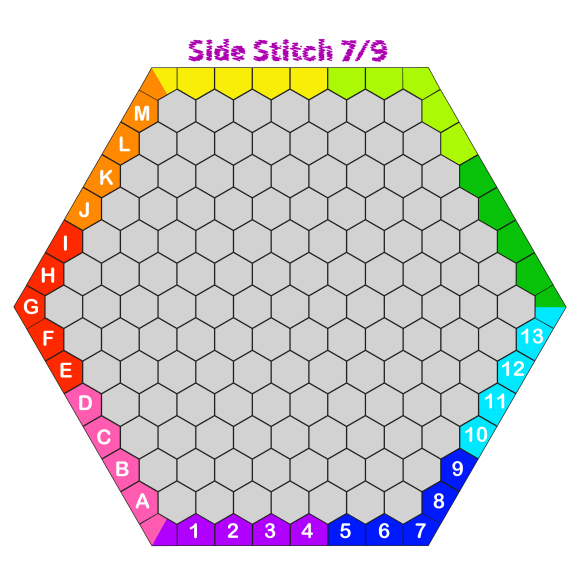
dai-dai-king-closeup

The King’s entourage grows ever larger, and more diverse.  Out of the 64 starting pieces, a full 47 of them are solo pieces, making for a complex and asymmetric starting position.

Maka Dai Dai Shogi

Maka Dai Dai Shogi is yet another step up in size from Tenjiku, played on a 19×19 board of 361 squares, with each player starting with an army of 96 pieces.  The name is a bit interesting — ‘Dai’ means big or large, as we know, and ‘Maka’ is a word derived from Sanskrit that means something like ‘Superior’.  So ‘Maka Dai Dai Shogi’ means basically ‘Superior Large Large Shogi’, or less awkwardly, ‘Superior Ultra-Large Shogi’.  I would argue this is pretty accurate — it’s definitely ultra-large, and has a number of superior qualities.

One of the standout qualities of Shogi as compared to Chess is that most of the pieces can promote, and the large variants for the most part carry on this tradition.  Maka Dai Dai, however, takes it to the next level, and allows the King himself to promote!  A promoted King becomes an Emperor, the most powerful piece to exist in any variant of Chess: the Emperor can instantly teleport to any unprotected square on the board, including squares occupied by enemy pieces.  In other words, the Emperor can instantly go anywhere and capture anything, so long as that square isn’t directly threatened with recapture by an enemy piece.

Alongside this, in Maka Dai Dai promotions occur by capture, as in Dai Dai Shogi — however here the promotion is optional, unless the captured piece is a promoted piece, in which case promotion is mandatory!  This helps to speed up the pace of the game, as on such a large board reaching the promotion zone would take forever.  Hook-moving pieces appear again in this game, but here they demote to Gold General on capture, so they’re effectively one-shot nuclear weapons if used to take out a promoted piece — use them wisely.

Promotion-by-capture also makes attacking the enemy King a risky proposition — if you mess it up, the King might capture an attacking piece, thereby immediately becoming an Emperor, which is both extremely powerful and desperately hard to checkmate!

“If you come at the King, you best not miss.”

–Omar Little

Maka Dai Dai, like most of the large Shogi variants, was invented by Buddhist monks — after all they have lots of time on their hands.  This is more apparent in Maka Dai Dai than the other variants, as it includes pieces drawn from Buddhist mythology that behave in unusual ways.  The Deva and Dark Spirit, for example, promote to Buddhist Spirit and Teaching King respectively — and any piece that captures them becomes a Buddhist Spirit or Teaching King, so these immortal creatures effectively never leave the board.

Substantial research has been done on this game by Professor Tomoyuki Takami, who states that Heian-Era sources suggest that Maka Dai Dai was actually one of the earliest forms of Shogi to exist, dating from as early as the 10th century.  He says that the pieces of the game are inspired by Chinese astrology and traditional masked dances and festivals of the early Heian era, and that in the early days the game was played as a form of ritual rather than entertainment.  Over the centuries, the game was reduced down to smaller forms, like Dai Dai Shogi, Dai Shogi and Chu Shogi, once they discovered that this ritual game was actually quite fun to play, but pretty long….

How long, you ask?  Well, George Hodges once compared the lengths of various versions of Shogi — this is the number of total moves in an average game for each variant:

  • Chess: 80
  • Shogi: 110
  • Dai Shogi: 400
  • Dai Dai Shogi: 800
  • Maka Dai Dai Shogi: 1100
  • Tai Shogi: 2000

Wow, that’s long.  If you start up a game of Maka Dai Dai Shogi, make sure you have the weekend free 🙂  I should say that I, of course, own a physical set for this game and would happily play it with anyone who asks.  The board is too big for my table, however, so we’d have to find a place big enough!

tsa maka set1

A Maka Dai Dai set by Angela/George Hodges — promoted pieces on top.

maka dai dai closeup1

Maka Dai Dai is such a large game that it can be quite intimidating — staring across the board at your opponent’s massive army lurking across the horizon feels quite different from more normal-sized Chess games.

maka dai dai emperor

The Mighty Emperor


Tai Shogi

OK, now this is getting ridiculous — Tai Shogi, or ‘Supreme Shogi’, is a spectacularly huge game played on a 25×25 board of 625 squares, invented in the 15th century by Buddhist monks (of course).  Each player marches into battle with an army of 177 pieces each, and in order to play you need to remember 99 distinct piece movements.

I’ve never personally played this, but remarkably, you can actually buy a set of this from Angela Hodges here in the UK.  The board is more than a metre square!  Even experienced players take upwards of two hours to set up the pieces in their initial position.  As you can see below, each players’ starting ranks are absolutely chock full of pieces — in fact the opening phase is a bit like a sliding-block puzzle as you try to free up lines for your pieces to get into the action.

Notably, there are actually no Kings on the board — each player starts with an Emperor in play (!), and a Crown Prince that moves like a King.  Both must be captured to win the game.  Many of the other pieces have strong promotions, which occur by capture as in Dai Dai and Maka Dai Dai rather than by entering the promotion zone — so carelessly leaving pieces out to be gobbled up can rapidly turn the game against you!

Those who’ve played Tai say it’s an extremely challenging game, because it’s very hard to formulate any kind of sensible whole-board strategy in a game this large.  As a result the game plays more like a wargame, with intensely tactical local skirmishes of great complexity breaking out across the board.  Meanwhile, the everpresent Emperors make each move feel consequential — leave anything hanging and you may give the Emperor a chance to start some carnage.  Given how old this game is, the creativity of all this is astounding — it’s kind of like an ancient version of Warhammer or something.

I don’t yet own this game but certainly plan to at some point — consider this a standing challenge to all!  Once I get a set for this, I’m happy to give it a go with anyone who’s interested.

tai shogi vs shogi comparison

Regular Shogi just looks tiny compared to Tai Shogi!  Without a doubt you could play an entire Shogi tournament in the time it takes to play one game of Tai Shogi.

tai shogi central files

A closeup of the Emperor’s immediate surroundings — quite a dense wall of protectors he has!  The Emperor is at the centre of the bottom row, the Crown Prince (taishi)  is directly above him, and the Drunk Elephant three pieces above the Prince.
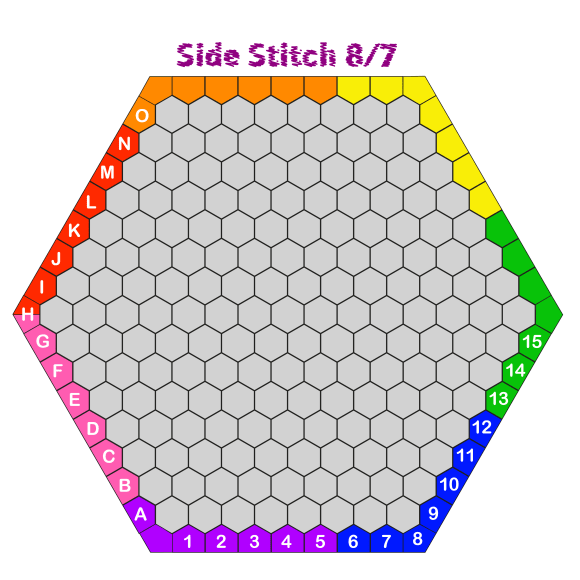
Taikyoku Shogi

Unbelievably, Tai Shogi is not the biggest Chess game to ever exist.  It used to be, until some documents were uncovered in 1997 with rules for a 16th-century Shogi variant called Taikyoku Shogi, or ‘Ultimate Shogi’.

This preposterous game is played on a 36×36 board of 1,296 squares.  Each player has an army of 402 pieces, and to play you must remember 253 distinct movement patterns.  Each side starts with a King and Crown Prince on the board, and a Drunk Elephant who can promote to Crown Prince — meaning you may have to capture three royal pieces to eventually win.

Unlike the other huge variants, in Tai Shogi promotion is once again by entering the enemy camp rather than by capture.  Each army contains a huge variety of pieces with whimsical names like the Running Bear, Vermillion Sparrow, Violent Ox, Enchanted Badger, and — my favourite — the Vertical Puppy.  If I ever play this game somehow, I’m going to devote my entire strategy toward devising a way to checkmate my opponent using the Vertical Puppy.

Amazingly, a real-life wooden set for Taikyoku Shogi was carved and used for a special segment on the Japanese variety show Fountain of Trivia back in 2004.  Two Shogi pros faced off in a game of Taikyoku Shogi, using a little reference book to help them remember how the pieces moved.  The game lasted 32 hours and 41 minutes, and ended in checkmate for the first player after 3,805 moves!
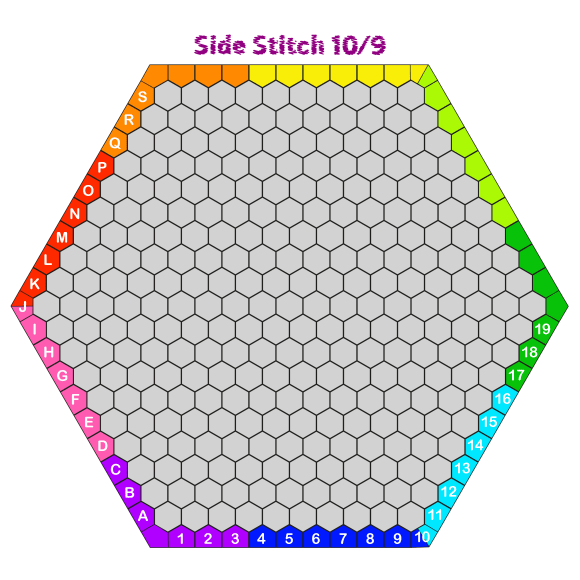
There’s a clip of the match on YouTube, unfortunately the quality isn’t great but the whole segment is there: https://www.youtube.com/watch?v=_c0Y26iTPSM

At the end of the match, the winning player says ‘I don’t want to do that again’; the loser says something hard to translate, but it’s kind of like ‘I have no regrets’, conveying the impression he doesn’t mind losing something so bizarre, and is mostly glad it’s over.

taikyoku-shogi-setup

A closer look at one player’s setup in Taikyoku Shogi — imagine trying to remember all 402 of these pieces!

taikyoku-real1

A fanmade version of Taikyoku Shogi — quite impressive!


Notes on the large Shogi variants

For much more detail on the Shogi variants, I recommend checking out this GeekList on Boardgamegeek.com from Shogi enthusiast The Player of Games that describes a large number of them.  Numerous resources are linked there, and I borrowed a bunch of the images in this post from there as the photos the author took of his sets are far better than any others I could find.  Many thanks to TPoG for taking the time to produce such crisp and high-resolution images of these great games!

Most importantly, TPoG’s list includes a detailed discussion of some discrepancies in the moves for certain pieces — the three main Edo Era sources for the larger games differ slightly in how they describe some moves.  For the most part these differences are very minor, and in games this size aren’t really going to have any influence at all on the overall play.

However, the recommended changes in that list for the upgraded forms of the Lion make much more sense than the currently-available moves in the English versions of these games.  They actually build on the Lion’s powers rather than weakening them.  For reasons of consistency I highly recommend using the updated moves suggested in that list when playing Dai Dai Shogi, Maka Dai Dai Shogi or Tai Shogi.

Where do I go from here?

Well, as you can see, Shogi offers a whole world of interesting games.  I wrote far too much here, and yet still didn’t cover anywhere near all the variants — there’s a number of smaller ones too, but I just love the big monster games.  If you fancy trying a variant of Shogi, and want to pick just one, I’d recommend Chu Shogi — it’s monstrous without being ponderous, and the Lion is such a creative and beautifully-balanced addition to the game.  Leaving aside my nerdy fascination with all things Shogi, it’s a genuinely delightful game.  Tori Shogi is also a great choice, as it’s small and easy to learn but still has tons of depth.

If you want to dive headfirst into one of the monster games, I highly recommend Maka Dai Dai Shogi.  It’s a fascinating game not just in terms of its unique play style and unusual pieces, but also because of its intriguing history and cultural relevance.  When playing this game you can feel that it could have been a ritual experience, a rumination on Buddhist thought as well as a battle playing out on a (huge) chessboard.  Sure, it’ll take awhile, and will require patience and dedication to get through a game — but those are quite Buddhist qualities, are they not?

Your best bet of course is to play modern Shogi — in my opinion it’s the finest version of Chess by quite some distance, and can easily support a lifetime of play and study.  There are numerous places these days to play online, like 81dojo  which is free, available in English and supports several variants as well.  Obviously modern Shogi has by far the largest playing community of any version of Shogi, and rightfully so — it strikes a balance between complexity and simplicity that’s hard to beat.

For a taste of Shogi, come on down to our Shogi event next month and get acquainted with the modern game!  I’m sure you’ll enjoy it, even if just as a peek into a corner of Japanese culture most of us never see.  For those of you who really take a fancy to the game, you’re welcome to join Shuzo and myself in our soon-to-be-launched Shogi club, which will meet regularly in Glasgow to play Shogi and learn about the game.

And, if you’re a weirdo like me who can easily spend all day playing games, join me for a game of Tori, Chu, Dai, Tenjiku or Maka Dai Dai Shogi!  Just make sure you free up your schedule first 🙂


Tagged , , , , , , , , ,

Chess Engine Update: Endgame Tablebases

In the background, while tons of work stuff has been happening, I’ve been continuing my mission to write a fully-featured computer chess engine in the C programming language.  My engine is named SpaceDog, in honour of my dog Laika, who is from space.

Work on SpaceDog has been proceeding well, with lots of additions to its evaluation function, convenience features like outputting fully-diagrammed logs of each game you play against it, outputting games in PGN format, etc.  Now I’m diving into adding more substantive features, in this case support for Syzygy endgame tablebases.

Endgames have always been a prominent feature of chess study, and over the centuries millions of players have stared uncomprehendingly at difficult endgame studies, mate-in-3 puzzles, and similar things.  For the improving player, endgame study is interesting but also very challenging, in that there are innumerable situations where a seemingly simple or natural move can lead to disaster, or conversely the failure to find a very specific and unintuitive move can lead to a missed win.

Naturally this is just as much of an issue for computer chess engines as it is for humans.  Many engines over the years have been programmed with specific rules for winning typical endgames like KPvsK (King and pawn versus a lone king) and some of the particularly long-winded and tedious ones like KRvsK (King and Rook versus King) or the dreaded KBNvsK (King, Bishop and Knight vs King — you get it now, abbreviations only from now on!).  Some of these endgames require remembering rules particular to each endgame, or even memorising long strings of winning moves in order to not mess up and give your opponent a stalemate.

Before we go any further, a quick reminder of the basic rules of ending a chess game:

  • Checkmate: opponent’s King is in check (attacked) and unable to escape to safety
  • Stalemate: opponent’s King is not in check, but your opponent has no legal moves, (remember it’s illegal to move into check)
  • Draw: declared when players repeat an identical board position 3 times in a row, OR when 50 moves have elapsed without a pawn move or capture taking place

These rules and the complicated nature of some endgames make things difficult for humans to succeed in their endgame play, and chess engines struggle too, even when looking ahead many more moves.  Let’s see, for example, how SpaceDog copes with the tricky KBNvsK ending:

KBNvsK no TBs 2

Here’s a snippet of SpaceDog’s attempt (before my recent additions) to play KBNvsK (the full PDF record is available here).  I actually stopped the engine after 26 moves as it was clearly making no progress!  If you check the full game log out, you’ll see that SpaceDog manoeuvres bravely, but is unable to work out the correct plan to trap the enemy King, even though it was looking ahead 25 moves at this point.  SpaceDog needed to trap the enemy King against the side or corner of the board to make it easier to deliver checkmate, but couldn’t coordinate its pieces correctly, and so the ending barrelled irretrievably toward a draw by the 50-move rule.

It’s worth saying that SpaceDog, even armed with only its core evaluation function and search, is more than capable of winning many endgames.  But even in those cases, it can make the occasional mistake that can allow a clever opponent to salvage a draw or stalemate, or can be simply inefficient and take longer than it should to mate the opponent.  Let’s take this KPPvsKP ending as an example:

KPPvsKP no TBs 2 This endgame looks simple, but the black King is in the way of White’s protected passed pawn on c4, so getting that pawn to promote and become a Queen requires some finesse.  SpaceDog manages this quite well without any additional help, mating the opponent in 24 moves.  However, with clever play it should be possible to checkmate Black quicker and with a greater material advantage.
And that clever play is what endgame tablebases are all about.  Endgame tablebases in chess came about thanks to Richard Bellman, who in 1965 proposed analysing chess endgames using retrograde analysis — starting from checkmate positions, and working backward from there to find the optimal moves to reach that position.  The end result of this would be a massive database containing every possible configuration of pieces on both sides of an endgame with small numbers of pieces, with complete information on how to reach the best possible ending from that position.  In 1977 computer science legend Ken Thompson used the first endgame tablebase in an engine against a human opponent, and from there chess engine programmers were off to the races.

Today thanks to widely available supercomputer power we have access to tablebases that enumerate all the optimal moves for both players from every possible endgame position containing seven or fewer total pieces.  This is a truly staggering number of positions — 423,836,835,667,331 to be exact!  Yes that’s 423 trillion positions.  There are 512 billion KRBNvsKBN endgames alone!  For every single one of these positions, we know: the game-theoretic value of the position (Win, Lose or Draw, or WDL for short); the distance-to-zero (moves before a pawn move or capture that zeroes out the 50-move drawing rule, or DTZ); and the distance-to-mate (number of moves for the winning side to mate, or DTM).  You can explore any and all of these positions and view the winning moves and various stats about endgames at Syzygy-Tables.info; the front page also has handy links for downloading all the tablebases for yourself.

I should note that of course given the size of these databases, the actual files are very large.  The best available compression algorithm for full WDL and DTZ tables is Syzygy, which is what I’ve added to SpaceDog.  The 3, 4 and 5-piece endgames will take about 1GB of storage, but you’ll need 149GB for the 6-piece endgames, and a staggering 18.4TB for the 7-piece endgames!  To use them most efficiently, make sure the WDL tables are on very fast storage like a solid-state drive (SSD), as these are accessed by engines very frequently to guide the engines toward favourable endgame positions, whereas the DTZ tables are only accessed once the engine actually enters an endgame position and needs to know the best moves.

So, after a weekend of work, SpaceDog can now use the Syzygy endgame tablebases, and thus plays endgames perfectly.  This makes it far better for practicing endgame play, for learning difficult endgame and mating sequences, and for analysing games.  To see how dramatic the change is, let’s go back to that KBNvsK endgame from earlier, where SpaceDog stumbled about uselessly for 26 moves heading for a draw, despite having a massive advantage in material.  Once we add Syzygy tablebases, SpaceDog obliterates its opponent in only 7 moves:

KBNvsK TBs 2

Look at that lovely short move listing!  This time, SpaceDog uses all of its pieces in concert, confining the enemy King to the corner by occupying the short f1-h3 diagonal with its bishop.  Shortly afterward, we end up with an effectively and efficiently checkmated opponent:

KBNvsK TBs mate 2

Even when we revisit endgames that SpaceDog can win easily, the Syzygy tablebases provide significant improvements.  Going back to the KPPvsKP endgame from earlier, SpaceDog checkmates five moves faster:

KPPvsKP TBs 2

SpaceDog not only wins faster, but it ends up with two queens instead of just one!  The opponent doesn’t stand a chance:

KPPvsKP TBs mate 2

Of course these are far from the most complicated endgames available.  SpaceDog can now win endgames that take potentially hundreds of moves, without making a single mistake.  The Syzygy tablebases are built with the 50-move rule in mind, so in some longer endgames you’ll see clever trickery as SpaceDog just manages to make or allow a pawn move or capture before the deadline, to reset the clock and deliver checkmate later on.  Take for example this KBBvsKQ endgame, in which SpaceDog achieves mate in 52 moves:

KBBvsKQ TBs

Here SpaceDog methodically manoeuvres the Queen to neutralise both of White’s bishops, until it captures one of those bishops at the last possible moment (the last half-move of move 50):

KBBvsKQ move 50

That gives SpaceDog the time to finally deliver forced checkmate two moves later:

KBBvsKQ mate

As you might imagine, remembering forced sequences of so many moves and using them with such impeccable timing is impossible even for the top Grandmasters — there are simply too many endgame possibilities to make rote memorisation worth the trouble.  Even if it were worth it, remembering sequences like that over the board under time pressure against live opponents would be a very tall order!

During my testing I found a particularly cruel example of this kind of brutal efficiency in this KNNvsKP endgame, where White delivers a tricky checkmate with two knights after 52 moves:

KNNvsKP TBs

Note that the first move, Na2, immediately immobilises Black’s passed pawn, where it stays frozen until move 50, when White lets it run free.  ‘Yay!’ says Black, ‘I’m making a Queen!  I’m back in this!’

KNNvsKP move 50

Black does make a Queen, as it happens, but it’s ultimately pointless as they get checkmated immediately:

KNNvsKP mate

SpaceDog, that’s just harsh!

Anyway, these are just some fun examples from 5-piece endgames — there’s some amazing endgames in the 6- and 7-piece databases of course, with forced checkmate sequences lasting hundreds of moves, totally bizarre-looking moves that turn out to be the only path to win or draw, and intricate piece play that has done wonders for our understanding of endgames.  I highly recommend taking a look at some cool endgames using an engine, or just browsing them via the web interface linked above — you’re bound to find something fascinating.  Assuming you care about chess, obviously.

So what’s next for SpaceDog?  Well first, my Syzygy tablebase support is only half-finished — endgame play is now perfect, but I have yet to implement searching of the WDL tables during midgame play to guide SpaceDog toward the best possible endgame positions.  That’s a relatively straightforward addition and will take much less time than adding the DTZ support, thankfully!

After that, I’m aiming to beef up SpaceDog’s search, making it more efficient to allow searching to greater depths, and making it much faster by using multi-threading (multiple CPU cores).  At that point, SpaceDog will have all the main features of a modern alpha-beta chess engine, and will make a worthy opponent for its eventual successor: SpaceDogNeuro.

You can download the latest SpaceDog executables for Windows and MacOS (Linux forthcoming, when I remember) at the Github repository, by the way, but bear in mind it’s a messy hobby project, and a major work-in-progress with bugs lurking everywhere!  If I were you I’d wait for version 1.0.  In the meantime, for serious chess analysis, Stockfish is the superior choice (and it’s free and open-source too).

Tagged , ,

(Re-)Learning C Via Computer Chess

In recent months I haven’t had much time to do a lot of programming, what with the demands of my work. One thing I’d been meaning to do, whether it factors into my research directly or not, was to re-acquaint myself with the C programming language. I used it way back in the day, but then as time went on I fell in love with Python, which despite being ridiculously slow in comparison, is extremely fun to use. But the fact remains that it’s very useful to be able to write compact, speedy code from time to time, either for writing simulations for work or for passion projects.

So, I decided to find myself just such a passion project to rediscover the joy of programming in C, and given that I’ve been playing and studying a hell of a lot of chess and shogi in my spare time of late, I decided to learn how to program a fast and relatively powerful chess engine in C. A traditional chess engine uses brute force to search a very large number of possible moves on its turn, evaluating each one in turn until it chooses what it thinks is the best move for the situation. Given how much computing power is available these days, even a half-decent smartphone can now play chess at a level greater than any human, including Grandmaster-level professionals.

In order to do this I followed a great series of videos on YouTube called ‘Programming a Chess Engine in C’, which is 95 videos long (!), but covers a ton of stuff, helping you build a fully-functional chess engine in C which uses the standard techniques in chess programming — alpha-beta search with null-move pruning and some other optimisations. The engine is capable of playing a game of chess via text commands with the user, or by communicating with graphical chess software using the UCI or WinBoard/CECP protocols to let you play a game with mouse control and lovely graphics for the pieces.

After watching all that and feeling my way around C again, I’ve now produced a chess engine of my own, which I’ve named SpaceDog, in honour of my dog who is from space.  At the moment it’s basically the same as the VICE engine which comes from the videos above, but has a few small additions in the evaluation function to make it a little stronger (hopefully), as well as a few quality-of-life improvements here and there.  It works great, and plays a mean game of chess already — which perhaps isn’t surprising since it searches and evaluates about 3.5 million chess positions per second!  In comparison a master-level human player might evaluate perhaps 3 or 4 positions per second.

Here’s a screenshot of SpaceDog playing in text mode:

Screen Shot 2018-10-14 at 03.23.34As you can see, it prints out a nice little text-based board for you (white pieces are capital letters, black pieces are lowercase).  Moves are entered in long algebraic notation — so to move white’s queen at the bottom of the board to the square above white’s king, you’d enter d1e2.  SpaceDog also prints out its search results and position evaluations on each move, so here you can see at the bottom that it searched nine moves ahead (depth:9) and spent 2.9 seconds evaluating 11.9 million moves before choosing the move e7e4 (taking my pawn with its queen) based on what it thinks of the resulting position and its future prospects.

Every searched position is evaluated quite simply, with a score calculated on the basis of material balance, the position of the pieces, and things like whether there are isolated pawns and other key features.  Right now I’m adding some additional evaluation terms that better capture how the relative value of certain pieces, and their ideal placement on the board, changes as you proceed from the opening to the endgame.  Hopefully this will make SpaceDog a bit more shrewd at finding checkmate!

The engine can also use opening books — these are files generated by processing millions of opening moves from many hundreds of thousands of professional chess games, choosing a repertoire of openings based on what moves proved to be most successful.  This means SpaceDog essentially has a huge file of opening moves already catalogued in the book, with an enormous selection of replies and counter-replies for all the best possible responses from the opponent.  These moves then don’t need to be searched, meaning that SpaceDog saves tons of time for searching much deeper in difficult middlegame and endgame positions.

At this point SpaceDog probably plays well enough to beat anyone I know, but would likely still lose to players above Master level.  That would probably change at fast time controls — i.e., quick game setups like blitz (5 or 10 minute time limit for each player) or bullet (1 minute each!).  At these time controls, humans simply can’t make much use out of our superior long-term strategic planning abilities, so even SpaceDog’s rudimentary but tactically sound play should be tough to beat when us human meat-bags are sweating over the clock and feeling the pressure.

Anyway, it’s been a lot of fun so I plan to keep it going!  Next steps are to continue to enhance the evaluation function to better account for things like keeping the king safe and setting up outposts for bishops and knights.  I’ll also work on some more technical enhancements like multi-PV search (searching multiple lines of play on multiple CPU cores simultaneously) and adding support for endgame tablebases to allow SpaceDog to achieve perfect endgame play.

Most importantly though, I want to add a mode so SpaceDog can play Crazyhouse and Chessgi, variants of chess in which captured pieces become yours and can be dropped back onto the board as part of your army.  This is a feature taken directly from shogi which is a game I also love, so I’m looking forward to implementing these.  Eventually I may try to build on that foundation and add a shogi mode as well.

‘What’s the point of all this?’ you’re probably asking at this point — after all, SpaceDog will never be as good as current strongest engine Stockfish, and plenty of other engines play Crazyhouse and lots of other variants besides (such as this version of the mighty Stockfish).  There are even innovative neural-network-based engines coming out now like LCZero that are challenging for the throne of toughest computer opponent.  But nevertheless writing SpaceDog has been satisfying and fun, and it’s given me another way to learn more about chess and enjoy the game from a different angle.  I’d also forgotten how satisfying coding in C can be — the final SpaceDog program takes up only 74KB (!), yet it effortlessly plays chess better than I can.

Anyway, I thought I’d post this up just on the off chance anyone else might get something out of learning a bit about chess programming.  I highly recommend the tutorial videos I linked above from Bluefever Software — they’re really easy to follow and provide excellent explanations of the key concepts you’ll need to know to write a chess engine.

Someday I’ll post up the code for SpaceDog too, once I add a few more additional features in!

Tagged , , ,